1.Introduction
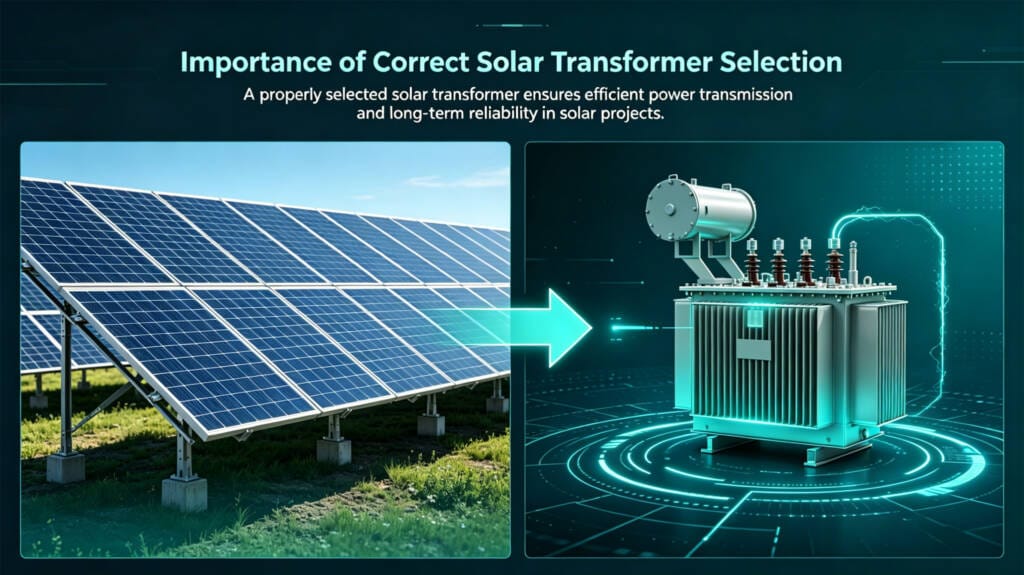
The rapid growth of solar energy projects has increased the demand for reliable equipment, but many developers still fall into common solar transformer mistakes. These critical components play a vital role in stepping up voltage from inverters to the grid, yet poor selection often leads to overheating, efficiency losses, project delays, and unexpected costs.
Solar transformer mistakes remain one of the leading causes of underperformance in PV systems worldwide. A single wrong decision during procurement can result in premature failure, higher energy losses over the 25-year project lifecycle, and significant financial setbacks — sometimes reaching hundreds of thousands of dollars.
This guide reveals the top 8 solar transformer mistakes that engineers, EPC contractors, and project owners frequently make in 2026. You will learn practical ways to avoid these pitfalls and make smarter purchasing decisions for your solar project.
Ready to avoid these solar transformer mistakes in your next project?
👉Get a free technical consultation and customized quote from our solar transformer experts.
Оглавление
- Введение
- Mistake 1: Ignoring Inverter Harmonics and K-Factor Requirements
- Mistake 2: Wrong Transformer Sizing
- Mistake 3: Incorrect Voltage Selection and Grid Requirements
- Mistake 4: Neglecting Environmental and Site Conditions
- Mistake 5: Focusing Only on the Lowest Upfront Price
- Mistake 6: Overlooking Efficiency and Lifetime Losses
- Mistake 7: Choosing the Wrong Supplier or Vendor
- Mistake 8: Ignoring Future Expansion and System Flexibility
- Solar Transformer Buying Checklist
- Заключение
2.Mistake 1: Ignoring Inverter Harmonics and K-Factor Requirements
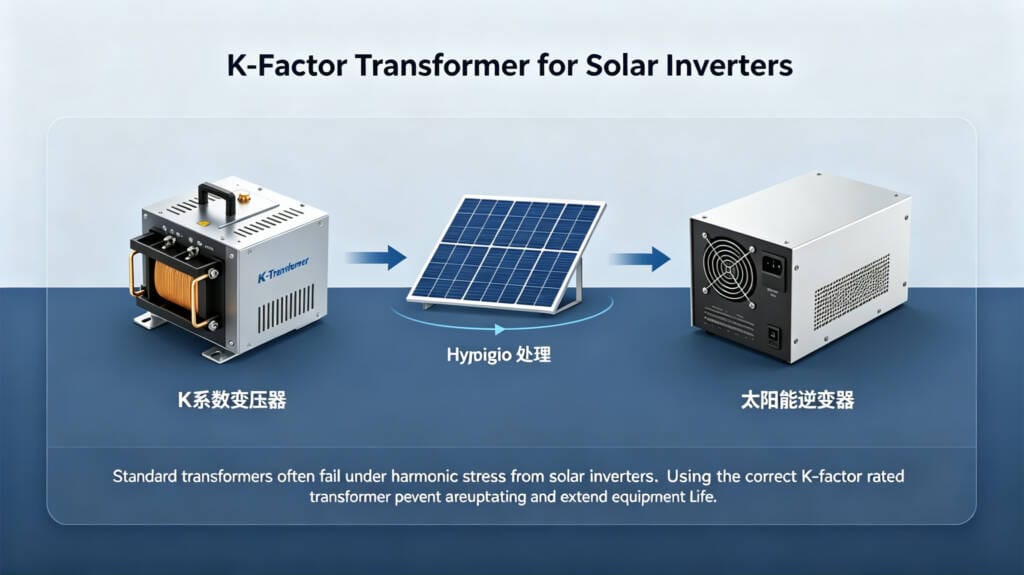
One of the most frequent solar transformer mistakes is treating a solar transformer like a standard distribution unit. Solar inverters produce significant harmonic distortion due to their switching electronics. Standard transformers (K-1 rating) are not designed for this, leading to excessive heating in windings and cores.
Why it happens: Many buyers assume any transformer will suffice if the kVA rating matches the inverter output. In reality, harmonics from inverters can cause eddy current losses that raise operating temperatures dramatically.
Consequences: Overheating reduces insulation life, increases no-load and load losses, and can trigger premature failures. In one documented European solar plant case, harmonic-related issues caused multiple transformer failures within months.
How to avoid it:
- Specify K-factor rated transformers (typically K-4, K-9, or K-13 for solar applications).
- K-4 handles moderate harmonics common in well-filtered inverters.
- K-13 provides better protection for systems with higher distortion or multiple inverters.
| K-Factor | Harmonic Tolerance | Recommended Solar Use Case | Additional Features |
|---|---|---|---|
| K-1 | Low (standard) | Not recommended | Никто |
| K-4 | Умеренный | Most utility-scale PV | 200% neutral |
| K-9 | Высокий | High-inverter density | Electrostatic shield |
| K-13 | Very High | Complex or storage hybrid | Enhanced cooling |
Include electrostatic shields to mitigate transients. Always request harmonic spectrum data from your inverter supplier and share it with the transformer manufacturer for proper design.
Proper attention here prevents one of the costliest solar transformer mistakes.
According to industry standards, using the proper K-factor rated transformer is essential when dealing with inverter harmonics. For detailed guidance, refer to the IEEE C57.159 standard for transformers in distributed photovoltaic systems.
3.Mistake 2: Wrong Transformer Sizing
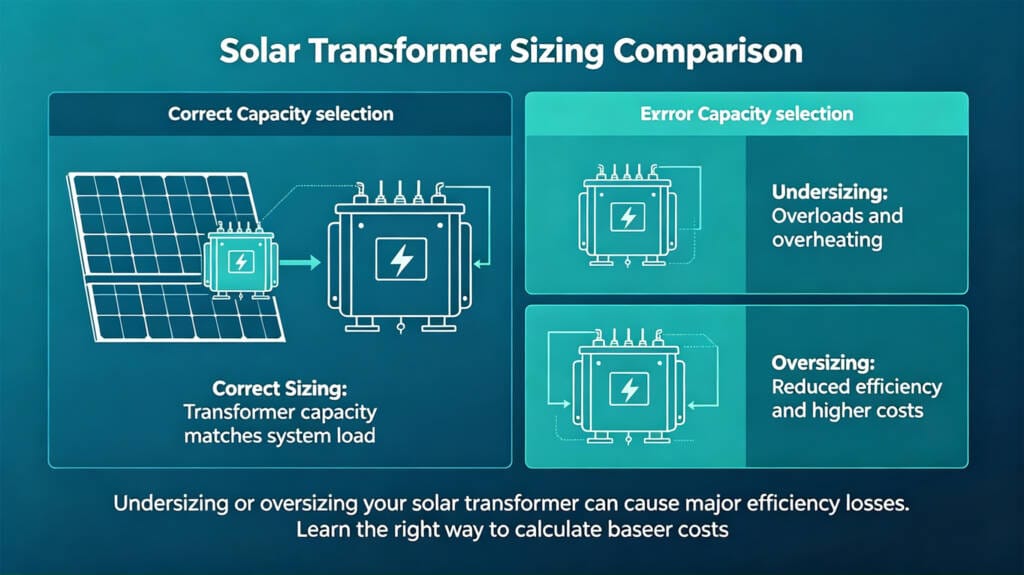
Incorrect sizing ranks among the top solar transformer mistakes. Both undersizing and oversizing create problems.
Undersizing leads to overload, overheating, and reduced lifespan. Oversizing inflates capital costs and increases no-load losses.
Common error: Applying a traditional 0.8 power factor when sizing. Solar inverters typically operate near unity power factor (0.95–1.0), unlike inductive motor loads. Using 0.8 can result in a transformer 20-25% larger than necessary.
Correct approach:
- Base sizing on inverter AC output (kW) at unity PF.
- Add 10-20% margin for overload, future expansion, and efficiency.
- Factor in inverter efficiency (typically 98-99%) and diversity.
Example Calculation (for a 10 MW AC system):
- Inverter output: 10,000 kW
- Power Factor: 0.98
- Safety Margin: 1.15
- Required kVA ≈ 10,000 / 0.98 × 1.15 ≈ 11,735 kVA
- Select next standard size: 12.5 MVA or 15 MVA depending on standards.
| Sizing Factor | Traditional Approach (0.8 PF) | Solar Best Practice (Unity PF) | Влияние |
|---|---|---|---|
| 5 MW System | ~7.8 MVA | ~5.75–6.5 MVA | 20%+ cost savings |
| No-load Losses | Выше | Optimized | Better ROI |
| Overload Capacity | Ограниченный | Adequate | Reliability |
Work closely with both inverter and transformer manufacturers. Request dual-rated temperature rise (55/65°C) for flexibility.
Proper sizing should always consider actual inverter output at near-unity power factor. The National Renewable Energy Laboratory (NREL) provides excellent best practices for PV system component selection.
Avoiding sizing errors is fundamental to successful solar project transformer deployment.
4.Mistake 3: Incorrect Voltage Selection and Grid Requirements
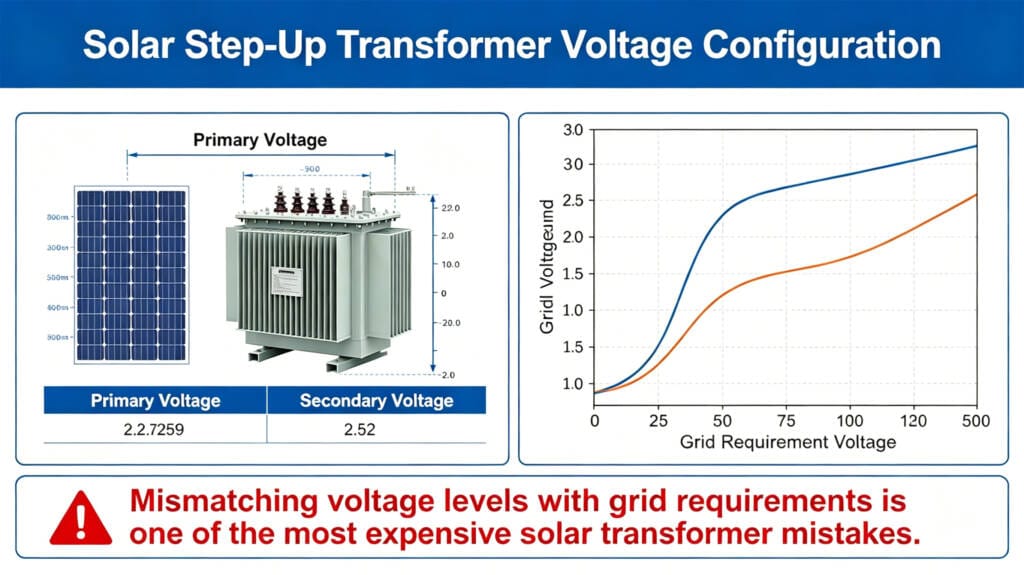
Mismatching voltage levels causes major headaches in solar projects. This solar transformer mistakes often surfaces late, leading to costly redesigns or delays.
Key issues:
- Failing to confirm Point of Interconnection (POI) voltage with the utility early.
- Ignoring grid code requirements for voltage regulation, fault levels, or impedance.
- Wrong vector group selection (e.g., Dy11 vs. Yd1).
Best practices:
- Engage the utility during the feasibility stage.
- Specify precise primary and secondary voltages with tap changer ranges (±2.5% to ±5%).
- Consider impedance (typically 6-10%) for fault current limitation and voltage stability.
For large solar farms, step-up transformers often go from 0.4/0.69 kV (LV) to 11/33/66/132 kV (MV/HV). Always verify local grid codes, as requirements vary significantly between regions.
Always verify local grid interconnection requirements early, as they vary significantly by region. The Solar Energy Industries Association (SEIA) offers valuable resources on utility-scale solar project development
Proper voltage planning prevents interconnection rejections—one of the most expensive solar transformer mistakes.
5.Mistake 4: Neglecting Environmental and Site Conditions
Environmental factors dramatically affect transformer performance, yet many overlook them when buying.
Common oversights:
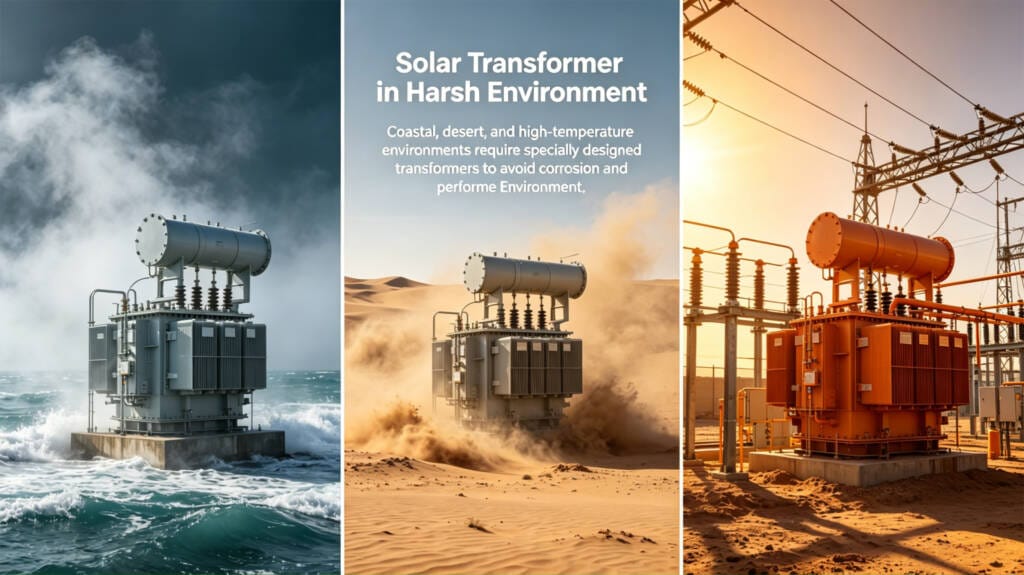
- Installing standard units in coastal areas without salt mist protection.
- Ignoring extreme temperatures (desert heat or cold climates).
- Choosing oil-immersed vs. dry-type incorrectly.
Recommendations:
- Coastal sites: Use stainless steel tanks or special coatings.
- High ambient temps: Specify lower temperature rise (e.g., 55°C) or forced cooling (ONAF).
- Dry-type for indoor or harsh environments; масляный for large outdoor utility-scale.
- Consider seismic zones, fire risks, and noise regulations.
| Environment | Recommended Transformer Type | Key Specs |
|---|---|---|
| Desert/High Heat | Oil-immersed with enhanced cooling | 55/65°C rise, high-temp insulation |
| Coastal | Oil-immersed with corrosion protection | C5-M coating, stainless steel |
| Indoor/Urban | Dry-type (cast resin) | IP-rated enclosure, low noise |
| Hybrid (PV+BESS) | K-rated with bi-directional capability | Robust neutral, monitoring |
Site-specific design is essential for long-term reliability and helps avoid preventable solar transformer mistakes.
For transformers installed in harsh environments, following international design standards is critical. See IEC 60076-16 for specific requirements on transformers for wind and solar applications.
6.Mistake 5: Focusing Only on the Lowest Upfront Price
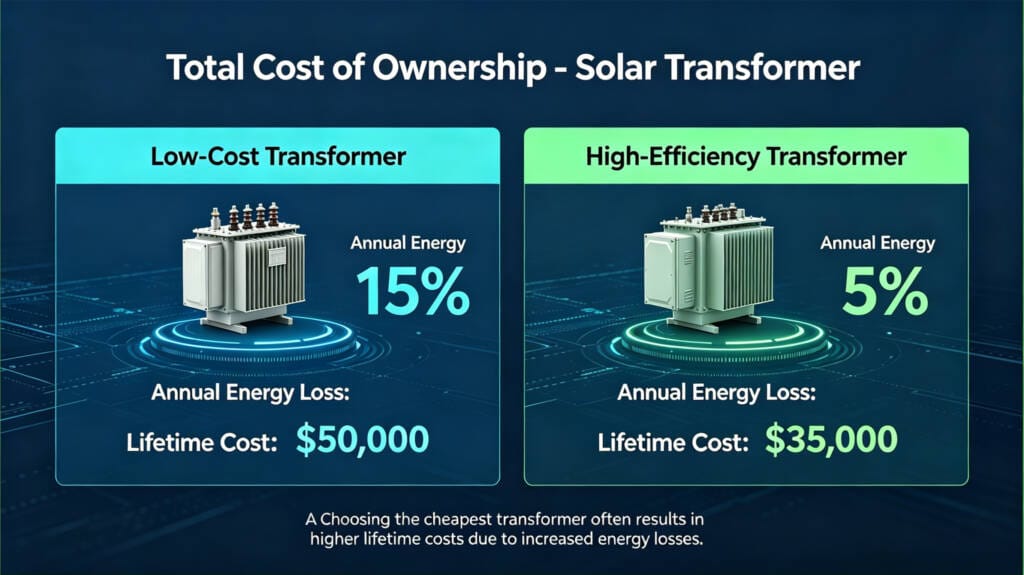
Chasing the cheapest quote is a classic solar transformer mistakes that ignores total cost of ownership (TCO).
Low-cost units often use inferior materials, leading to higher losses, frequent maintenance, and shorter lifespan. Over 25 years, a premium efficient transformer can save far more in energy than its higher initial cost.
TCO Formula Considerations:
- Capital cost
- No-load + load losses (capitalized at expected energy price)
- Обслуживание
- Downtime risk
- Residual value
A 1% efficiency improvement can yield massive savings in large plants. Always compare loss guarantees and request loss evaluation formulas from utilities.
Prioritize quality certifications (ISO, IEC, UL) and proven track records in solar applications over rock-bottom prices.
Don’t let the wrong purchasing decision cost you thousands in the long run.
👉Contact us today for a professional solar transformer selection review and competitive pricing.
7.Mistake 6: Overlooking Efficiency and Lifetime Losses
Closely related to price focus, many buyers ignore efficiency ratings. Solar transformers operate at varying loads due to daily irradiance changes, making low-loss designs critical.
Modern premium transformers achieve 99%+ efficiency. Specify losses at 50% and 100% load. Amorphous core or high-grade silicon steel significantly reduces no-load losses.
Request efficiency curves and perform a 25-year loss calculation during procurement. This data-driven approach separates professional solar transformer selection from guesswork.
Evaluating total losses over the project lifetime is one of the most important steps. The IEEE standards on transformer losses provide comprehensive methodologies for accurate evaluation.
8.Mistake 7: Choosing the Wrong Supplier or Vendor
Supplier selection determines long-term success. Inexperienced vendors may lack solar-specific expertise in harmonics, thermal cycling, or bi-directional flow.
Red flags:
- No dedicated solar references
- Long lead times without transparency
- Weak after-sales support
- Limited testing capabilities
What to look for:
- Manufacturers with proven solar project experience
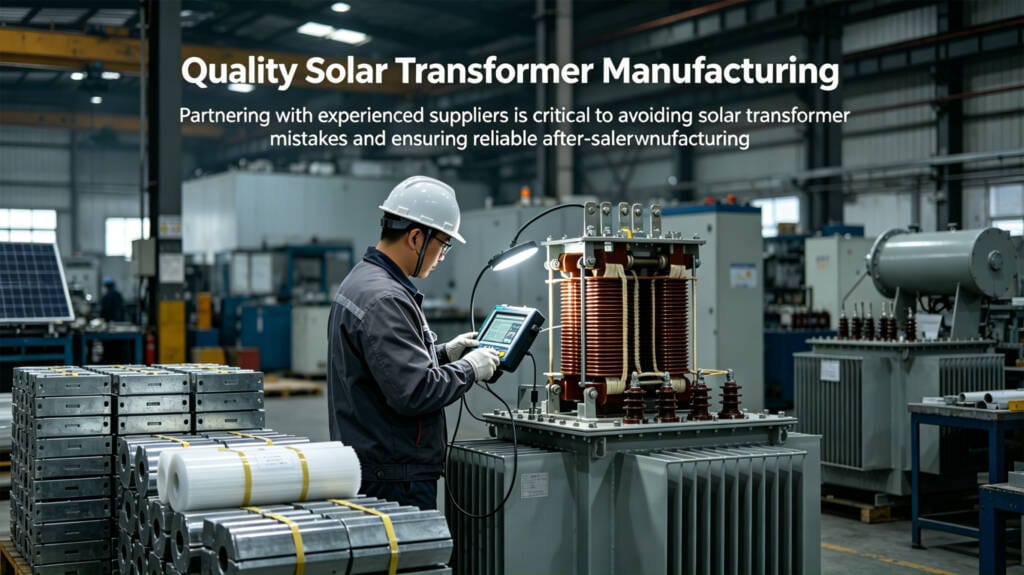
- Full factory acceptance testing (FAT) including heat run and impulse tests
- Strong warranty (minimum 5-10 years) and local service partners
- Ability to provide customized designs
Request client references and visit manufacturing facilities when possible. A reliable partner prevents many downstream solar transformer mistakes.
9.Mistake 8: Ignoring Future Expansion and System Flexibility
Solar projects rarely stay static. Many fail to plan for expansion, energy storage integration, or bi-directional power flows.
Forward-thinking design:
- Oversize by 10-20% for future phases
- Specify bi-directional capability for BESS integration
- Include provisions for additional taps or monitoring
- Consider modular designs
With the rapid growth of hybrid solar-storage projects, transformers must handle reverse power flow without issues. Planning ahead avoids expensive retrofits later.
10.Solar Transformer Buying Checklist
Use this checklist to avoid common solar transformer mistakes:
- Harmonics: K-factor specified with inverter data?
- Sizing: Unity PF calculation with margin?
- Напряжение: Confirmed with utility?
- Environment: Site conditions addressed?
- Эффективность: Losses evaluated over 25 years?
- Supplier: Experience and support verified?
- Future-proof: Expansion and storage ready?
- Testing & Warranty: Full FAT and strong coverage?
Download this checklist as a PDF for your team (contact us for a customizable version).
11.Conclusion
Avoiding these top 8 solar transformer mistakes can dramatically improve your solar project’s performance, reliability, and profitability. The right solar transformer is not just a commodity—it’s a strategic investment that affects your system for decades.
Focus on expertise-driven solar transformer selection rather than shortcuts. Partner with experienced manufacturers who understand inverter duty requirements, grid codes, and long-term operation in renewable environments.
At [Your Company Name], we specialize in high-quality inverter duty and step-up transformers tailored for solar applications. Our team provides technical consultations, custom designs, and full lifecycle support to ensure your project succeeds.
Ready to avoid costly solar transformer mistakes?