In today’s fast-evolving energy landscape, power transformers are critical infrastructure components. Driven by surging demand from AI data centers, renewable energy integration, grid modernization, and industrial electrification, the global power transformer market faces unprecedented pressure. Many buyers are actively comparing China vs Europe Transformers to balance cost, quality, delivery speed, and long-term reliability.
This comprehensive guide examines Chinese transformers versus European transformers across key factors. Whether you are an EPC contractor, utility operator, data center developer, or industrial project manager, this analysis provides data-driven insights to help you make the right choice in 2026.
China vs Europe Transformers is no longer a simple price-versus-premium debate. Top Chinese manufacturers have narrowed the quality gap significantly while maintaining substantial advantages in cost and lead times. European brands continue to excel in certain high-end applications and regulatory environments.
Request a Quote Now
Оглавление
- Global Power Transformer Market Overview and Trends
- China vs Europe Transformers: Head-to-Head Comparison
- Cost Analysis: Purchase Price and Total Cost of Ownership (TCO)
- Quality, Reliability, and Performance
- Standards, Certifications, and Compliance
- Delivery Times and Supply Chain Reliability
- Design, Technology, and Customization
- After-Sales Service, Warranty, and Spare Parts
- Pros and Cons: Chinese vs European Transformers
- Decision Framework: Which One Should You Choose?
- Real-World Case Studies and Buyer Insights
- Frequently Asked Questions (FAQ)
- Заключение
1.Global Power Transformer Market Overview and Trends
The global power transformer market is projected to grow steadily at a CAGR of approximately 6.5% through 2030, reaching over USD 40 billion. Asia-Pacific, led by China, holds the largest share (around 40%+), while Europe focuses on grid upgrades and renewable integration.
Key drivers include:
- Explosive growth in renewable energy (solar, wind, HVDC links).
- AI data centers demanding massive reliable power.
- Aging grid infrastructure replacement.
- Electrification of transport and industry.
Supply constraints are acute. European and North American lead times often stretch 18–48+ months for large units due to capacity bottlenecks and raw material issues. In contrast, Chinese manufacturers leverage massive production scale (China accounts for ~60% of global capacity) and deliver faster.
For a more detailed look at current market dynamics, read our latest global power transformer market trends analysis.
This imbalance explains why more international buyers are evaluating China-made transformers as viable alternatives to traditional European transformers from brands like Siemens Energy, ABB (Hitachi Energy), and others.
2.China vs Europe Transformers: Head-to-Head Comparison
Here is a high-level overview table comparing key attributes:
| Аспект | Chinese Transformers | European Transformers | Winner / Notes |
|---|---|---|---|
| Цена покупки | 20-50% lower | Higher (premium positioning) | Китай |
| Lead Time | 8-16 weeks (standard/custom) | 12-48+ months | Китай |
| Quality & Reliability | Good to excellent (top-tier factories) | Traditionally superior, proven longevity | Europe (edge), closing gap |
| Certifications | IEC, increasingly UL/IEEE/ANSI | Native IEC, strong local compliance | Tie / Project-dependent |
| Efficiency & Losses | Competitive, improving rapidly | Often best-in-class (EcoDesign) | Europe slight edge |
| Customization | High flexibility, large scale | Advanced engineering | China for volume |
| TCO (25 years) | Competitive when losses & failures managed | Often lower due to efficiency & reliability | Depends on use case |
| After-Sales | Improving global support | Strong local European service | Europe in EU |
Data synthesized from 2025-2026 industry reports and manufacturer benchmarks.
3.Cost Analysis: Purchase Price and Total Cost of Ownership (TCO)
Purchase price remains the most obvious difference in China vs Europe Transformers comparisons.
Chinese power transformers typically cost 20-50% less than equivalent European units. For example, a 10 MVA power transformer might range from $90,000–$180,000 from China versus significantly higher from European sources. Distribution transformers show similar gaps ($12-22k vs premium European pricing).
However, smart buyers focus on Общая стоимость владения (TCO), which includes:
- Initial purchase
- Energy losses (no-load + load losses)
- Installation and commissioning
- Maintenance and downtime
- Failure/replacement costs
- Financing and opportunity costs
Example TCO Comparison Table (approximate 1500 kVA unit, 25-year horizon, assuming $0.10/kWh):
| Компонент затрат | Chinese Tier-1/2 Transformer | European Premium Transformer | Notes |
|---|---|---|---|
| Цена покупки | $12,000 – $18,000 | $25,000 – $35,000 | China advantage |
| Energy Losses (25 yrs) | $90,000 – $110,000 | $65,000 – $80,000 | Europe better efficiency |
| Maintenance & Failures | Умеренный | Ниже | Europe edge |
| Total TCO | $120,000 – $150,000 | $110,000 – $140,000 | Close; China wins on non-critical apps |
Top Chinese manufacturers now offer high-efficiency designs that minimize the losses gap. When project timelines are tight or budgets constrained, Chinese transformers often deliver superior overall value.
4.Quality, Reliability, and Performance
European transformers have long enjoyed a reputation for exceptional build quality, using premium materials and conservative design margins. Brands like Siemens and ABB have decades of proven field performance in harsh conditions.
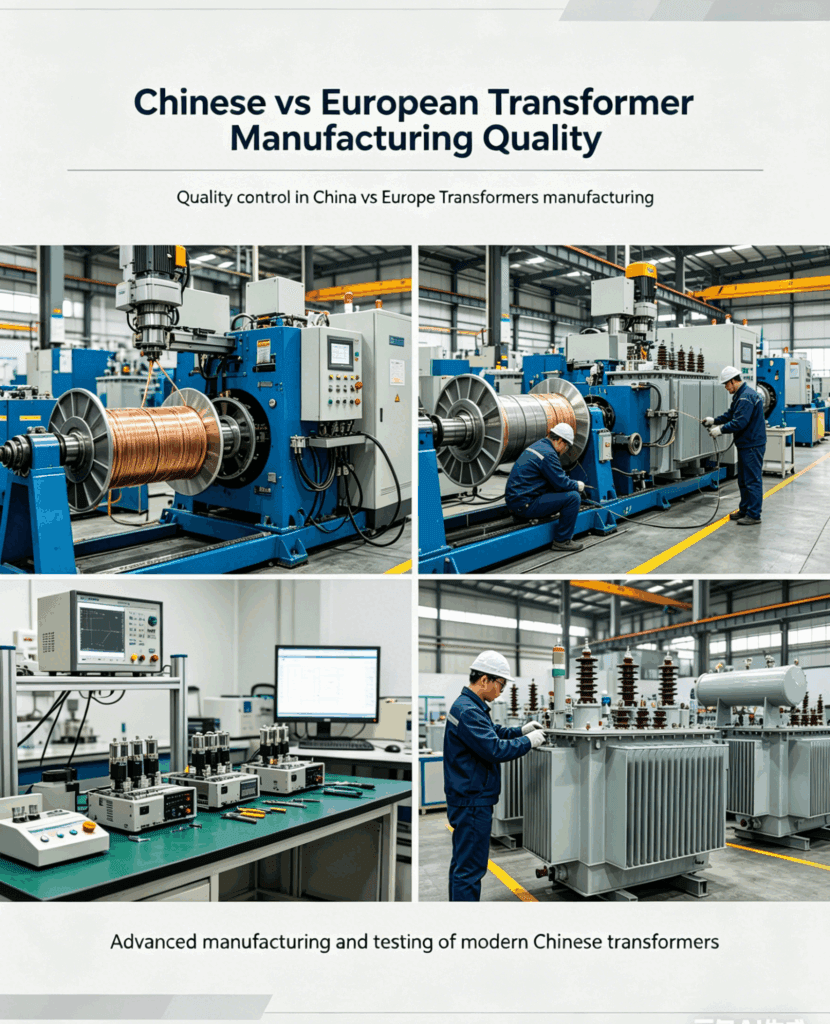
Chinese manufacturers have made massive strides. Leading factories (e.g., TBEA, XD Group, and export-focused specialists) employ modern automated production, high-quality silicon steel, copper windings, and advanced insulation. Many now match or approach European performance in standard applications.
All transformers should comply with the latest МЭК 60076 international standard.
Reliability metrics have improved through:
- Rigorous in-house and third-party testing (SGS, BV, Intertek).
- Adoption of Industry 4.0 manufacturing.
- Extensive export experience to 100+ countries.
For mission-critical projects (e.g., nuclear, ultra-high reliability grids), European options may still be preferred. For most industrial, renewable, data center, and utility applications, properly specified China-made transformers deliver excellent reliability.
5.Standards, Certifications, and Compliance
European transformers are designed around IEC standards and easily meet EU-specific regulations (EcoDesign, CE marking).
Chinese transformers from reputable exporters commonly comply with:
- IEC 60076 (core international standard)
- IEEE/ANSI C57 (for North America)
- UL/cUL listings
- CE, KEMA, GOST, and others
Many factories offer dual certification or project-specific adaptations. Always verify third-party test reports and factory audits when sourcing Chinese power transformers.
For projects in Europe, ensure compliance with local grid codes. Chinese suppliers increasingly provide tailored solutions that meet these requirements.
6.Delivery Times and Supply Chain Reliability
This is where the China vs Europe Transformers gap is most dramatic in 2026.
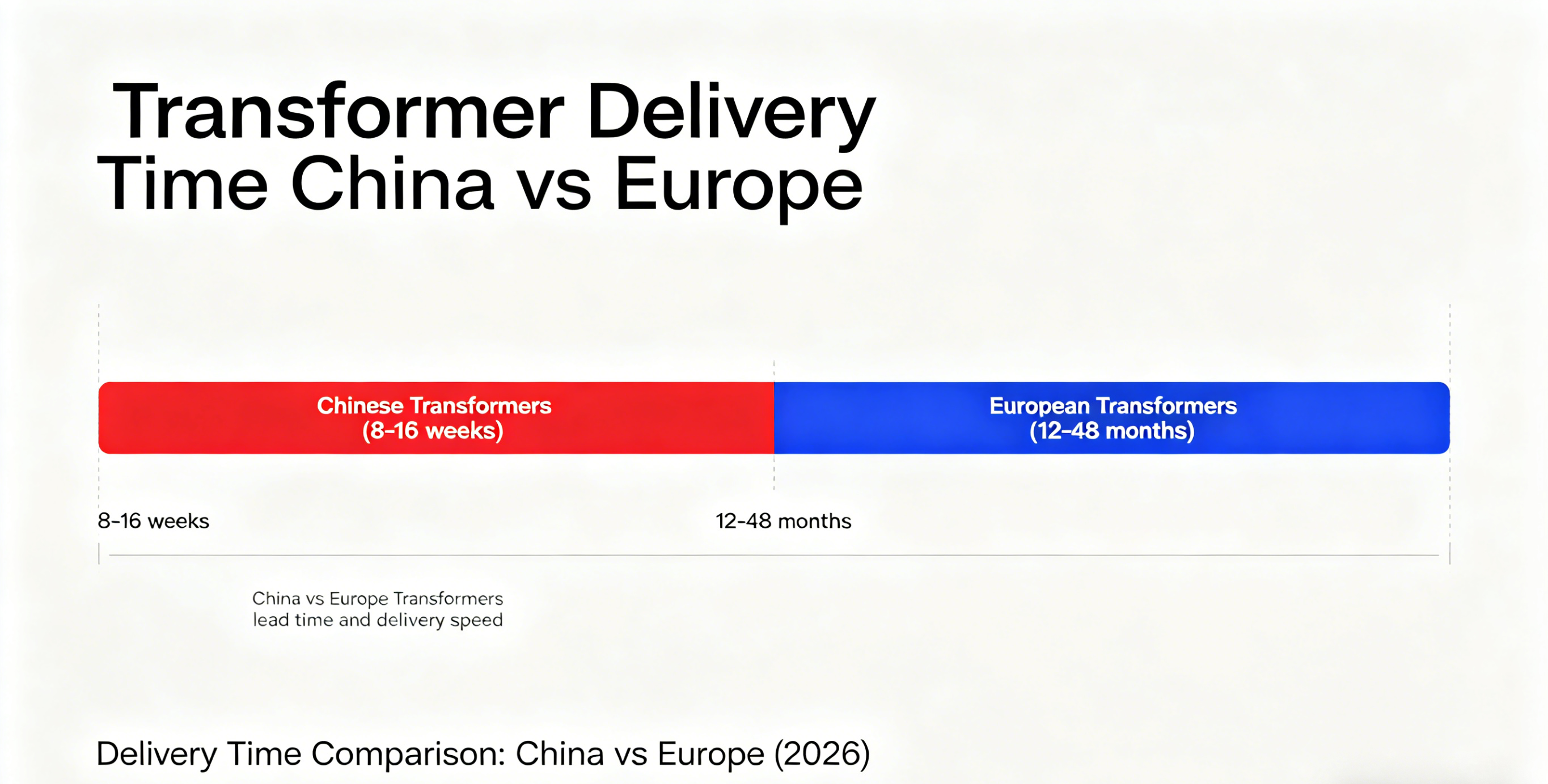
European lead times frequently exceed 18–48 months due to capacity constraints and high domestic demand. Chinese manufacturers typically quote 8–16 weeks for many units, with some booked into 2027 but still far faster overall.
This speed advantage is critical for time-sensitive projects like data centers or renewable installations, where delays cost millions in lost revenue.
7.Design, Technology, and Customization
Design philosophy, technological capabilities, and customization flexibility represent key differences in the China vs Europe Transformers comparison. European manufacturers traditionally focus on premium, highly optimized designs, while leading Chinese manufacturers leverage massive scale and engineering agility to deliver cost-effective, rapidly adaptable solutions.
European Design Strengths: Precision, Efficiency, and Digital Integration
European transformers (from brands like Siemens Energy and Hitachi Energy/ABB) are renowned for:
- Compact and space-efficient designs — ideal for urban substations and constrained sites.
- Superior energy efficiency — meeting stringent EcoDesign requirements with minimized no-load and load losses.
- Advanced digital features — widespread adoption of digital twins, IoT-enabled monitoring, predictive maintenance, and real-time asset performance analytics.
- High-end insulation and cooling systems — optimized for longevity and reliability under demanding European grid conditions.
These designs excel in applications where maximum efficiency, smart grid integration, and long-term operational intelligence are priorities.
Chinese Design Strengths: Scale, Flexibility, and High-Voltage Expertise
Chinese transformer manufacturers have become global leaders in several technological areas, particularly:
- Ultra-High Voltage (UHV) and HVDC technology — China dominates the world’s UHVDC projects, with extensive experience in 800kV+ systems for long-distance renewable power transmission.
- Rapid customization — ability to tailor transformers to specific voltage levels, environmental conditions (desert, high-altitude, tropical), efficiency requirements, or seismic standards in very short timeframes.
- Large-scale production capability — handling massive orders while maintaining cost efficiency.
- Cost-effective innovation — combining proven international standards with domestic advancements in materials and manufacturing processes.
Leading Chinese companies such as TBEA, China XD Group, and others have demonstrated strong capabilities in both AC and DC high-voltage transformers, supporting global renewable energy integration.
Modern Shared Technologies
Both Chinese and European manufacturers now offer advanced eco-friendly options, including:
- Natural and synthetic ester fluids — for significantly improved fire safety (fire point >300–360°C), biodegradability, and extended insulation life.
- Smart transformer features — online dissolved gas analysis (DGA), temperature monitoring, and condition-based maintenance systems.
- Sustainable design elements — reduced environmental impact and compliance with international green grid standards.
Chinese manufacturers have notably pioneered several large-scale ester fluid projects, including 500kV and even 750kV ester-filled units.
Design & Technology Comparison Table
| Аспект | Chinese Transformers | European Transformers | Winner / Notes |
|---|---|---|---|
| Design Philosophy | Scale + Rapid Customization | Precision, Compactness & Efficiency | Depends on project |
| UHV / HVDC Expertise | World-leading (extensive domestic projects) | Strong, but fewer large-scale references | China (volume) |
| Efficiency & Losses | Very competitive, rapidly improving | Often best-in-class (EcoDesign) | Europe slight edge |
| Digital Monitoring | Good and improving (IoT, smart systems) | Advanced digital twins & predictive analytics | Europe |
| Customization Speed | Excellent (weeks vs months) | High quality but slower | Китай |
| Экологичные жидкости | Strong adoption (e.g., 500kV+ ester units) | Mature offerings | Tie |
| Overall Innovation | Cost-effective & large-scale | Premium & digitally mature | Специфический для проекта |
Key Takeaway for Buyers
In the China vs Europe Transformers decision, European designs often suit projects requiring the highest efficiency and sophisticated digital integration in regulated markets. Chinese designs shine in large-scale renewable, grid expansion, and time-sensitive projects where customization, high-voltage capability, and speed provide clear advantages.
Many forward-thinking EPC contractors now adopt a hybrid strategy — using Chinese transformers for main power units (leveraging scale and customization) while incorporating European technology for critical monitoring components.
When evaluating options, always share detailed project specifications (voltage, climate, efficiency targets, and grid codes) early in the quotation process to receive optimized designs from either source.
8.After-Sales Service, Warranty, and Spare Parts
After-sales support is one of the most important yet often overlooked factors when comparing China vs Europe Transformers. While European manufacturers have traditionally held an advantage in local service networks, Chinese suppliers have made significant progress in global support capabilities in recent years.
European Transformers: Strong Local Support Advantage
European brands (such as Siemens Energy, Hitachi Energy/ABB, and others) typically offer excellent after-sales service, especially within Europe. Key strengths include:
- Extensive local technical teams and authorized service partners across EU countries.
- Fast response times for on-site troubleshooting and maintenance.
- Readily available spare parts stocked in regional warehouses.
- Comprehensive long-term service contracts, including remote monitoring and predictive maintenance using digital solutions.
- Strong technical training and knowledge transfer for customer teams.
This localized support makes European transformers particularly attractive for utilities and industrial users in Europe who prioritize minimal downtime and prefer dealing with nearby service providers.
Chinese Transformers: Rapidly Improving Global Service
Leading Chinese transformer manufacturers have substantially upgraded their after-sales capabilities to meet international buyer expectations. Today, reputable exporters typically provide:
- Warranties: Standard 2–5 years, with many offering extendable warranties up to 7–10 years on core components.
- Spare Parts Logistics: Improved global supply chains with strategic stocking in Asia, Middle East, and Africa. Delivery times for common spares have dropped significantly.
- Technical Support: 24/7 remote support, on-site supervision during installation and commissioning, and English-speaking engineering teams.
- Local Partnerships: Collaboration with regional integrators and service companies in over 80 countries for faster response.
- Digital Tools: Increasing adoption of IoT-based monitoring systems for real-time performance tracking.
Many top Chinese factories now assign dedicated international project managers to handle post-delivery support, ensuring smoother communication and faster issue resolution.
Head-to-Head Comparison
| Аспект | Chinese Transformers | European Transformers | Notes |
|---|---|---|---|
| Warranty Period | 2–5 years (extendable) | 3–5 years (often extendable) | Similar |
| Local Service in Europe | Growing via partners | Excellent & well-established | Europe stronger |
| Spare Parts Availability | Improving (8–12 weeks typical) | Fast in Europe (days to weeks) | Europe edge in EU |
| Response Time | 24–48 hours remote / 3–7 days on-site | Same-day to 48 hours in Europe | Depends on location |
| Cost of Service | Generally lower | Выше | China advantage |
| Remote Monitoring | Increasingly available | Advanced & mature | Europe slight edge |
Best Practices for Buyers
To minimize risks and maximize long-term reliability in your China vs Europe Transformers decision:
- Always request detailed after-sales service agreements during the quotation stage.
- Verify the supplier’s export track record and ask for recent customer references in your region.
- Consider third-party maintenance contracts with local companies as a safety net.
- Include clear spare parts lists and delivery timelines in the purchase contract.
- For critical projects, opt for suppliers who offer supervised installation and training.
Pro Tip: Many experienced EPC contractors now use a hybrid approach — purchasing main transformers from China for cost and speed advantages, while securing European or local partners for long-term service support.
In summary, while European suppliers still lead in localized after-sales within Europe, top-tier Chinese transformer manufacturers have narrowed the gap considerably. With proper planning and supplier selection, Chinese units can deliver reliable long-term performance and excellent value.
9.Pros and Cons: Chinese vs European Transformers
Chinese Transformers Advantages:
- Superior value and lower upfront cost.
- Much shorter lead times.
- High customization and production capacity.
- Rapid technological catch-up.
- Strong for renewables and large-scale projects.
Недостатки:
- Perceived (and sometimes real) quality variability between suppliers.
- Potentially higher losses in lower-tier units.
- Longer-distance logistics and import processes.
European Transformers Advantages:
- Proven long-term reliability and brand trust.
- Optimized efficiency and lower TCO in high-utilization scenarios.
- Seamless regulatory compliance in Western markets.
- Strong local technical support.
Недостатки:
- Significantly higher cost.
- Long delivery delays.
- Limited capacity for urgent or very large orders.
10.Decision Framework: Which One Should You Choose?
Use this checklist for your China vs Europe Transformers decision:
- Project Timeline — Tight schedule? Strongly favor China.
- Budget Constraints — Prioritize TCO; China often wins.
- Criticality & Risk Tolerance — Ultra-critical infrastructure? Lean European or top-tier certified Chinese.
- Regulatory Requirements — Europe-heavy project? Verify full compliance.
- Volume & Customization — High volume favors China.
- Location & Service Needs — EU-based long-term? European support stronger.
Recommendation Scenarios:
- Data centers, renewables, cost-sensitive industrial: Chinese transformers (top manufacturers).
- Legacy European grids, highest reliability mandates: European brands.
- Hybrid: Chinese for main units + European for critical auxiliaries.
Ready to Make the Right Choice?
Get expert recommendations tailored to your project specifications. Get Competitive Quote →
11.Real-World Case Studies and Buyer Insights
In 2025, Chinese transformer exports reached record levels, surging nearly 36% year-on-year to approximately 64.6 billion yuan (around USD 9.3 billion). Exports to Europe skyrocketed by more than 138%, while shipments to Asia and Africa also posted strong double-digit growth. Many international buyers, particularly in Europe, were reportedly willing to pay a 15–20% premium for the significantly faster delivery times offered by Chinese manufacturers compared to local European options.
This surge reflects a broader global trend in the China vs Europe Transformers debate. As European and North American lead times stretched to 18–48 months amid soaring demand from AI data centers, renewable energy projects, and grid modernization, buyers turned to reliable Chinese suppliers for speed without compromising essential performance.
Notable Success Stories
Middle East – Grid Modernization Projects
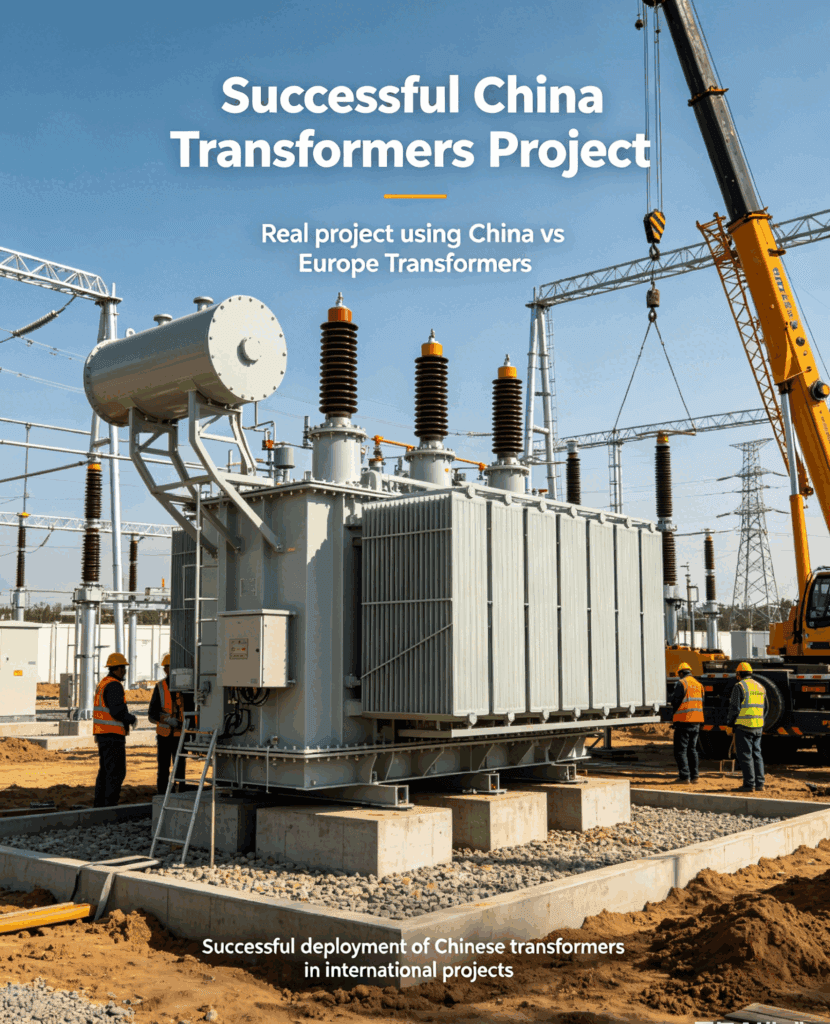
Major utilities in Saudi Arabia and the UAE have deployed hundreds of Chinese power transformers in large-scale substation upgrades. After rigorous factory audits, third-party testing (SGS/BV), and successful pilot installations, several projects reported smooth operation and on-time energization. Chinese units helped accelerate renewable integration timelines by 6–12 months compared to traditional European sourcing.
Africa – Electrification & Renewable Energy
In countries across East and West Africa, Chinese transformers power major solar and wind farms as well as rural electrification initiatives. EPC contractors highlight the combination of competitive pricing, rapid customization, and strong technical support from manufacturers like TBEA and XD Group. One 2025 project in Ethiopia utilized over 70% Chinese-sourced transformers, achieving reliable performance under demanding tropical conditions.
Southeast Asia – Data Centers & Industrial Parks
Data center developers in Vietnam, Indonesia, and Malaysia increasingly choose Chinese power transformers for new hyperscale facilities. The ability to secure delivery in 8–16 weeks — versus multi-year waits from European brands — has proven decisive. Buyers report that top-tier Chinese factories, when paired with proper specifications and supervision, deliver efficiency and reliability on par with project requirements.
12.Frequently Asked Questions (FAQ)
Are Chinese transformers reliable? Yes, when sourced from reputable manufacturers with proper certifications and quality controls. Many exceed IEC standards and have strong international track records.
How do I mitigate risks when buying Chinese transformers?
- Select factories with UL/IEEE/IEC certifications.
- Conduct third-party inspections (SGS/BV).
- Request detailed test reports and references.
- Consider supplier audits.
What about warranty and after-sales? Reputable Chinese suppliers offer 2-5+ year warranties and are expanding global support.
Can Chinese transformers meet European grid standards? Yes, many are engineered specifically for IEC compliance and local codes.
Which is better for TCO? It depends. For most applications, well-specified Chinese units deliver excellent value. High-duty-cycle projects may favor European efficiency.
13. Заключение
There is no universal “best” in the China vs Europe Transformers debate. The optimal choice depends on your specific project requirements, timeline, budget, and risk profile. In 2026, Chinese transformers from quality manufacturers represent a compelling, highly competitive option for the majority of global buyers seeking speed and value without sacrificing essential performance.
European transformers remain excellent for applications where brand heritage, marginal efficiency gains, or local support are paramount.
Ready to move forward? Contact our team for personalized recommendations, technical specifications, factory audits, or competitive quotations. We help buyers navigate Chinese power transformers and European options with transparent, data-backed guidance to ensure project success.
Not sure whether to choose China vs Europe Transformers for your project?
👉Contact us for a free technical consultation and quotation within 24 hours.