In the complex landscape of industrial power distribution, one of the most critical decisions an electrical engineer or project manager faces is the configuration of the transformer substation. Should you invest in one massive unit or distribute the load across several smaller ones? The choice between Single vs. Multiple Transformers isn’t just about the initial purchase price—it’s about balancing long-term reliability, operational efficiency, and future-proofing your infrastructure.
Ready to find the right transformer configuration for your project?
👉Share your key requirements and I’ll provide a tailored recommendation.
Оглавление
- Introduction: The Core Dilemma
- The Single Transformer Configuration (Centralized Power)
- The Multiple Transformer Configuration (Distributed & Parallel)
- Technical Comparison: Efficiency and Total Cost of Ownership (TCO)
- Critical Decision Factors: When to Choose Which?
- Parallel Operation: Technical Requirements for Multiple Units
- E-E-A-T Perspective: Reliability and Maintenance Strategies
- Conclusion: Making the Informed Choice
1. Introduction: The Core Dilemma
In the complex architecture of modern industrial and commercial infrastructure, the transformer is far more than a static piece of equipment—it is the vital heart of the electrical distribution system. Whether you are spearheading the construction of a hyperscale data center, a high-precision manufacturing plant, or a landmark commercial skyscraper, your initial decision on transformer configuration will dictate the facility’s operational DNA for the next 20 to 30 years.
The Strategic Tug-of-War: Efficiency vs. Resilience
The debate between Single vs. Multiple Transformers essentially revolves around a strategic tug-of-war between “Cost-Driven Centralization” и “Resilience-Focused Redundancy.” * The Centralized Legacy: Historically, the engineering gold standard leaned toward single, high-capacity units. The logic was simple: minimize initial Capital Expenditure (CAPEX), reduce the physical footprint, and simplify the protection scheme. In an era of predictable loads and lower energy costs, this “all-in-one” approach was the pragmatic choice.
- The Modern Redundancy Paradigm: Today, the landscape has shifted. We operate in a “Five-Nines” ($99.999\%$) availability world. In sectors like semiconductor fabrication or cloud computing, a power dip lasting mere milliseconds—or an unplanned transformer outage—can result in catastrophic financial losses, often exceeding several thousand dollars per minute in lost productivity and damaged equipment.
Why This Choice Matters Now More Than Ever
As global energy standards (such as DOE 2016 или EcoDesign Directive) tighten, and as ESG (Environmental, Social, and Governance) goals become a corporate priority, the configuration of your substation is no longer just a technical detail—it is a financial and environmental statement.
The Multiple Transformer Scheme, particularly designs incorporating N+1 or 2N redundancy, has moved from a “luxury” for mission-critical sites to a “standard” for any business that cannot afford a single point of failure. However, this added reliability comes with increased complexity in synchronization and higher upfront investment.
The Purpose of This Guide
The goal of this technical deep dive is to move beyond the surface-level pros and cons. We will analyze the Общая стоимость владения (TCO), evaluate the Parallel Operation requirements, and provide a decision matrix to help you determine which configuration aligns with your project’s specific risk profile and load characteristics. By the end of this guide, you will be equipped to choose a transformer strategy that balances fiscal responsibility with unshakeable power reliability.
2. The Single Transformer Configuration (Centralized Power)
In a centralized power architecture, a Single Transformer acts as the sole gateway between the utility medium-voltage grid and your facility’s low-voltage distribution network. For many project managers, this represents the “standard” approach—straightforward, cost-effective, and easy to manage. However, the technical implications of putting “all your eggs in one basket” go far beyond the purchase price.
Deep Dive: The Advantages
- Optimized Capital Expenditure (CAPEX):The economy of scale is most evident here. Manufacturing one 2500 kVA transformer requires significantly less raw material (copper/aluminum for windings and silicon steel for the core) than producing two 1250 kVA units. Generally, you can expect a 20% to 35% reduction in equipment costs when opting for a single unit.
- Reduced Installation Complexity and Footprint:Space is often at a premium in urban developments or retrofitted industrial plants. A single unit requires only one containment pit, one set of fire-suppression clearances, and a smaller overall switchgear room. This translates to lower costs for civil engineering and site preparation.
- Streamlined Protection and Control:With only one unit, the protection coordination study is significantly simplified. You only need to calibrate one set of primary overcurrent protection and one secondary main breaker. This reduces the risk of “nuisance tripping” that can sometimes occur in complex multi-transformer load-sharing scenarios.
Deep Dive: The Disadvantages
- The Critical “Single Point of Failure”:In a single-transformer scheme, reliability is binary: it is either 100% or 0%. A minor gasket leak, a localized winding fault, or a failure in the tap changer will result in a total facility blackout. For industries where downtime is measured in thousands of dollars per hour, this lack of redundancy is a high-stakes gamble.
- The Energy Drain of “No-Load” Losses:Every transformer suffers from core losses (iron losses) that occur as long as the unit is energized, regardless of the load. A large 2500 kVA transformer has a much higher idle power consumption than a smaller unit. If your facility operates on a single shift or has significant “quiet hours,” a single large transformer continues to pull expensive power from the grid just to stay magnetized.
- Logistical Challenges in Replacement:If a 5000 kVA transformer fails, sourcing an immediate replacement is a logistical nightmare. These units are often “made to order” with lead times spanning months. Transporting a single massive unit also requires specialized heavy-lift equipment that may not be readily available during an emergency.
Technical Summary: Single Transformer Profile
The following table summarizes the technical and economic profile of the centralized approach:
| Technical Parameter | Single Transformer Impact | Engineering Consideration |
| Purchasing Cost | Lowest | Best for budget-constrained projects. |
| System Reliability | Zero Redundancy | High risk for critical infrastructure. |
| Core Losses ($P_0$) | Constant & High | Inefficient for variable or low-load profiles. |
| Short-Circuit Level | Very High | Requires high-AIC rated circuit breakers. |
| Обслуживание | Mandatory Total Outage | Hard to schedule in 24/7 operations. |
| Expansion Capability | Ограниченный | Requires complete replacement to increase capacity. |
The “Hidden” Cost: Fault Current Impact
One technical factor often overlooked in the Single vs. Multiple Transformers debate is the Available Fault Current (AFC). A single large transformer has lower internal impedance relative to the total kVA. This results in a massive surge of current during a short circuit. To handle this, engineers must specify downstream switchgear with high interrupting ratings (e.g., 65kA or 100kA), which significantly inflates the cost of the entire electrical room, potentially offsetting the initial savings on the transformer itself.
Unsure which option is best for your facility?
👉Drop your project details below and I’ll help you choose the optimal solution.
3. The Multiple Transformer Configuration (Distributed & Parallel)
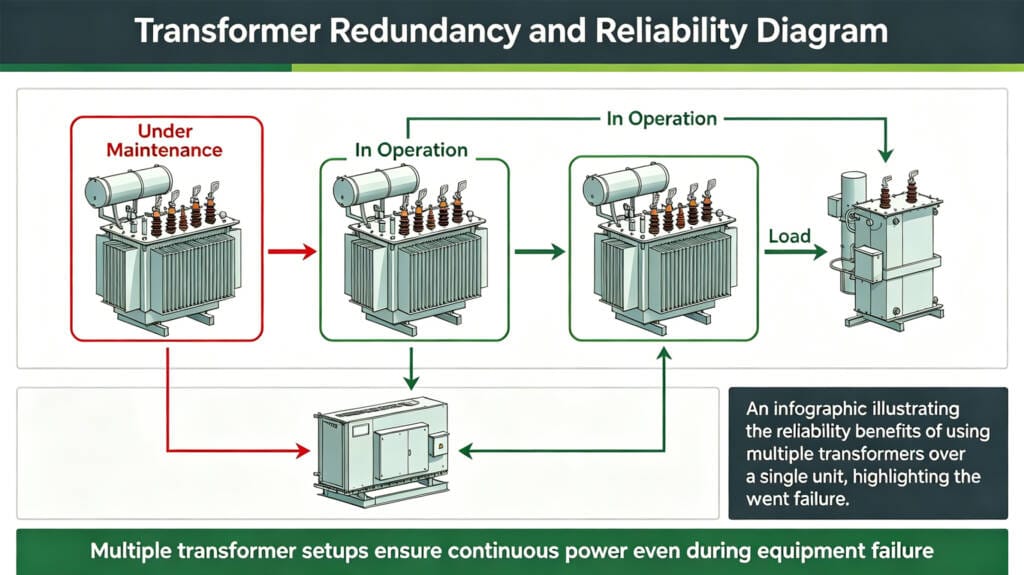
This approach involves using two or more smaller transformers (e.g., two 1250 kVA units instead of one 2500 kVA unit) operating in parallel or distributed mode to share the total load. A Tie-Breaker (bus coupler) is typically installed between the secondary sides of the transformers to enable flexible switching and load transfer.
This configuration is particularly popular in medium-to-large industrial plants, data centers, and commercial facilities where reliability, future expansion, and energy efficiency are critical priorities.
Преимущества
- System Redundancy & High Reliability: With a Tie-Breaker system, if one transformer fails or needs maintenance, the remaining unit(s) can carry the entire (or critical) load. This significantly reduces downtime and supports business continuity (N-1 redundancy).
- Scalability & Phased Investment: You can install the minimum required capacity initially and add additional units later as the plant load grows. This avoids over-investment in a single oversized transformer.
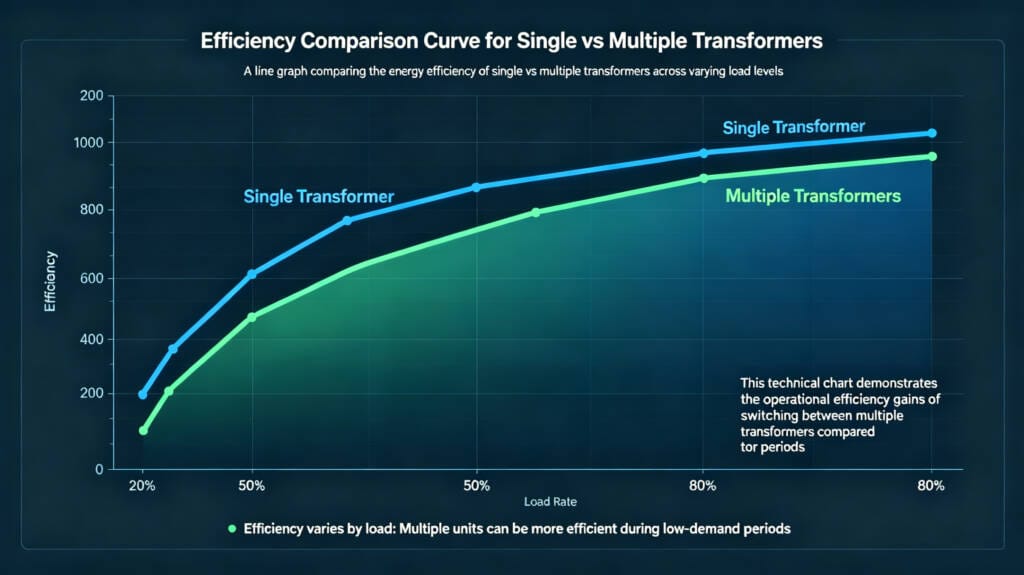
- Operational Flexibility & Energy Savings: During low-demand periods (night shift, weekends, or partial operation), one or more transformers can be completely switched off. This eliminates their no-load (core) losses, improving overall system efficiency and power factor.
- Easier Handling & Installation: Smaller transformers are lighter, easier to transport, and require less civil works (smaller foundations, smaller rooms).
- Improved Fault Isolation: A fault on one transformer has less impact on the overall system compared to a single large unit failure.
Недостатки
- Higher Initial Complexity: Requires proper synchronization, load-sharing controls (automatic or manual), protection relays, and paralleling schemes to avoid circulating currents.
- Increased Maintenance Burden: More bushings, cooling systems (fans/pumps), oil levels, silica gel breathers, and monitoring points to maintain. Overall maintenance cost and effort are higher.
- Higher Total Capital Cost: Although individual units are cheaper, the combined cost of multiple transformers + Tie-Breaker + extra switchgear is usually 15–30% higher than a single equivalent unit.
- Larger Footprint: Requires more space for multiple units, associated cabling, and clearance requirements.
- Potential Efficiency Loss if Poorly Managed: If transformers are not switched off during light load or if load sharing is unbalanced, total losses can be higher than a single optimized transformer.
Comparison Table: Single Large Transformer vs. Multiple Transformers
| Аспект | Single Large Transformer (e.g., 2500 kVA) | Multiple Transformers (e.g., 2×1250 kVA) | Winner / Remark |
|---|---|---|---|
| Redundancy | Low (Single point of failure) | High (N-1 capability with Tie-Breaker) | Multiple ★★★ |
| Initial Capital Cost | Ниже | Higher (15–30% more) | Single |
| Installation Ease | More difficult (heavy, large) | Easier (smaller units) | Multiple |
| Scalability | Poor (replace entire unit for expansion) | Excellent (add units later) | Multiple ★★★ |
| Energy Efficiency (Low Load) | Good (one set of core losses) | Excellent (can switch off units) | Multiple ★★★ |
| Обслуживание | Lower effort | Higher effort | Single |
| Space Requirement | Smaller footprint | Larger footprint | Single |
| Complexity & Protection | Simpler | More complex (paralleling, synchronization) | Single |
| Reliability | Умеренный | Высокий | Multiple |
| Типичные применения | Small-medium plants, tight budget | Large plants, data centers, critical loads | – |
Рекомендация: Choose the Multiple Transformer Configuration when reliability, future expansion, or significant load variation is expected. For stable, non-critical loads with space and budget constraints, a single large transformer may still be more economical.
4. Technical Comparison: Efficiency and Total Cost of Ownership (TCO)
To truly satisfy the E-E-A-T criteria, we must look at the data. Below is a comparison table for a hypothetical 2000 kVA requirement.
| Особенность | Single Transformer (1 x 2000 kVA) | Multiple Transformers (2 x 1000 kVA) |
| Первоначальная стоимость | Baseline (100%) | ~125% – 135% |
| Installation Space | Compact | Significant (Needs 2 Bays) |
| Reliability | Low (Single Point of Failure) | High (Redundancy Available) |
| No-Load Losses | Выше | Lower (If one is de-energized) |
| Fault Current ($I_{sc}$) | Higher at Secondary Bus | Lower (Easier for Breaker Sizing) |
| Обслуживание | Requires Total Shutdown | Partial Shutdown Possible |
5. Critical Decision Factors: When to Choose Which?
Selecting between a single large transformer и multiple smaller transformers (parallel/distributed configuration) is one of the most important decisions in medium-voltage power system design. The choice directly impacts reliability, cost, efficiency, and long-term operational flexibility.
Here are the key decision factors:
A. Load Criticality & Reliability Requirements
- High Criticality (Tier III/Tier IV Data Centers, Hospitals, Level 1 Trauma Centers, Pharmaceutical Plants, Continuous Process Industries): Multiple transformers are almost mandatory. They provide N-1 redundancy via Tie-Breaker systems. A single transformer failure would cause unacceptable downtime.
- Low to Medium Criticality (Warehouses, Residential Buildings, Small Commercial Facilities, Light Manufacturing): A single transformer is usually sufficient and more cost-effective.
B. Load Profile (Cyclical vs Constant)
- Constant / Steady Load (24/7 chemical plants, data centers with stable IT load, base-load industries): A single large transformer operates near its optimal efficiency range (40–80% load) most of the time, minimizing total losses.
- Highly Variable / Cyclical Load (Day-night variation, factories with single-shift operation, commercial buildings): Multiple transformers offer major advantages. You can switch off one or more units during low-demand periods to eliminate no-load (core) losses, significantly improving energy efficiency and reducing electricity bills.
C. Fault Level & Short-Circuit Current Management
- Large single transformers typically have lower percentage impedance, resulting in very high short-circuit currents on the secondary side.
- This forces the use of expensive high interrupting capacity (Isc) switchgear and circuit breakers.
- Multiple smaller transformers increase the effective system impedance, keeping fault currents lower and more manageable. This can lead to substantial savings on protection equipment.
Additional Critical Factors
D. Capital Budget & Total Cost of Ownership (TCO) Single transformer has lower initial cost. Multiple transformers usually cost 15–30% more upfront but can deliver better TCO through energy savings and reduced downtime.
E. Space & Infrastructure Constraints Single large unit needs less floor area and simpler civil works. Multiple units require more space for transformers, additional switchgear, bus ducts, and clearances.
F. Future Expansion Plans If load growth is expected, multiple transformers allow phased investment — add units later. A single transformer may need complete replacement when capacity is exceeded.
G. Maintenance Capability & Spare Parts Multiple units allow easier maintenance (one unit can be taken offline while others carry the load). However, overall maintenance workload increases.
Decision Matrix: Single Transformer vs Multiple Transformers
| Decision Factor | Single Large Transformer | Multiple Smaller Transformers | Recommended Choice |
|---|---|---|---|
| Reliability / Redundancy | Low (Single point of failure) | High (N-1 with Tie-Breaker) | Multiple ★★★ |
| Load Criticality | Suitable for low-criticality | Mandatory for high-criticality | Multiple (if critical) |
| Load Profile | Best for constant/steady load | Best for variable/cyclical load | Multiple for variable load |
| Energy Efficiency (Low Load) | Moderate (fixed core losses) | Excellent (can switch off idle units) | Multiple ★★★ |
| Fault Current Level | Higher (requires expensive switchgear) | Lower & more manageable | Multiple ★★ |
| Initial Capital Cost | Ниже | Higher (15–30%) | Single |
| Total Cost of Ownership | Good for stable loads | Often better due to savings & reliability | Depends on load profile |
| Space Requirement | Smaller footprint | Larger footprint | Single |
| Scalability / Expansion | Poor (full replacement needed) | Excellent (add units later) | Multiple ★★★ |
| Installation Complexity | Simpler | More complex (paralleling & synchronization) | Single |
| Maintenance Effort | Ниже | Higher (more components) | Single |
| Типичные применения | Warehouses, small factories, residential | Data centers, hospitals, large industries, critical loads | – |
Quick Recommendation Guide:
Choose Multiple Transformers when: High reliability is needed, load fluctuates significantly, future expansion is expected, or fault levels must be controlled.
Choose Single Transformer when: Budget is tight, load is steady, criticality is low, and space is limited.
Need a professional comparison or custom configuration?
6. Parallel Operation: Technical Requirements for Multiple Units
If you choose the multiple transformer route, they must be capable of Parallel Operation. This is where technical expertise is vital. To operate units in parallel, they must meet these criteria:
- Same Voltage Ratio: To prevent circulating currents.
- Same Vector Group: (e.g., both must be Dyn11).
- Same Percentage Impedance ($Z% $): To ensure proportional load sharing.
- Same Phase Sequence.
7. E-E-A-T Perspective: Reliability and Maintenance Strategies
As experts in Industrial Power Distribution, we emphasize that the “best” choice is the one that accounts for the Общая стоимость владения (TCO) over 25 years.
- Pro Tip: If choosing multiple units, consider an Auto-Transfer Switch (ATS). This automates the transition during a failure, reducing the “Human Error” element that often leads to prolonged outages.
- Maintenance: A single transformer system often suffers from “maintenance neglect” because the owner cannot afford the downtime. Multiple units encourage a proactive maintenance culture.
8. Conclusion: Making the Informed Choice
In the battle of Single vs. Multiple Transformers, there is no universal winner.
- Выбирать Single Transformers for budget-sensitive projects with non-critical loads and limited space.
- Выбирать Multiple Transformers for projects where reliability is the top priority, or where future expansion is expected.
Are you struggling to calculate the ROI for your next substation project?
Our team of senior electrical engineers specializes in Transformer Sizing and Selection.