1.Introduction
When sourcing power equipment for international projects, understanding the IEC vs IEEE transformer standards is essential. These two major standard systems define how transformers are designed, tested, and applied across different regions. Choosing the wrong standard can lead to compatibility issues, higher costs, or even project delays.
For EPC contractors, utilities, and industrial buyers, knowing the difference between IEC and IEEE transformers is not just a technical detail—it directly impacts procurement decisions, compliance, and long-term performance.
In this guide, we provide a complete comparison of IEC vs IEEE transformer standards, covering design philosophy, testing methods, applications, and selection strategies to help you make the right decision.
For practical applications, selecting the right transformer type is equally important, such as choosing between an oil immersed transformer or a dry type transformer based on project requirements.
Оглавление
- Введение
- What Are IEC and IEEE Transformer Standards
- Why Transformer Standards Matter in Global Projects
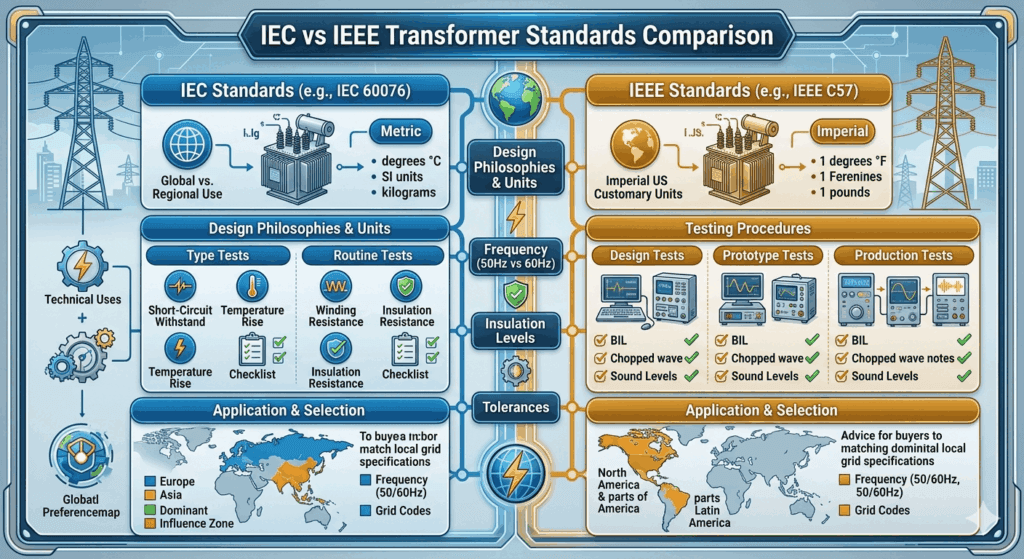
- Key Differences Between IEC vs IEEE Transformer Standards
- IEC vs IEEE Transformer Standards Comparison Table
- Applications of IEC and IEEE Transformers
- Which Transformer Standard Should You Choose
- Can a Transformer Be Designed for Both IEC and IEEE
- How to Choose a Reliable Transformer Supplier
- Frequently Asked Questions
- Заключение
2.What Are IEC and IEEE Transformer Standards
The IEC transformer standard is developed by the International Electrotechnical Commission and is widely adopted across Europe, Asia, Africa, and many international markets. The most relevant standard is IEC 60076, which defines requirements for power transformers.
On the other hand, the IEEE transformer standard (often associated with ANSI/IEEE) is primarily used in North America, including the United States and Canada. The IEEE C57 series governs transformer design, testing, and performance.
While both standards aim to ensure safety, efficiency, and reliability, they differ in technical approaches and regional preferences. This is why many buyers search for IEC vs ANSI transformer comparisons when working on global projects.
Compare IEC vs IEEE transformer standards and find the best solution for your project.
👉 Request a Quote Now
3.Why Transformer Standards Matter in Global Projects
Transformer standards play a critical role in project success. Selecting the correct standard ensures:
- Grid compatibility: Different countries operate under different voltage and frequency systems
- Regulatory compliance: Local authorities may mandate IEC or IEEE standards
- Operational reliability: Properly designed transformers reduce failure risks
- Cost efficiency: Avoid redesign or retrofitting costs
For example, using an IEEE transformer in a region that follows IEC standards may require modifications in insulation levels, testing procedures, and protection systems.
For international buyers, understanding IEC vs IEEE transformer differences helps avoid costly mistakes and ensures smooth project execution.
Working with a reliable transformer supplier that offers custom transformer solutions ensures compliance with both IEC and IEEE standards.
4.Key Differences Between IEC vs IEEE Transformer Standards
Understanding the technical differences between these two systems is essential for proper transformer selection. For engineers, EPC contractors, and international buyers, a detailed comparison of IEC vs IEEE transformer standards helps ensure compliance, performance reliability, and cost efficiency across different regions.
While both standards aim to guarantee safe and efficient transformer operation, they differ in design philosophy, testing approaches, and application practices. Below are the key aspects of IEC vs IEEE transformer differences that every buyer should understand.
Design Philosophy
The IEC transformer standard is built around flexibility and global applicability. It allows manufacturers to optimize transformer design based on specific project conditions such as climate, load profile, and installation environment. This makes IEC standards highly adaptable for diverse international markets.
In contrast, the IEEE transformer standard follows a more prescriptive approach. It emphasizes well-defined parameters and standardized practices, primarily tailored to North American grid systems. This results in a more conservative design philosophy, often prioritizing robustness and long-term reliability.
For buyers comparing IEC vs IEEE transformer design differences, this means IEC offers more customization flexibility, while IEEE provides stricter standardization.
Rated Voltage and Frequency
One of the most fundamental differences between IEC vs IEEE transformer standards lies in operating frequency:
- IEC systems typically operate at 50 Hz
- IEEE systems typically operate at 60 Hz
This difference directly impacts transformer core design, magnetic flux density, and overall efficiency. A transformer designed for 50 Hz cannot always be directly used in a 60 Hz system without design adjustments.
Additionally, rated voltage definitions and system tolerances may vary slightly between the two standards. When evaluating IEC vs IEEE power transformer specifications, ensuring frequency and voltage compatibility is critical to avoid performance issues or overheating.
Insulation Levels
Insulation design is another key area where IEC vs IEEE transformer differences become evident.
IEC standards typically define insulation levels based on system voltage and application requirements, allowing for more optimized and application-specific designs.
IEEE standards, on the other hand, often adopt more conservative insulation margins, particularly for high-reliability applications in North America.
Differences may include:
- Basic Insulation Level (BIL) values
- Dielectric test methods
- Safety margins under transient conditions
For high-voltage or critical infrastructure projects, understanding these differences in IEC vs IEEE transformer insulation design is essential to ensure long-term operational safety.
Testing Standards
Testing procedures represent one of the most significant differences between the two systems.
- IEC transformers are tested according to МЭК 60076
- IEEE transformers follow the IEEE C57 series
These standards define:
- Routine tests
- Type tests
- Special tests
However, the test methods, acceptance criteria, and reporting formats can vary.
For example:
- Short-circuit testing approaches may differ
- Loss measurement tolerances can vary
- Impulse testing requirements are defined differently
These variations directly affect factory acceptance testing (FAT), documentation, and project approval processes. This is why many buyers actively search for IEC vs IEEE transformer testing standards when evaluating suppliers.
Temperature Rise Limits
Temperature rise is a critical factor that influences transformer lifespan, insulation aging, and operational efficiency.
Both IEC and IEEE define allowable temperature rise limits, but their calculation methods and reference conditions may differ. These differences can impact:
- Cooling system design
- Loading capacity
- Expected service life
In general, IEEE standards may allow slightly different temperature rise limits depending on insulation class and application conditions, while IEC provides structured guidelines based on standardized categories.
Understanding IEC vs IEEE transformer temperature rise limits helps engineers design transformers that meet both performance and durability requirements.
Cooling Methods
Both IEC and IEEE standards support similar transformer cooling methods, but their naming conventions and classifications may vary slightly.
Common cooling methods include:
- ОНАН (Масло Натуральное Воздух Натуральное)
- ОНАФ (Масло Природное Air Force)
- OFAF (Нефтяные ВВС)
- ODAF (ВВС с масляным управлением)
While these cooling techniques are widely recognized in both systems, differences may exist in:
- Terminology usage
- Performance classification
- Testing and rating procedures
Cooling method selection directly affects transformer efficiency, load capacity, and installation requirements. Therefore, when comparing IEC vs IEEE transformer cooling methods, buyers should ensure that the selected cooling class aligns with project conditions and environmental factors.
In summary, the key differences between IEC vs IEEE transformer standards extend beyond simple technical definitions. They influence design flexibility, testing procedures, and real-world application performance.
For international projects, understanding these differences allows buyers to:
- Avoid compatibility issues
- Ensure compliance with local regulations
- Optimize transformer performance and cost
Working with an experienced manufacturer that understands both IEC transformer standard и IEEE transformer standard requirements can significantly reduce project risks and improve long-term reliability.
Understanding these differences helps ensure proper selection.
👉 Get Detailed Transformer Datasheet
5.IEC vs IEEE Transformer Standards Comparison Table
Below is a simplified comparison of the key differences:
| Параметр | IEC Transformer Standard | IEEE Transformer Standard |
|---|---|---|
| Частота | 50 Hz | 60 Hz |
| Main Standard | МЭК 60076 | IEEE C57 |
| Design Approach | Flexible | Standardized |
| Insulation Levels | Application-based | Often more conservative |
| Testing | IEC-defined tests | IEEE-defined tests |
| Applications | Global markets | Северная Америка |
| Temperature Rise | Different limits | Different limits |
This table helps buyers quickly understand IEC vs IEEE transformer differences when evaluating suppliers.
Now that you understand the key differences:
👉 Get a Custom Transformer Quote
6.Applications of IEC and IEEE Transformers
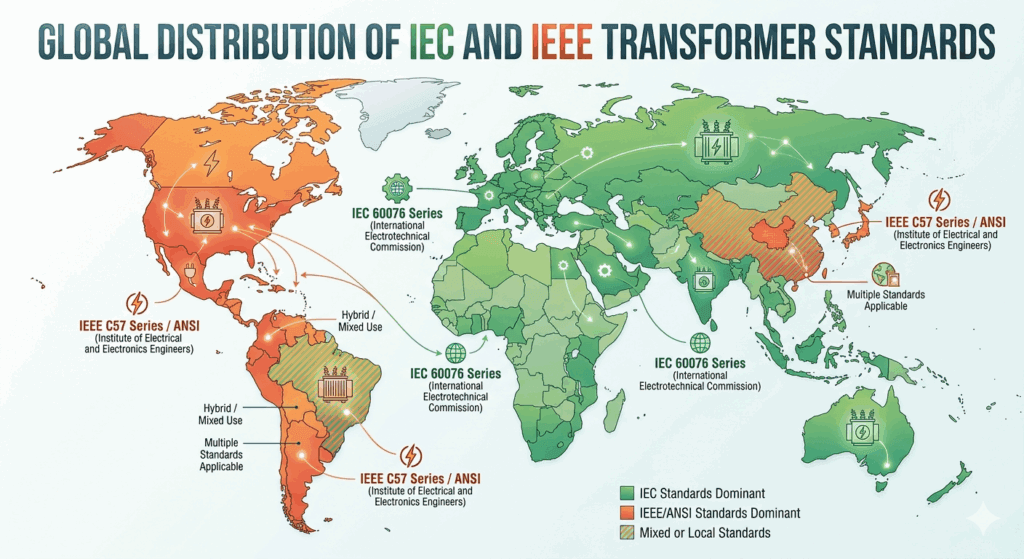
Different regions prefer different standards:
- IEC transformers are widely used in Europe, Asia, Africa, and the Middle East
- IEEE transformers are mainly used in the United States, Canada, and some Latin American countries
For export-oriented projects, manufacturers often provide custom transformer IEC / IEEE compliant solutions to meet local requirements.
7.Which Transformer Standard Should You Choose
Выбор между IEC vs IEEE transformer standards is not simply a technical preference—it is a strategic decision that directly affects project compliance, performance, and long-term operational costs. For EPC contractors, utilities, and industrial buyers, selecting the right standard requires a clear understanding of project-specific conditions.
Rather than asking which transformer standard is better, the more practical question is: which standard is right for your project?
Below are the key factors to consider when evaluating IEC vs IEEE transformer standards.
Choosing between IEC and IEEE depends on several factors:
Project Location
The most important factor is the geographical location of your project.
Different regions follow different transformer standards:
- IEC standards are widely used in Europe, Asia, Africa, and the Middle East
- IEEE standards are primarily used in the United States, Canada, and parts of Latin America
Local grid codes and regulations usually mandate compliance with a specific standard. Selecting the wrong standard may lead to approval delays, redesign requirements, or even project rejection.
For international projects, understanding regional preferences is essential when comparing IEC vs IEEE transformer applications.
Utility Requirements
Utility companies often specify transformer standards in their technical specifications or tender documents.
These requirements may include:
- Compliance with IEC 60076 or IEEE C57
- Specific testing procedures
- Defined insulation levels
- Approved supplier lists
Ignoring these requirements can result in disqualification during bidding or failure during project acceptance.
For this reason, buyers evaluating IEC vs IEEE transformer standards should always review utility specifications before making a decision.
Cost Considerations
Cost is another critical factor when choosing between IEC and IEEE transformers.
Differences in design philosophy, material selection, and testing requirements can lead to variations in:
- Manufacturing cost
- Testing cost
- Transportation and installation cost
For example, IEEE transformers may involve more conservative design margins, which can increase material usage and overall cost. On the other hand, IEC transformers often allow more optimized designs, potentially reducing initial investment.
However, lower upfront cost should not compromise long-term reliability. A proper evaluation of IEC vs IEEE transformer cost differences should consider both initial investment and lifecycle cost.
Technical Compatibility
Ensuring compatibility with existing infrastructure is essential for seamless integration.
Ключевые соображения включают в себя:
- System voltage and frequency (50 Hz vs 60 Hz)
- Protection systems and relay coordination
- Installation environment and cooling requirements
- Grid stability and load characteristics
A mismatch in technical specifications can lead to operational inefficiencies or equipment failure. Therefore, when comparing IEC vs IEEE power transformer specifications, compatibility should always be verified during the design stage.
Project Complexity and Customization Needs
For complex or international projects, customization plays a significant role.
In such cases:
- IEC standards may offer more flexibility for tailored designs
- IEEE standards may be required for strict compliance in specific markets
Some projects may even require dual compliance with both standards, especially when equipment is exported or used in multinational infrastructure.
Working with a supplier capable of delivering custom transformer IEC / IEEE compliant solutions can provide a significant advantage in these scenarios.
8.Can a Transformer Be Designed for Both IEC and IEEE
Yes, modern manufacturers can design transformers that comply with both standards.
Dual-standard transformers are particularly useful for:
- Export projects
- Multinational infrastructure
- Flexible procurement strategies
However, designing a transformer to meet both IEC vs IEEE transformer standards may increase complexity and cost. It requires careful engineering and advanced testing capabilities.
Choosing between IEC vs IEEE transformer depends on your project needs.
👉 Let Us Help You Choose the Right Standard
9.How to Choose a Reliable Transformer Supplier
Selecting the right supplier is just as important as choosing the correct standard. Even if you fully understand IEC vs IEEE transformer differences, working with an inexperienced manufacturer can still lead to quality issues, delays, or compliance risks.
For global buyers, EPC contractors, and utilities, choosing a qualified supplier ensures that the transformer not only meets technical specifications but also delivers long-term reliability and performance.
Below are the key factors to evaluate when selecting a transformer supplier IEC standard or an IEEE standard transformer manufacturer.
Key factors include:
Compliance Capability
A reliable supplier must demonstrate the ability to design and manufacture transformers in accordance with both IEC transformer standard и IEEE transformer standard.
This includes:
- Compliance with IEC 60076 and IEEE C57 series
- Ability to meet regional grid codes
- Proper documentation and certification
Suppliers should be able to clearly explain how their products align with IEC vs IEEE transformer standards, rather than simply claiming compliance.
Engineering Expertise
Transformer design requires deep technical knowledge and real-world experience.
Look for manufacturers that have:
- Proven experience in international projects
- Engineering teams familiar with both IEC and IEEE requirements
- Capability to handle complex specifications
Experienced suppliers can provide valuable insights into IEC vs IEEE transformer design differences, helping you avoid costly mistakes during the design and procurement stages.
Customization Ability
Most projects require more than standard, off-the-shelf solutions.
A qualified supplier should be able to offer:
- Custom voltage and capacity configurations
- Application-specific designs (industrial, utility, renewable energy)
- Flexible solutions based on environmental conditions
For projects involving exports or mixed standards, the ability to deliver custom transformer IEC / IEEE compliant solutions is a major advantage.
Testing and Certification
Testing is a critical part of transformer quality assurance.
Ensure the supplier provides:
- Routine tests, type tests, and special tests
- Compliance with IEC vs IEEE transformer testing standards
- Detailed test reports and documentation
- Factory Acceptance Testing (FAT) support
Reliable manufacturers will have advanced testing facilities and transparent quality control processes to ensure every transformer meets required standards.
Export Experience
For international projects, export capability is essential.
An experienced supplier should understand:
- Packaging standards for long-distance transportation
- Documentation for customs clearance
- Regional certification requirements
- Logistics coordination and delivery timelines
Working with a qualified transformer supplier IEC standard или IEEE standard transformer manufacturer ensures product reliability and long-term performance.
10.Frequently Asked Questions
What is the difference between IEC and IEEE transformer standards
IEC standards are used globally, while IEEE standards are mainly used in North America. They differ in design philosophy, testing methods, and technical specifications.
Which is better IEC or IEEE transformer
Neither is inherently better. The choice depends on project location, regulatory requirements, and system compatibility.
Can IEC and IEEE standards be combined
Yes, transformers can be designed to meet both standards, but this may increase cost and complexity.
11.Conclusion
Understanding IEC vs IEEE transformer standards is essential for making informed procurement decisions in global projects. From design philosophy to testing procedures, each standard has its own advantages and applications.
For buyers, the key is not choosing one over the other, but selecting the standard that best fits the project requirements. Working with an experienced supplier that supports both IEC and IEEE standards can significantly reduce risks and improve project outcomes.
If you are planning an international project and need expert guidance, choosing a manufacturer with proven experience in IEC vs IEEE transformer standards will ensure reliable performance, compliance, and long-term value.
Ready to choose the right transformer for your project?
👉 Get a Quote Within 24 Hours