1. Introduction
When selecting a distribution transformer или power transformer, one of the most critical decisions involves choosing the right winding material for optimal performance, reliability, and economics. The ongoing debate on aluminum vs copper transformer designs has persisted for decades, with procurement managers, engineers, and project developers frequently asking: Which is better — a copper transformer or an aluminum transformer?
The answer is nuanced. Neither material is universally superior. Both copper windings и aluminum windings deliver excellent results in modern transformers when engineered correctly. The choice hinges on factors like budget constraints, application demands, efficiency requirements, physical space, weight considerations, and long-term operational costs.
This comprehensive guide provides an in-depth aluminum vs copper transformer comparison, covering technical specifications, real-world performance, cost implications, and practical recommendations. Whether you are evaluating copper vs aluminum transformer options for renewable energy projects, industrial facilities, or utility distribution networks, this article equips you with the insights needed for informed decision-making.
By the end, you will understand the trade-offs between aluminum transformer windings и copper transformer windings, enabling selection of the most suitable solution for your specific needs.
Need expert advice?
👉Get a free technical consultation on aluminum vs copper transformer today.
Оглавление (ТОС)
- Введение
- What Is Transformer Winding Material
- Key Differences Between Aluminum and Copper Transformers
- Copper vs Aluminum Transformer Efficiency Comparison
- Aluminum vs Copper Transformer Cost Analysis
- Pros and Cons of Copper and Aluminum Windings
- Performance Comparison Table
- Which Is Better: Aluminum or Copper Transformer
- How to Choose the Right Transformer Winding Material
- Applications of Aluminum vs Copper Transformers
- Common Myths About Aluminum Transformers
- Часто задаваемые вопросы
- Заключение
2. What Is Transformer Winding Material
Transformer windings consist of coils that carry electrical current and establish the magnetic field essential for voltage transformation. The winding material directly influences key performance metrics, including electrical conductivity, heat generation (I²R losses), overall transformer efficiency, mechanical integrity under short-circuit forces, and total ownership cost.
The two primary materials used in transformer windings are copper и aluminum. Both serve the fundamental purpose of conducting electricity while minimizing energy losses, yet their inherent physical and electrical properties create distinct design and operational characteristics.
Copper windings offer superior conductivity, allowing for more compact designs. Aluminum windings, on the other hand, provide advantages in weight and material cost, often requiring larger cross-sectional areas to achieve comparable current-carrying capacity. Modern manufacturing techniques, including advanced insulation systems and precise coil geometry, ensure that both materials meet stringent industry standards for safety and performance in oil-immersed, dry-type, and cast-resin transformers.
Understanding these properties is the first step in navigating the aluminum vs copper transformer decision, as the material choice affects not only initial procurement but also installation, maintenance, and lifecycle economics.
3. Key Differences Between Aluminum and Copper Transformers
The core distinctions between aluminum vs copper transformer designs stem from fundamental material science properties: electrical conductivity, density, thermal behavior, and mechanical characteristics.
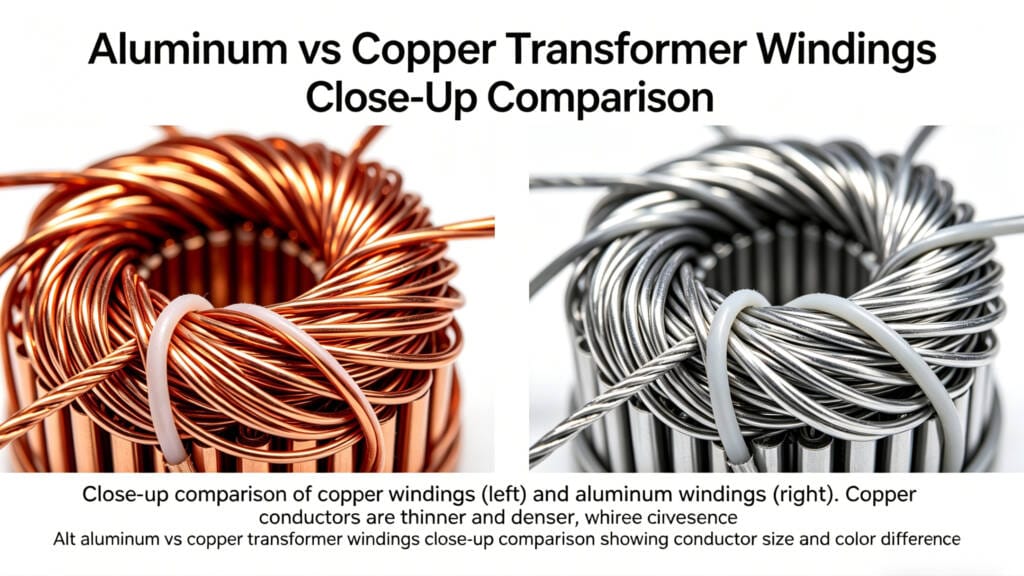
Electrical Conductivity: Copper exhibits significantly higher electrical conductivity — approximately 100% IACS (International Annealed Copper Standard) — compared to aluminum’s roughly 61% IACS. This means copper windings can carry more current per unit cross-sectional area with lower resistance. In contrast, aluminum transformer designs typically incorporate larger conductor cross-sections (often about 1.6 times larger) to compensate for the lower conductivity and maintain equivalent performance levels.
Density and Weight: Copper has a density of about 8.96 g/cm³, making it roughly three times denser than aluminum (2.7 g/cm³). Consequently, copper transformers are heavier, while aluminum transformers are substantially lighter — often 20-30% lighter overall even with increased winding volume. This weight advantage simplifies transportation, installation (especially in rooftop or remote sites), and structural support requirements.
Thermal Expansion and Stability: Aluminum has a higher coefficient of thermal expansion (approximately 23 × 10⁻⁶/°C) compared to copper (16.6 × 10⁻⁶/°C). This causes aluminum windings to expand and contract more during temperature cycling, potentially affecting joint integrity if connections are not properly designed with spring washers or equivalent compensation. Copper windings offer greater dimensional stability, reducing risks of loosening over time.
Thermal Conductivity and Heat Dissipation: Copper also boasts superior thermal conductivity (around 401 W/m·K vs. aluminum’s lower value), aiding faster heat dissipation from hotspots. However, properly sized aluminum windings can achieve comparable hotspot temperatures through optimized coil geometry, ducting, and cooling surfaces.
Mechanical Strength: Copper provides higher tensile strength (around 32,000 lb/in² for soft annealed vs. 12,000 lb/in² for aluminum), making copper transformer windings more robust against short-circuit forces and mechanical stresses in high-power applications. Aluminum requires careful design reinforcements in larger units.
These differences influence everything from transformer size and losses to long-term reliability in the copper vs aluminum transformer comparison.
4. Copper vs Aluminum Transformer Efficiency Comparison
Efficiency remains a top priority when evaluating aluminum vs copper transformer options, as even small differences in losses translate to significant energy costs over decades of operation.
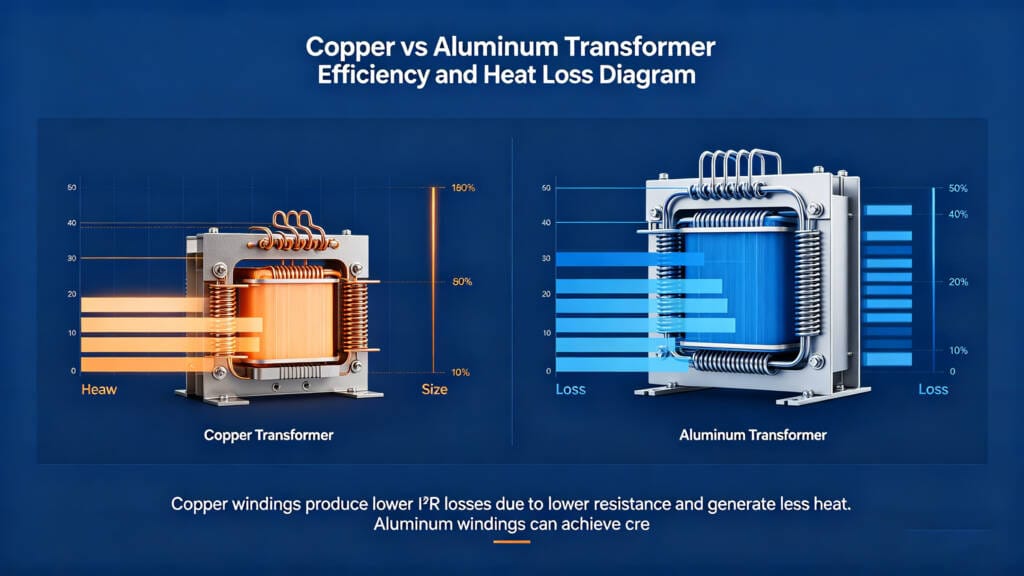
Copper windings inherently produce lower I²R (load) losses due to reduced electrical resistance. This results in less heat generation and potentially higher overall transformer efficiency, particularly under high-load or harmonic-rich conditions where skin effect and proximity losses become relevant.
However, manufacturers compensate for aluminum’s lower conductivity by increasing conductor cross-sectional area. In well-designed aluminum transformers, load losses can be brought very close to those of equivalent copper transformers. No-load (core) losses depend primarily on the magnetic steel and remain largely unaffected by winding material.
Real-world data shows that modern aluminum winding transformers often achieve efficiency levels comparable to copper units when adhering to standards like DOE efficiency requirements. For instance, at the same temperature rise rating, energy losses can be equivalent because the larger aluminum conductors reduce current density effectively.
That said, copper vs aluminum transformer efficiency edges slightly favor copper in scenarios involving frequent overloading, high ambient temperatures, or applications with significant harmonics. Copper’s better thermal conductivity helps manage hotspot temperatures more effectively in identical geometries, though optimized aluminum designs mitigate this through enhanced cooling.
In practice, the efficiency gap is often minimal (typically less than 0.5-1% in total losses for distribution-class units), and total cost of ownership calculations — factoring in energy savings — must weigh against upfront costs. Advanced design tools and testing ensure both materials deliver reliable performance without compromising safety or lifespan.
5. Aluminum vs Copper Transformer Cost Analysis
Cost represents one of the most influential factors in the aluminum vs copper transformer selection process.
Raw Material Cost: Aluminum is significantly less expensive and more price-stable than copper. Copper prices are notoriously volatile due to global market fluctuations, while aluminum offers predictable budgeting. Per kilogram, aluminum often costs one-third to one-fourth that of copper.
Manufacturing and Overall Cost: Although aluminum windings require larger volumes (increasing core steel, tank size, and insulation needs in some designs), the lower material price typically results in aluminum transformers being 20%-40% cheaper overall than comparable copper transformers. Some analyses indicate copper units can cost 2-3 times more in certain configurations, though the differential narrows in liquid-filled designs.
Lifecycle cost analysis is crucial. Copper transformers may offer lower long-term energy expenses due to marginally better efficiency, potentially recovering the higher initial investment within 4-7 years in high-usage scenarios. However, for many standard applications with moderate loads, the upfront savings from aluminum provide superior total ownership economics, especially when factoring in lower shipping and installation costs from reduced weight.
Additional considerations include labor for winding (copper’s smaller size can simplify some processes, but aluminum’s stability aids scalability) and connection hardware. In large projects requiring dozens of units — such as solar farms — the cumulative savings from aluminum transformer choices can be substantial.
Wonder how much an aluminum transformer can save you?
👉Request a customized quote now.
6. Pros and Cons of Copper and Aluminum Windings
Advantages of Copper Winding Transformers:
- Superior electrical conductivity for lower losses and higher efficiency.
- More compact size, ideal for space-constrained installations.
- Excellent mechanical strength and short-circuit withstand capability.
- Better thermal conductivity for effective heat dissipation.
- Greater stability under temperature variations and mechanical stress.
- Preferred for high-reliability, critical-load applications.
Disadvantages of Copper Winding Transformers:
- Higher initial and material costs with price volatility.
- Heavier weight, increasing transportation and structural demands.
- Potential for higher upfront investment without proportional benefits in all scenarios.
Advantages of Aluminum Winding Transformers:
- Significantly lower cost, enabling budget-friendly projects.
- Lighter weight for easier handling, shipping, and installation.
- Good corrosion resistance in many environments.
- Scalability for large-volume production.
- Heat storage capacity per pound often exceeds copper, beneficial during short-term overloads.
- Stable pricing for better cost forecasting.
Disadvantages of Aluminum Winding Transformers:
- Lower inherent conductivity requiring larger conductors and potentially bigger overall units.
- Higher thermal expansion, necessitating careful connection design.
- Moderate mechanical strength, which may require reinforcements in high-stress applications.
- Slightly higher potential for losses if not properly compensated in design.
Both options perform reliably when manufactured to modern standards, making the pros/cons evaluation highly application-specific in any aluminum vs copper transformer review.
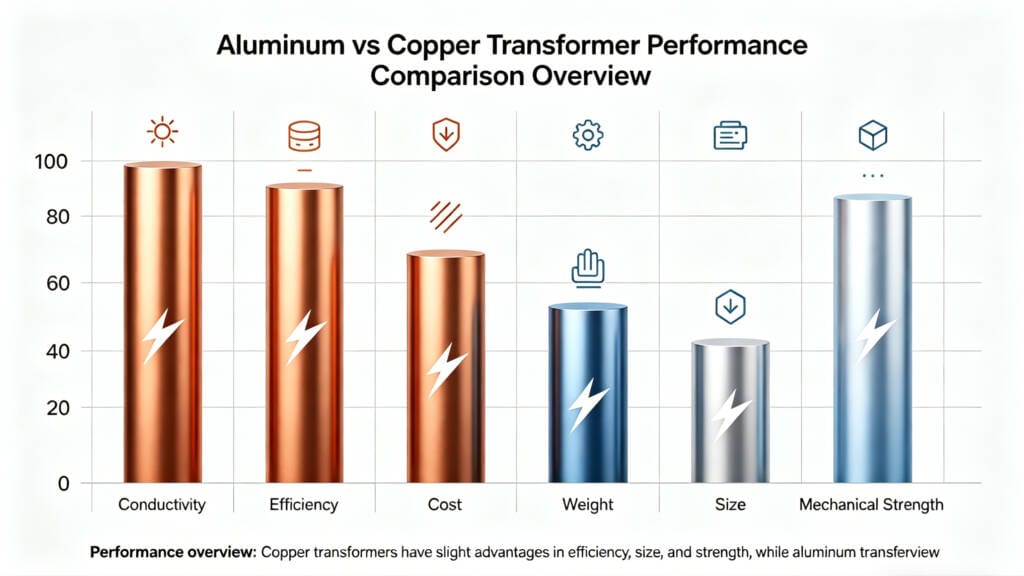
7. Performance Comparison Table
| Особенность | Copper Transformer | Aluminum Transformer |
|---|---|---|
| Conductivity | Very High (~100% IACS) | Moderate (~61% IACS) |
| Эффективность | Slightly Higher | Comparable with proper larger conductors |
| Расходы | Higher (often 20-40%+ more) | Cost-effective and more stable |
| Масса | Heavier | Significantly lighter (up to 20-30% less) |
| Size | More compact | Larger due to conductor cross-section |
| Mechanical Strength | Excellent tensile strength | Moderate; requires design reinforcements |
| Corrosion Resistance | Хороший | Excellent in many conditions |
| Thermal Stability | High (lower expansion) | Moderate (higher expansion) |
| Heat Dissipation | Superior thermal conductivity | Good when sized appropriately |
| Short-Circuit Withstand | Stronger | Adequate for most distribution applications |
This table summarizes the key trade-offs in the copper vs aluminum transformer landscape. Actual performance depends heavily on specific design and manufacturer expertise.
8. Which Is Better: Aluminum or Copper Transformer
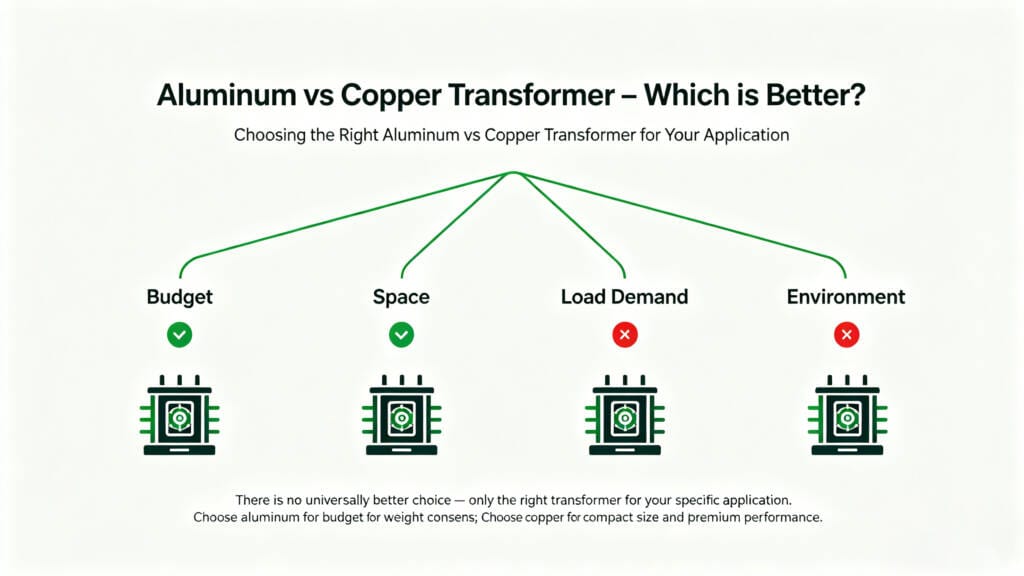
There is no single “better” option in the aluminum vs copper transformer debate — the optimal choice depends entirely on project priorities.
Industrial Applications and Heavy Loads: Copper transformers are often preferred for high-load stability, frequent overloading, data centers, hospitals, and critical infrastructure where compact size, superior mechanical strength, and marginal efficiency gains justify the premium. Their robustness handles short-circuit forces and harsh environments effectively.
Power Distribution and Utility Networks: Aluminum transformers dominate due to cost-effectiveness and lighter weight. They are widely used in residential and commercial distribution, pole-mounted, and pad-mounted units where budgets are constrained and performance remains fully acceptable.
Solar Energy Systems and Renewables: Aluminum windings are frequently favored for photovoltaic installations and wind farms. The combination of lower cost, reduced weight (beneficial for rooftop or remote mounting), and scalability makes them ideal for large arrays requiring numerous transformers.
In summary, copper excels in performance-critical, space-limited, or high-stress scenarios, while aluminum shines in cost-sensitive, weight-sensitive, or high-volume deployments. Many utilities and industries successfully deploy both, selecting based on total cost of ownership modeling.
Still unsure whether to choose aluminum or copper transformer?
👉Let our experts recommend the perfect solution for your project.
9. How to Choose the Right Transformer Winding Material
Selecting between aluminum vs copper transformer involves a systematic evaluation of several factors:
- Budget Constraints: Limited capital or large-scale projects often point toward aluminum for substantial initial savings. Premium or long-term efficiency-focused budgets may lean toward copper.
- Installation Space and Weight Limits: Tight footprints or structural load restrictions favor the more compact, albeit heavier, copper option. Rooftop, mobile, or remote sites benefit from aluminum‘s lighter profile.
- Load Demand and Operating Conditions: High or fluctuating loads, harmonics, or elevated ambient temperatures suit copper better. Standard or moderate loads align well with aluminum.
- Environmental Factors: Harsh, corrosive, or vibration-heavy settings may require copper‘s mechanical advantages. Standard indoor/outdoor conditions work effectively with either, provided proper enclosure and maintenance.
- Lifecycle Analysis: Calculate energy losses, maintenance needs, and expected lifespan (typically 25-40+ years for both with good design). Factor in electricity rates and duty cycle.
- Regulatory and Efficiency Standards: Ensure compliance with DOE, IEC, or local requirements — both materials can meet them when appropriately designed.
Consult with experienced manufacturers for customized simulations and quotes tailored to your copper vs aluminum transformer needs.
10. Applications of Aluminum vs Copper Transformers
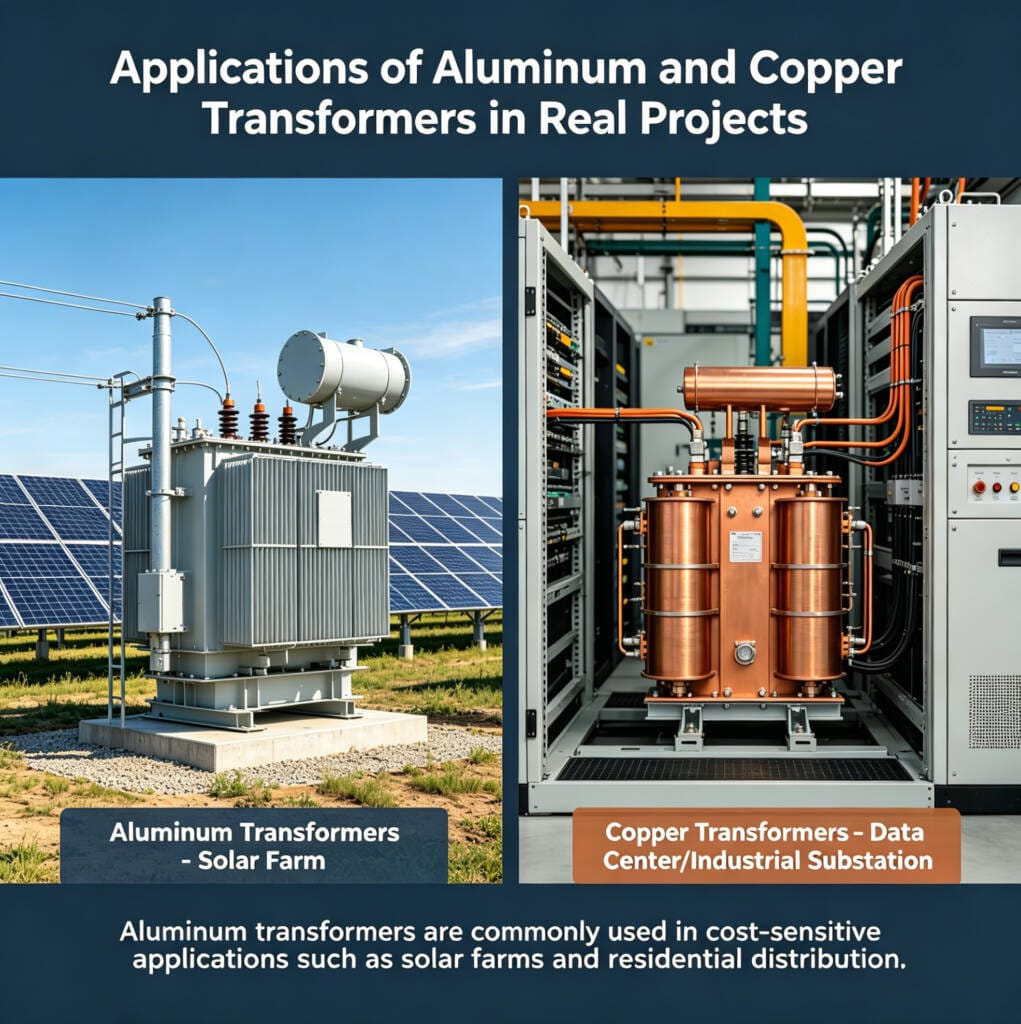
Aluminum Transformers are commonly applied in:
- Residential and commercial power distribution (pole-mounted, pad-mounted).
- Renewable energy projects, including solar farms and wind installations.
- General commercial buildings, schools, and office complexes.
- Budget-driven utility networks where weight and cost savings matter.
Copper Transformers find favor in:
- Heavy industry and manufacturing with high mechanical stresses.
- Data centers, hospitals, and mission-critical facilities requiring high reliability.
- Power plants, substations, and infrastructure demanding compact, robust performance.
- Applications with frequent overloads or challenging environmental conditions.
Hybrid approaches exist, such as copper-aluminum combinations in certain designs, but pure material selection usually suffices for most needs.
Looking for the right aluminum vs copper transformer solution for your project?
11. Common Myths About Aluminum Transformers
Myth 1: Aluminum Transformers Are Less Reliable Fact: Modern aluminum transformers are highly reliable when properly designed with appropriate joint techniques, insulation systems, and testing. Reliability equals that of copper units when manufactured according to international industry standards such as IEC 60076.
Myth 2: Aluminum Has a Shorter Lifespan Fact: Lifespan (often 25-40 years or more) depends primarily on insulation quality, loading, maintenance, and cooling — not the conductor material itself. Both perform similarly with proper care.
Myth 3: Aluminum Is Unsafe or Prone to Failures Fact: Safety stems from engineering practices, not the metal. Issues like joint loosening were more common historically but are mitigated today with spring-loaded connections and best practices. Both materials are safe when manufactured to standards.
Myth 4: Copper Is Always More Efficient Fact: Differences are often negligible in properly compensated designs.
Debunking these myths helps stakeholders make objective aluminum vs copper transformer choices.
12. FAQ
Q1: Which is more efficient, copper or aluminum transformer? Copper offers slightly better inherent efficiency due to lower resistance, but well-designed aluminum transformers achieve comparable overall performance through larger conductors.
Q2: Why are aluminum transformers cheaper? Primarily because raw aluminum costs less and prices are more stable than copper, despite larger conductor requirements.
Q3: Do aluminum transformers last as long as copper? Yes, when properly designed, insulated, and maintained. Lifespan is driven more by thermal management and duty cycle than winding material.
Q4: Which transformer is better for solar systems? Aluminum transformers are commonly selected for solar due to cost savings, lighter weight, and adequate performance in distributed generation setups.
Q5: Can aluminum windings handle high short-circuit forces? Yes, in appropriately reinforced designs for distribution-class units; copper may have an edge in very large power transformers.
13. Conclusion
Choosing between an aluminum vs copper transformer is not about declaring one material universally superior — it is about matching the right solution to your project’s technical, economic, and operational requirements. Copper windings deliver premium performance, compactness, and robustness for demanding applications, while aluminum windings excel in cost-efficiency, weight reduction, and scalability for standard or large-scale deployments.
Careful evaluation of budget, space, load profile, and lifecycle costs will guide you to the optimal copper vs aluminum transformer decision. Both technologies continue to evolve, supported by advanced engineering that ensures high reliability and efficiency.
🚀 Get Expert Support At Solarasia, we specialize in high-quality масляные трансформаторы, distribution transformers, dry-type units, and custom transformer solutions using both aluminum and copper windings as appropriate.
👉 Contact us today for:
- Free technical consultation and efficiency modeling
- Competitive pricing with transparent cost comparisons
- Fast global delivery and customized specifications
Send your inquiry now and receive a tailored aluminum vs copper transformer recommendation within 24 hours. Let our experts help you select the ideal winding material for maximum value and performance in your application.