In the fast-evolving electrical infrastructure sector, choosing a Sous-station préfabriquée has become the ultimate strategy for companies looking to accelerate their “time to energization.” For project managers and EPC contractors, traditional on-site substation assembly is often a costly bottleneck, plagued by complex vendor coordination, unpredictable weather delays, and labor-intensive wiring.
However, by adopting a modern Sous-station préfabriquée—a fully integrated, factory-built power solution—businesses can now reduce installation time by up to 40%. This “plug-and-play” approach doesn’t just shorten your project timeline; it redefines operational efficiency by merging the transformer, switchgear, and distribution components into a single, high-performance unit. In this guide, we will explore why the Sous-station préfabriquée is the fastest and most reliable route to a live power grid.
Table des matières
- Introduction: The Speed Revolution in Power Distribution
- What is a Prefabricated Substation?
- Why Choose a Prefabricated Substation Over Conventional Builds?
- How Prefabricated Substation Solutions Reduce Installation Time
- Technical Specifications: Integration of Transformer & Switchgear
- Cost-Benefit Analysis: Time is Money
- Key Applications for Rapid Deployment
- Conclusion: Future-Proofing Your Infrastructure
1. Introduction: The Speed Revolution in Power Distribution
In the global energy landscape of 2026, the demand for rapid infrastructure deployment has reached an all-time high. Whether you are scaling a hyperscale data center, launching a utility-scale solar farm, or upgrading an aging industrial grid, “time to market” remains your most critical KPI. Every hour your site remains without power represents a direct hit to your Return on Investment (ROI).
Traditionally, electrical substations were built piece-by-piece on-site. This “stick-built” approach requires a massive coordination effort between transformer manufacturers, switchgear suppliers, and local civil contractors. Unfortunately, this fragmented method often leads to:
- Logistical Bottlenecks: Coordinating multiple heavy-equipment deliveries.
- On-site Errors: Misalignments between the transformer terminals and the switchgear busbars.
- Unpredictable Delays: Weather-related shutdowns that halt critical wiring and testing.
To solve these challenges, the industry has embraced the Sous-station préfabriquée solution. A Sous-station préfabriquée is not just a piece of equipment; it is a fully integrated power transformation system designed to eliminate the friction of field construction. By shifting the complexity from the construction site to a controlled factory environment, project managers can now slash their installation timelines by up to 40% or more.
In this comprehensive guide, we will explore how a Sous-station préfabriquée integrates cutting-edge transformer and switchgear technology to provide a “plug-and-play” experience for modern electrical engineering.
View Our Successful Global Projects
2. What is a Prefabricated Substation?
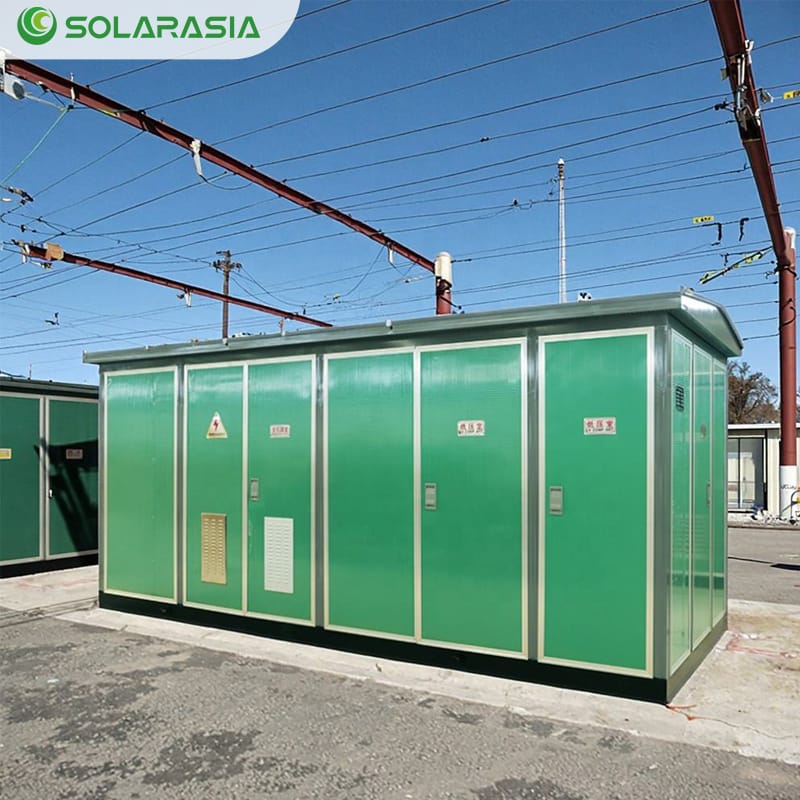
To understand why a Sous-station préfabriquée saves so much time, we must first look at its internal architecture and the “All-in-One” philosophy behind its design. Unlike a standard substation where components are exposed and spread out, a Sous-station préfabriquée (often called a Packaged Substation or Compact Substation) houses all critical elements within a high-strength, protective enclosure.
Core Components of the System
A high-quality Sous-station préfabriquée consists of three primary compartments, each optimized for space and performance:
- The High-Voltage (HV) / Medium-Voltage (MV) Compartment: This section houses the incoming switchgear, which may include Ring Main Units (RMU), circuit breakers, and disconnectors. In a Sous-station préfabriquée, these components are pre-configured to handle the specific voltage requirements of your local utility grid.
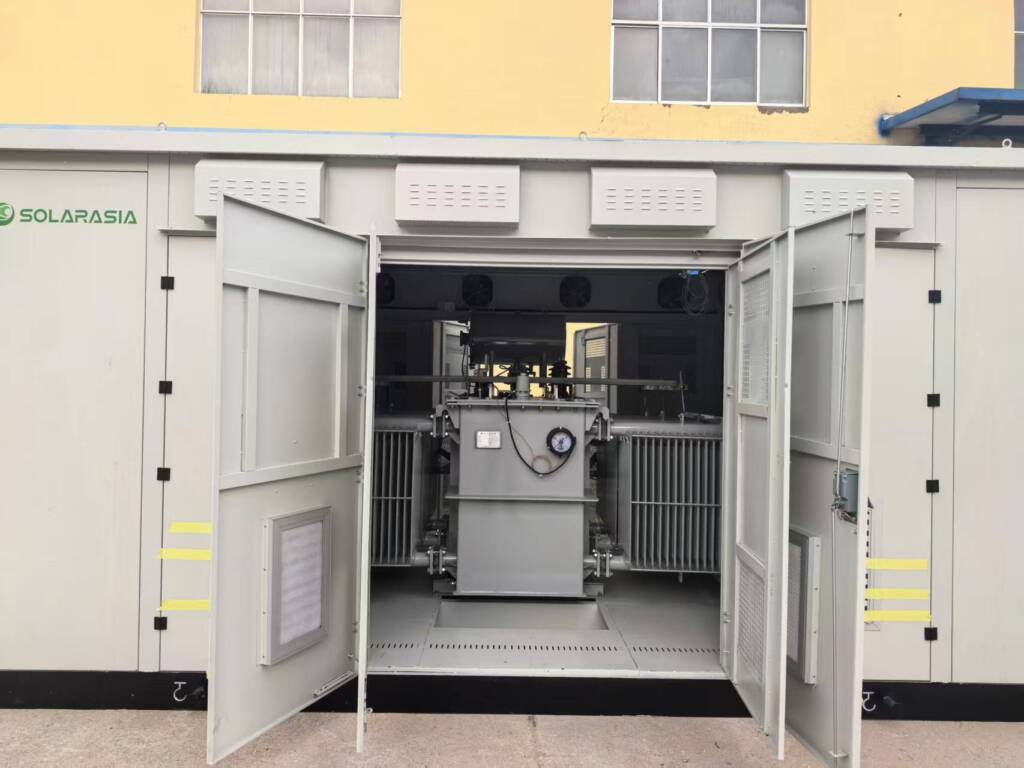
- The Transformer Compartment: The heart of the Sous-station préfabriquée. It typically contains either an oil-immersed transformer or a dry-type transformer. Because the unit is pre-engineered, the transformer’s cooling systems and busbar connections are already perfectly aligned with the other compartments.
- The Low-Voltage (LV) Distribution Compartment: This area contains the outgoing feeders, metering equipment, and protection relays. It distributes the stepped-down voltage to your facility’s machinery or the grid.
The Evolution: From “Components” to “Integrated Solutions”
The transition to the Sous-station préfabriquée represents a move away from manual labor toward industrial automation. Every Sous-station préfabriquée we produce follows a standardized manufacturing protocol. This means:
- Enclosure Engineering: The outer shell is built from GRC (Glass-reinforced Concrete), stainless steel, or aluminum alloy, ensuring a service life of 30+ years in harsh environments.
- Thermal Management: Advanced ventilation systems are integrated during the assembly of the Sous-station préfabriquée, preventing overheating without the need for additional site-installed HVAC systems.
- Safety Standards: Each Sous-station préfabriquée is designed to meet strict international standards (such as IEC 62271-202), ensuring internal arc classification (IAC) safety for operators.
By choosing a Sous-station préfabriquée, you are not just buying a transformer and a switchgear; you are investing in a pre-verified, factory-certified power hub that eliminates the variables of site-based assembly.
Need a Customized Compact Substation?
3. Why Choose a Prefabricated Substation Over Conventional Builds?
To truly appreciate the efficiency of a Sous-station préfabriquée, we must compare it to the traditional “stick-built” or conventional substation construction method. In a conventional setup, the project manager acts as a conductor for an orchestra of different suppliers, contractors, and engineers, often leading to a fragmented and high-risk workflow.
The Fragmented Nature of Conventional Construction
In a traditional project, you typically purchase the transformer from one vendor, the MV switchgear from another, and the LV distribution panels from a third. Each component arrives at the site at different times. Once on-site, a specialized team must:
- Build a large, complex housing or substation room.
- Install separate support structures for each component.
- Manually cut, bend, and install busbars or heavy cables to connect the units.
- Conduct individual testing for each piece of equipment under potentially dusty or humid site conditions.
The Integrated Advantage of a Sous-station préfabriquée
Le Sous-station préfabriquée flips this model entirely. It treats the power distribution system as a single product rather than a collection of parts. When you opt for a Packaged Substation, you shift 90% of the technical labor to a controlled factory floor.
Key Differentiators:
- Reliability: Factory-controlled environments prevent the ingress of moisture or contaminants during the critical connection phase of the Packaged Substation.
- Footprint: UN Packaged Substation is incredibly compact, often requiring 30% to 50% less land than a conventional open-air or room-built substation.
- Vendor Management: You have a single point of accountability. If a technical question arises, you contact one manufacturer for the entire Packaged Substation rather than chasing multiple suppliers.
4. How Prefabricated Substation Solutions Reduce Installation Time
How exactly does a Integrated Substation save weeks, or even months, of project time? It is not magic; it is the result of optimized engineering and streamlined workflows. We can categorize the time-saving mechanisms into three distinct phases:
Phase 1: Parallel Path Execution (The “Time-Overlap” Effect)
In traditional construction, the timeline is linear: Site Preparation → Civil Works → Equipment Delivery → On-site Assembly → Commissioning.
With a Integrated Substation, the timeline becomes parallel. While your site team is still excavating and pouring the concrete pad, the internal assembly of your Integrated Substation is already nearing completion in the factory.
Result: By the time the foundation has cured, the fully-tested Sous-station préfabriquée is ready for delivery. This “overlap” can shave 4 to 8 weeks off a standard project schedule.
Phase 2: Elimination of On-site Interconnections
Wiring is the most time-consuming part of substation installation. In a conventional build, electricians must spend hundreds of man-hours measuring, cutting, and terminating high-voltage cables between the transformer and the switchgear.
UN Containerized Substation arrives with all internal “soft” and “hard” connections already installed and torque-tested.
- Plug-and-Play: The only wiring required on-site is the connection of the incoming utility lines and the outgoing feeder cables.
- Error Reduction: Because the factory uses precision jigs to build the Containerized Substation, there is zero risk of “cable length mismatch” or “terminal misalignment”—common issues that cause days of delay in traditional builds.
Phase 3: Rapid Commissioning and “Cold” Startups
Commissioning a substation involves rigorous safety checks. In a traditional build, this is the first time all components “meet” each other, leading to unexpected circuit logic errors or protection relay conflicts.
Every Modular Substation undergoes a Full System Routine Test before shipment. We simulate the operational environment to ensure that the transformer, switchgear, and monitoring systems communicate perfectly.
- Site Deployment: Once the Modular Substation is bolted to the pad, the commissioning team only needs to perform basic insulation and grounding checks.
- Speed to Power: You can often move from “delivery” to “energization” in as little as 48 to 72 hours.
Installation Efficiency Comparison Table
| Milestone | Conventional Substation (Weeks) | Prefabricated Substation (Weeks) | Time Saved |
| Procurement & Design | 8 – 12 | 4 – 6 | 4+ Weeks |
| Civil & Foundation Works | 4 – 6 | 1 – 2 | 3 Weeks |
| On-site Component Assembly | 6 – 10 | 0 (Factory Done) | 6+ Weeks |
| Final Wiring & Commissioning | 3 – 5 | 0.5 – 1 | 2+ Weeks |
| Total Estimated Time | 21 – 33 Weeks | 5.5 – 9 Weeks | ~15 Weeks |
5. Technical Specifications: Integration of Transformer & Switchgear
UN Modular Substation is a masterpiece of electrical engineering that maximizes power density within a minimal footprint. To ensure the highest levels of safety and reliability, we adhere to rigorous international standards such as IEC 62271-202 (High-voltage/low-voltage prefabricated substation). Engineers can refer to the IEEE Power and Energy Society technical guidelines to better understand the thermal management requirements for integrated transformer units in enclosed spaces.
Precision Engineering of the Transformer Compartment
The heart of any Sous-station préfabriquée is the transformer. Depending on your specific project requirements, we offer two main configurations:
- Oil-Immersed Transformers: Ideal for outdoor installations where natural cooling is sufficient. In a Sous-station préfabriquée, the transformer oil tank is integrated with pressure relief valves and temperature sensors connected to the central monitoring system.
- Dry-Type Transformers: These are perfect for indoor or environmentally sensitive areas (such as high-rise buildings or forests) because they eliminate the risk of oil leaks and fire hazards.
The Switchgear Architecture
Inside the Unitized Substation, the Medium-Voltage (MV) switchgear acts as the primary defense mechanism.
- Compact Design: We utilize Gas-Insulated Switchgear (GIS) or Air-Insulated Switchgear (AIS) that are specifically modified to fit the compact internal bays of the Unitized Substation.
- Intelligent Protection: Every Unitized Substation features advanced relays that provide overcurrent, short-circuit, and ground-fault protection. We pre-wire these systems to the LV distribution board to ensure seamless communication between incoming and outgoing circuits.
6. Cost-Benefit Analysis: Time is Money
In the world of capital-intensive projects, “Cost” is often misunderstood as just the purchase price. For a professional project manager, the Total Cost of Ownership (TCO) and the Opportunity Cost of Delay are far more important metrics. Choosing a Sous-station préfabriquée significantly improves both.
Reducing Hidden On-site Costs
When you build a substation conventionally, you face unpredictable costs:
- Labor Overruns: Specialized electricians for on-site busbar welding are expensive. A Sous-station préfabriquée eliminates this need.
- Safety & Liability: Construction sites are high-risk zones. By moving the assembly of the Sous-station préfabriquée to a factory, you reduce the number of workers on-site and lower your insurance premiums.
- Waste Management: On-site construction generates significant waste (cables, packaging, metal scraps). A Sous-station préfabriquée is a “zero-waste” delivery for your job site.
Impact on ROI
Consider a 10MW Solar Farm project. If a conventional substation delay prevents the farm from connecting to the grid for 30 days, the lost revenue from electricity sales can be staggering. A Sous-station préfabriquée ensures you meet your “Commercial Operation Date” (COD), allowing the project to begin generating cash flow immediately.
7. Key Applications for Rapid Deployment
The versatility of the Sous-station préfabriquée makes it the preferred choice across diverse industries that prioritize speed and reliability. As reported by the International Energy Agency (IEA), the global transition to net-zero requires a massive scale-up in rapid power distribution infrastructure, making modular solutions more critical than ever.
A. Renewable Energy (Solar and Wind Farms)
In remote solar fields, terrain can be challenging and skilled labor is scarce. The Sous-station préfabriquée is a game-changer here. We can deliver dozens of units ready to bolt directly onto your pre-cast concrete pads. This “standardized fleet” approach allows for the rapid scaling of renewable energy capacity.
B. Data Centers and Cloud Computing
Data centers operate on aggressive growth timelines. A Sous-station préfabriquée provides a modular way to expand power capacity as the server load increases. Its compact design also leaves more room for high-density server racks, maximizing the revenue-per-square-foot of the facility.
C. Industrial Retrofitting and Urban Expansion
In congested urban environments, there is no room for a large, traditional substation. The Sous-station préfabriquée can be placed on rooftops, in basements, or even in narrow alleyways. Because the installation time is so short, it minimizes disruption to local traffic and nearby business operations.
8. Conclusion: Future-Proofing Your Infrastructure
The evolution of power distribution is moving toward integration, intelligence, and speed. The Sous-station préfabriquée is at the forefront of this movement. By choosing a solution that prioritizes reduced installation time, you are not just buying equipment; you are securing a competitive advantage in an increasingly demanding market.
If you are ready to accelerate your next power project, investing in a high-quality Sous-station préfabriquée is the most effective way to ensure safety, reliability, and on-time delivery.
9.FAQ
Q1: What is a prefabricated substation?
A prefabricated substation (also known as a compact substation or box-type substation) is a factory-assembled, tested, and ready-to-install power distribution solution. It typically integrates high-voltage switchgear, a power transformer, and low-voltage distribution panels into a single, weather-proof enclosure.
Q2: What are the main advantages of using a prefabricated substation over traditional ones?
The primary benefits include:
- Space-saving: Its compact design requires much less land than a conventional built-on-site substation.
- Reduced Installation Time: Since it is pre-assembled and tested in the factory, on-site installation is significantly faster.
- Cost-effective: Lower civil engineering costs and reduced labor requirements on-site.
- Enhanced Safety: The enclosed design protects the equipment from environmental factors and prevents accidental contact.
Q3: What are the typical applications of prefabricated substations?
Prefabricated substations are widely used in various sectors, including:
- Renewable Energy: Solar farms and wind power plants.
- Infrastructure: High-rise buildings, residential areas, and hospitals.
- Industrial: Mining sites, factories, and construction projects.
- Urban Grid: Upgrading city power distribution where space is limited.
Q4: Can a prefabricated substation be customized?
Yes. At Solarasia, we provide highly customizable prefabricated substations. You can choose different transformer capacities (e.g., 630kVA, 1250kVA, 1600kVA), enclosure materials (stainless steel, GRG, or aluminum alloy), and specific protection grades (IP ratings) to suit your project’s environment.
Q5: Is it easy to maintain a compact prefabricated substation?
Yes, they are designed for easy maintenance. Most units feature accessible doors for each compartment (High Voltage, Transformer, and Low Voltage). Regular inspections and dust cleaning are usually sufficient to ensure a long service life.
Q6: How long does it take to deliver a prefabricated substation?
The lead time depends on the complexity and customization requirements. Generally, a standard prefabricated substation can be manufactured and shipped within 4 to 8 weeks. Contact our technical team for a specific timeline for your project.