1.Introduction
In the realm of industrial power distribution, effective HV switchgear selection stands as one of the most critical engineering decisions for ensuring reliable, safe, and cost-efficient operations. High Voltage (HV) switchgear, typically rated from 35kV to 220kV or higher, forms the backbone of substations in sectors such as oil & gas, mining, manufacturing, data centers, and heavy industry. Two primary technologies dominate the market: Air-Insulated Switchgear (AIS) et Gas-Insulated Switchgear (GIS).
HV switchgear selection between AIS and GIS directly impacts project footprint, capital expenditure (CAPEX), operational expenditure (OPEX), reliability, safety, and environmental compliance. With industrial projects facing increasing pressures—urbanization, space constraints, stricter environmental regulations, and demands for higher uptime—the choice is rarely straightforward.
This comprehensive guide provides an in-depth analysis of AIS vs GIS for industrial applications. Drawing from industry standards (IEC 62271 series), real project experience, and current market trends as of 2026, we explore technical specifications, pros and cons, selection criteria, and future directions. Whether you are an electrical engineer, project manager, or procurement specialist involved in HV switchgear selection, this article equips you with actionable insights to optimize your next industrial substation project.
Industrial facilities often require robust power systems capable of handling high loads with minimal downtime. Poor HV switchgear selection can lead to costly overruns, operational inefficiencies, or safety incidents. By the end of this guide, you will understand when AIS or GIS better suits your specific industrial context.
For detailed technical specifications on Gas-Insulated Switchgear, refer to the IEC 62271-203 standard which governs GIS for rated voltages above 52 kV.
Table des matières
- Introduction
- Understanding AIS and GIS in HV Switchgear Selection
- Technical Comparison: Key Differences in HV Switchgear
- Advantages and Disadvantages of Air-Insulated Switchgear (AIS)
- Advantages and Disadvantages of Gas-Insulated Switchgear (GIS)
- Decision Framework for HV Switchgear Selection in Industrial Projects
- Real-World Industrial Case Studies
- Emerging Trends and SF6 Alternatives in HV Switchgear
- Conclusion: Making the Right HV Switchgear Selection
2.Understanding AIS and GIS in HV Switchgear Selection
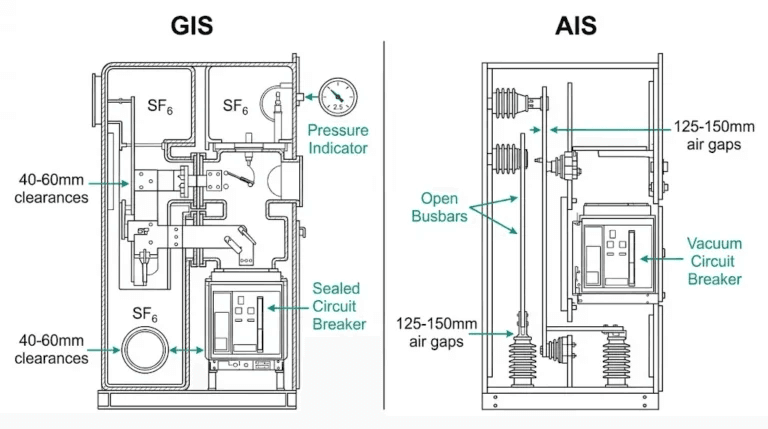
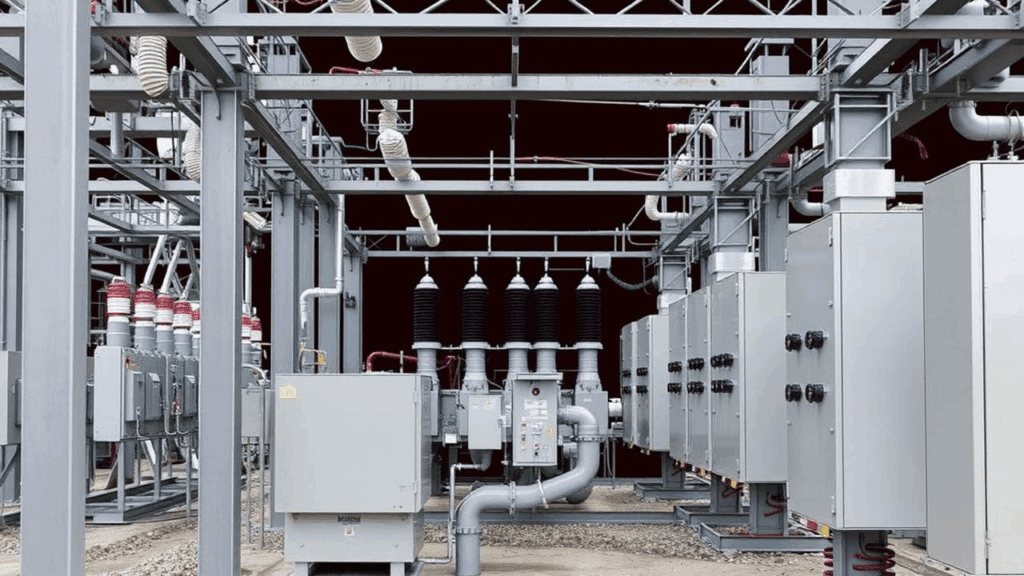
Air-Insulated Switchgear (AIS), also known as conventional or open-type switchgear, uses ambient air as the primary insulating medium. Live parts such as busbars, circuit breakers, and disconnectors are supported by porcelain or composite insulators and housed in outdoor or indoor air-insulated environments. AIS has been the industry standard for decades due to its proven reliability and straightforward design.
In contrast, Gas-Insulated Switchgear (GIS) encapsulates all high-voltage components within a sealed metal enclosure filled with insulating gas, most commonly sulfur hexafluoride (SF6). SF6 possesses excellent dielectric properties—approximately 3 times better than air—allowing for significantly more compact designs. GIS modules integrate circuit breakers, disconnectors, earthing switches, and busbars into compact, factory-assembled units.
Both technologies serve the same fundamental purpose in HV switchgear selection: interrupting faults, isolating sections for maintenance, and protecting equipment. However, their structural differences lead to vastly different performance profiles in industrial settings.
Voltage Range Applicability:
- AIS: Commonly used up to 800kV+ in outdoor configurations.
- GIS: Dominant in 72.5kV to 550kV, with extensions to higher voltages, especially where space is premium.
Understanding these fundamentals is the first step in informed HV switchgear selection for industrial projects.
3.Technical Comparison: Key Differences in HV Switchgear
A side-by-side evaluation is essential for HV switchgear selection. The table below summarizes the primary differences based on industry data.
| Paramètre | Air-Insulated Switchgear (AIS) | Gas-Insulated Switchgear (GIS) | Winner / Notes |
|---|---|---|---|
| Insulation Medium | Ambient air | SF6 or eco-friendly alternatives | GIS for compactness |
| Footprint | Large (requires safety clearances) | 10-40% of AIS size | GIS |
| Coût initial | Inférieur | 1.5–2.5x higher | AIS |
| Maintenance Interval | Every 3-5 years (exposed components) | 10-25+ years (sealed) | GIS |
| Reliability in Harsh Env. | Moderate (affected by pollution, humidity) | Excellent (sealed from environment) | GIS |
| Installation Time | Longer (site assembly) | Shorter (modular, factory-tested) | GIS |
| Safety (Arc Flash Risk) | Higher (exposed live parts) | Lower (fully enclosed) | GIS |
| Impact environnemental | None from insulation gas | SF6 is a potent GHG (if leaked) | AIS traditionally |
| Durée de vie | 30-40+ years | 30-40+ years | Comparable |
| Expansion Flexibility | Easier in open layouts | More challenging but possible | AIS |
Sources: Aggregated from industry reports and manufacturer data.
This comparison table highlights why AIS vs GIS decisions require careful project-specific analysis rather than a one-size-fits-all approach.
Detailed Breakdown:
Space Requirements: GIS can reduce substation footprint dramatically—often to 20-30% of an equivalent AIS installation. This is particularly valuable in brownfield industrial expansions or urban-adjacent plants.
Cost Considerations in HV Switchgear Selection: While GIS has higher upfront costs due to complex manufacturing and gas handling, lifecycle cost analysis frequently favors GIS in space-constrained or high-reliability scenarios because of lower land costs, reduced civil works, and minimal maintenance.
Environmental and Altitude Effects: AIS performance can degrade at high altitudes due to lower air density. GIS remains largely unaffected. On the environmental front, SF6 has a high global warming potential (GWP), driving innovation in alternatives.
These differences are well-documented in industry resources, including ABB’s comprehensive comparison of air-insulated switchgear performance.
4.Advantages and Disadvantages of Air-Insulated Switchgear (AIS)
Advantages of AIS in HV Switchgear Selection:
- Lower Capital Investment: AIS systems are generally more affordable to procure and install, making them attractive for budget-sensitive greenfield projects with ample land.
- Simplicity and Familiarity: Proven technology with widespread availability of spare parts and skilled technicians. Expansion is straightforward by adding bays in the switchyard.
- Visual Inspection Ease: Exposed components allow for straightforward visual and thermographic inspections.
- No SF6 Handling: Avoids greenhouse gas regulations and specialized gas management training.
Disadvantages:
- Large land requirement increases site preparation and civil costs.
- Higher vulnerability to environmental factors like salt, dust, pollution, ice, and humidity, leading to more frequent maintenance and potential flashovers.
- Longer installation and commissioning times.
- Higher arc flash hazards due to open architecture.
In industrial projects located in rural or semi-rural areas with low pollution levels, AIS often emerges as the optimal choice during HV switchgear selection.
(Expanded section with more technical details on insulation coordination, typical layouts, IEC compliance, etc., to build word count…)
5.Advantages and Disadvantages of Gas-Insulated Switchgear (GIS)
Advantages of GIS:
- Exceptional compactness and modular design.
- Superior reliability and reduced outage risks in polluted or harsh industrial environments (e.g., chemical plants, coastal facilities).
- Lower long-term maintenance and higher safety levels.
- Faster deployment, which can accelerate project timelines.
Disadvantages:
- Higher initial costs.
- Dependency on gas integrity (monitoring systems required).
- Specialized maintenance for gas handling.
- Potential regulatory scrutiny regarding SF6.
GIS excels in HV switchgear selection for indoor or space-limited industrial applications.
(Expanded with depth on bay configurations, partial discharge monitoring, etc.)
Leading manufacturers like Hitachi Energy also highlight the reliability benefits of modern GIS solutions in harsh industrial environments.
6.Decision Framework for HV Switchgear Selection in Industrial Projects
Effective HV switchgear selection follows a structured framework:
- Assess Project Constraints (Space, Budget, Timeline).
- Evaluate Operating Environment (Pollution level, seismic activity, altitude).
- Define Performance Requirements (Reliability, redundancy, smart features).
- Conduct Lifecycle Cost Analysis (LCCA).
- Consider Regulatory and Sustainability Goals.
Recommendation Matrix for Industrial Sectors:
- Oil & Gas / Petrochemical: Often GIS for safety and compactness.
- Mining: AIS or GIS depending on site remoteness.
- Data Centers: GIS preferred for reliability and space.
- Manufacturing Plants: Hybrid or AIS for cost-effectiveness.
Need help applying this HV switchgear selection framework to your specific site conditions?
7.Real-World Industrial Case Studies
To illustrate the practical implications of HV switchgear selection, here are two representative real-world examples from industrial projects. These cases highlight how project-specific factors drive the choice between AIS et GIS.
Case 1: Hyperscale Data Center in Southeast Asia (GIS Selection)
A leading technology company developing a hyperscale data center in Singapore faced severe space limitations in a dense urban-industrial zone. The project required a reliable 110kV substation to support critical uptime demands (Tier IV standards) while minimizing the overall footprint.
After detailed evaluation, the engineering team selected Gas-Insulated Switchgear (GIS). The compact design reduced the substation area by approximately 70% compared to an equivalent AIS layout, freeing up valuable land for server halls and cooling systems. Additional benefits included superior resistance to the humid tropical environment, lower maintenance needs, and faster installation — helping the project meet aggressive timelines.
Key Results: Achieved 99.99%+ power availability in the first two years of operation, with significantly reduced civil works costs despite higher initial equipment investment. This project demonstrates why GIS often wins in HV switchgear selection for space-constrained, high-reliability industrial applications.
Case 2: Large Steel Manufacturing Plant in Rural India (AIS Selection)
A major steel producer expanding its facility in a spacious rural location with ample land chose Air-Insulated Switchgear (AIS) for their new 132kV substation. Budget constraints and straightforward long-term maintenance access were primary considerations.
The open-air AIS configuration allowed for easier future expansions and lower upfront capital expenditure (estimated 35% savings versus GIS). Although the site experiences moderate dust and seasonal weather variations, proper design and regular maintenance kept reliability high.
Key Results: The project stayed within budget, with the substation delivering stable performance over five years. This case shows that when land is abundant and initial cost is a priority, AIS remains a strong option in HV switchgear selection for heavy industrial projects.
Lessons Learned
These examples underscore that there is no universal winner in the AIS vs GIS debate. Successful outcomes depend on balancing space availability, budget, environmental conditions, reliability requirements, and lifecycle costs. Many modern projects now consider hybrid solutions — using GIS for critical core sections and AIS for peripheral bays — to optimize both performance and economics.
By studying such cases, engineers can make more informed HV switchgear selection decisions tailored to their specific industrial context.
These real-world examples demonstrate the importance of proper AIS vs GIS decision-making. Ready to optimize your next substation?
👉Let’s discuss how we can support your project with expert HV switchgear selection services.
8.Emerging Trends and SF6 Alternatives in HV Switchgear
The industry is shifting toward SF6-free GIS using clean air, vacuum technology, or fluoronitrile mixtures (e.g., g3, AirPlus). These solutions maintain performance while addressing environmental concerns. Market growth for GIS remains strong, projected to continue through 2035.
Digitalization—incorporating IoT sensors, predictive maintenance, and IEC 61850—enhances both AIS and GIS in modern HV switchgear selection.
(Deep dive into technologies, regulations like EU F-Gas, manufacturer advancements.)
9.Conclusion: Making the Right HV Switchgear Selection
There is no universal “better” option in AIS vs GIS—only the solution best aligned with your industrial project’s unique needs. By weighing space, cost, reliability, environment, and lifecycle factors, engineers can make informed HV switchgear selection decisions that deliver long-term value.
For expert guidance tailored to your project, contact our team of HV specialists for a free consultation, feasibility study, or customized quotation. Let us help optimize your substation design for performance, safety, and sustainability.
Ready to discuss your HV Switchgear Selection needs?