1. Introduction to EV Charging Transformer
The rapid growth of electric vehicles (EVs) is reshaping global energy infrastructure. At the core of this transformation lies a critical yet often overlooked component: the EV charging transformer.
An EV charging transformer is responsible for stepping down medium voltage electricity from the grid to a usable low voltage level required by EV chargers. Whether for residential charging, commercial charging hubs, or highway fast-charging stations, transformers play a key role in ensuring stable, efficient, and safe power delivery.
Unlike traditional power distribution applications, EV charging presents unique load characteristics such as high power demand, rapid fluctuations, and nonlinear loads. This makes the selection and design of EV charging transformers significantly more complex.
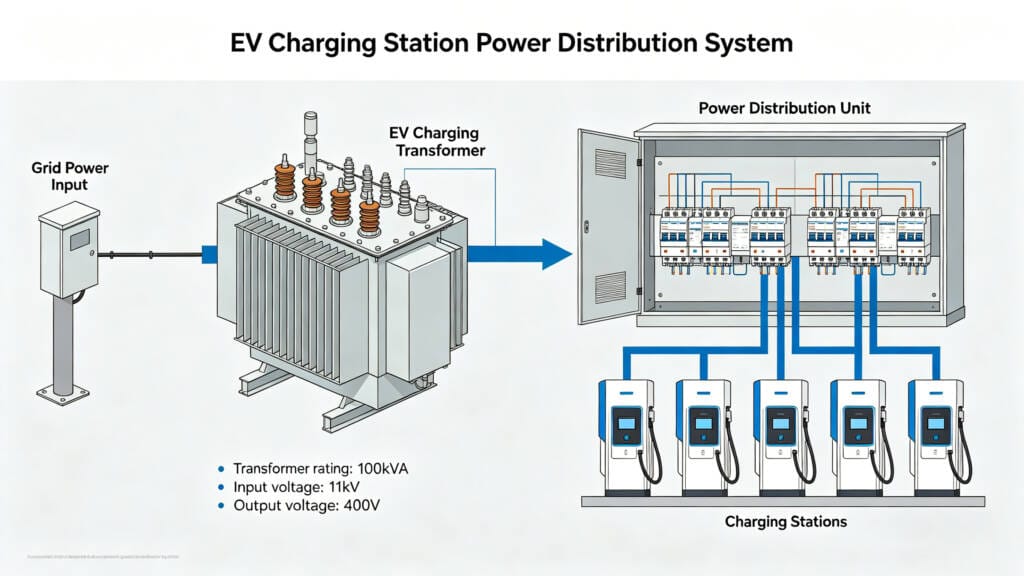
Table des matières
- Introduction to EV Charging Transformer
- Why EV Charging Infrastructure Requires Specialized Transformers
- Types of Transformers Used in EV Charging Stations
- Key Technical Requirements of EV Charging Transformers
- How to Size an EV Charging Transformer
- Oil Immersed vs Dry Type Transformer for EV Charging
- Challenges in EV Charging Transformer Applications
- Market Opportunities in EV Charging Infrastructure
- How to Choose the Right EV Charging Transformer Supplier
- Frequently Asked Questions
- Conclusion
2. Why EV Charging Infrastructure Requires Specialized Transformers
The rapid expansion of electric vehicle infrastructure is fundamentally changing how power distribution systems are designed. Unlike conventional loads, EV charging introduces high power density, fluctuating demand, and power electronics-driven characteristics. As a result, selecting a properly engineered EV charging transformer is critical to ensure system reliability, efficiency, and long-term performance.
1.Increasing Power Demand
Modern EV charging stations—particularly those equipped with DC fast charging technology—require significantly higher power levels than traditional electrical loads. Individual chargers typically operate in the range of 50 kW to 350 kW, while ultra-fast charging systems can exceed this range.
In large-scale installations such as highway charging hubs or fleet depots, multiple chargers operate simultaneously, pushing total demand into the megawatt (MW) range. This creates a need for high-capacity electric vehicle charging station transformers capable of handling continuous heavy loads without performance degradation.
In addition, the growing adoption of high-voltage EV platforms (800V systems) is further increasing power requirements, placing additional stress on upstream distribution equipment. A well-designed EV power distribution transformer must therefore provide not only sufficient capacity but also stable voltage regulation under sustained high-load conditions.
2.Load Variability and Peak Demand
One of the most challenging aspects of EV charging infrastructure is its highly dynamic load profile. Unlike traditional industrial loads that follow predictable patterns, EV charging demand can change rapidly depending on user behavior.
For example, multiple vehicles may begin charging at the same time during peak hours, resulting in sudden load spikes. Conversely, demand may drop sharply during off-peak periods. These fluctuations require an EV charging transformer that can respond quickly to load changes without causing voltage instability or excessive thermal stress.
To address this, modern EV charger transformers are often designed with enhanced overload capability and optimized thermal performance. Engineers also consider diversity factors and smart load management strategies when sizing transformers to ensure they can handle real-world operating conditions rather than theoretical maximum loads.
3.Grid Stability Requirements
Maintaining grid stability is a critical requirement for any EV charging project. Poorly specified or undersized transformers can lead to voltage drops, flicker, and even system failures, directly impacting charger performance and user experience.
Moreover, EV chargers rely heavily on power electronic converters, which introduce harmonics into the system. If not properly managed, these harmonics can cause additional losses, overheating, and insulation stress within the transformer. This is why a high-quality transformer for EV infrastructure must be designed with strong harmonic resistance and low loss characteristics.
Specialized EV charging transformers are engineered to maintain voltage stability under variable load conditions while minimizing the impact of harmonics on both the transformer and the wider electrical network. Features such as optimized winding design, advanced cooling systems, and high-grade core materials all contribute to improved reliability and longer service life. Specialized EV charging transformers are engineered to maintain stable voltage under variable load conditions.
Electric vehicle adoption is accelerating globally, supported by policies and infrastructure investments, as highlighted by the International Energy Agency.
👉Power your EV infrastructure with confidence — Contact us today.
3. Types of Transformers Used in EV Charging Stations
Different transformer types are used depending on installation environment, capacity, and safety requirements.
Common Transformer Types
- Transformateur immergé d'huile
- Transformateur de type sec
- Transformateur monté sur le coussin
- Compact Substation
Table: Comparison of Transformer Types
| Taper | Installation | Refroidissement | Avantages | Application typique |
|---|---|---|---|---|
| Oil Immersed | Outdoor | Oil | High efficiency, cost-effective | Large charging stations |
| Dry Type | Indoor | Air | Fire-resistant, low maintenance | Bâtiments commerciaux |
| Pad Mounted | Outdoor | Oil | Compact, secure | Urban EV charging |
| Compact Substation | Outdoor | Combined | Integrated solution | Fast deployment projects |
Each type of EV charging transformer must be selected based on environmental conditions, safety requirements, and project scale.
For outdoor charging projects, many developers prefer oil immersed transformers due to their high efficiency and cost-effectiveness.
In indoor installations such as parking garages, dry type transformers are often selected for their safety and low maintenance.
4. Key Technical Requirements of EV Charging Transformers
Designing a reliable EV charging transformer requires a deeper understanding of the unique electrical and operational characteristics of EV charging infrastructure. Compared with conventional distribution systems, EV charging introduces higher power density, nonlinear loads, and more frequent load fluctuations.
Therefore, a high-performance electric vehicle charging station transformer must meet a set of stringent technical requirements to ensure safe operation, long service life, and optimal energy efficiency.
1.High Load Capacity
EV charging stations—especially those equipped with DC fast chargers—often operate under sustained high-load conditions. Unlike intermittent loads, EV chargers may draw near-rated power continuously for extended periods, particularly in commercial or highway charging environments.
A robust EV power distribution transformer must be designed to handle this continuous loading without excessive temperature rise. This typically involves:
- High-quality core materials to reduce no-load losses
- Adequate conductor sizing to minimize copper losses
- Efficient cooling systems (oil or air-based)
In real-world applications, undersized transformers can experience accelerated insulation aging and reduced lifespan. Therefore, engineers often select an EV charging transformer with sufficient thermal margin to support long-duration operation at high load factors.
2.Voltage Stability
Stable voltage output is critical for the safe and efficient operation of EV chargers. Voltage fluctuations can lead to reduced charging efficiency, equipment malfunctions, or even charger shutdown.
A properly designed transformer for EV infrastructure must maintain tight voltage regulation under varying load conditions. This is particularly important in fast-charging scenarios, where sudden changes in load can cause voltage dips or spikes.
To ensure voltage stability, modern EV charger transformers often incorporate:
- Optimized winding design for reduced impedance
- Tap changers for voltage adjustment
- Low impedance characteristics to minimize voltage drop
These features help maintain a consistent power supply, ensuring that EV chargers operate within their required voltage range.
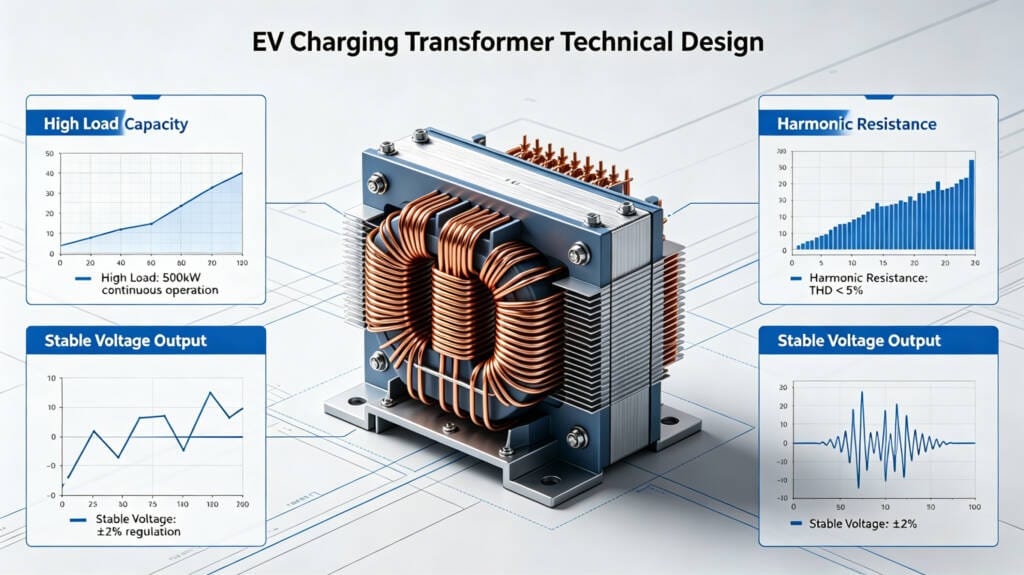
3.Harmonic Resistance
One of the most critical technical challenges in EV charging systems is harmonic distortion. EV chargers rely on power electronic converters, which generate nonlinear currents and introduce harmonics into the electrical system.
If not properly addressed, harmonics can cause:
- Additional heating in transformer windings
- Increased losses
- Reduced insulation life
- Interference with other electrical equipment
A high-quality EV charging transformer must therefore be specifically designed to handle harmonic-rich environments. This may include:
- K-factor rated transformer design
- Enhanced insulation systems
- Special winding configurations to reduce eddy current losses
By improving harmonic resistance, these transformers ensure stable operation and long-term reliability in demanding EV charging applications.
4.Overload Capability
EV charging demand is inherently unpredictable. Peak usage periods—such as evenings or holiday travel seasons—can result in temporary overload conditions.
An advanced EV charging station transformer must be capable of handling short-term overloads without compromising safety or performance. This requires:
- Thermal design that allows for controlled temperature rise
- Insulation systems rated for higher thermal stress
- Accurate load forecasting and protection coordination
In practice, engineers often design systems with a certain overload tolerance to accommodate real-world usage patterns, ensuring that the EV charging transformer remains reliable even during peak demand events.
5.Energy Efficiency
Efficiency is a critical factor in large-scale EV charging infrastructure, where even small energy losses can translate into significant operational costs over time.
A high-efficiency EV charging transformer minimizes both no-load and load losses, improving overall system performance and reducing electricity costs. This is particularly important for commercial operators managing multiple charging stations.
Key design considerations include:
- Low-loss core materials (such as amorphous or high-grade silicon steel)
- Optimized winding design to reduce resistance losses
- Advanced manufacturing processes to improve efficiency
In addition to cost savings, higher efficiency also contributes to reduced carbon emissions, aligning EV charging infrastructure with broader sustainability goals.
Table: Key Technical Requirements for EV Charging Transformers
| Technical Requirement | Why It Matters | Engineering Solution | Impact on Performance |
|---|---|---|---|
| High Load Capacity | Continuous high-power charging demand | Oversized conductor design and efficient cooling | Prevents overheating and extends lifespan |
| Voltage Stability | Sensitive EV charging equipment | Low impedance design and tap changers | Ensures stable charging and protects equipment |
| Harmonic Resistance | Nonlinear loads from EV chargers | K-factor design and optimized windings | Reduces losses and improves reliability |
| Overload Capability | Peak demand fluctuations | Thermal margin and advanced insulation | Handles short-term overload safely |
| Energy Efficiency | High operational cost in large stations | Low-loss core materials and optimized design | Reduces energy consumption and operating cost |
These technical specifications highlight why a properly designed EV charging transformer is essential for reliable and efficient EV charging infrastructure.
EV charging transformers must comply with IEC transformer standards to ensure safety and performance in high-load environments.
Need help selecting the right EV charging transformer for your project
5. How to Size an EV Charging Transformer
Proper sizing of an EV charging transformer is essential to ensure reliable operation, avoid unnecessary capital costs, and support future scalability. An undersized transformer may lead to overheating, voltage drops, and reduced equipment lifespan, while an oversized transformer increases upfront investment and energy losses.
In real-world EV charging projects, transformer sizing is not just a simple calculation—it requires consideration of load behavior, diversity, and long-term expansion.
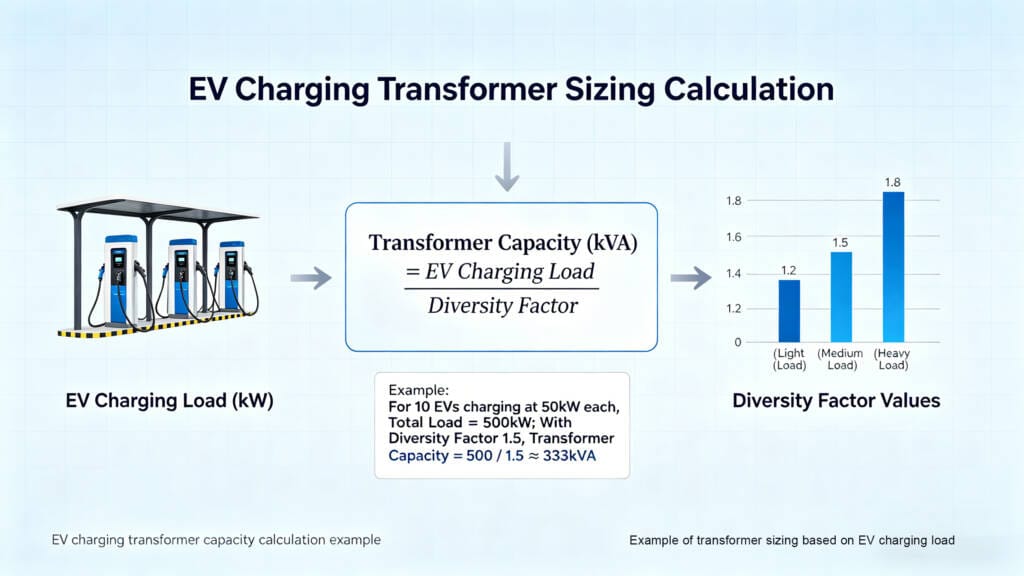
Step 1 – Calculate Total Charging Load
The first step is to determine the total installed charging power.
Total Load = Number of Chargers × Power per Charger
Example:
10 chargers × 120 kW = 1200 kW
This value represents the theoretical maximum load if all chargers operate at full capacity simultaneously. However, in most practical scenarios, this rarely happens.
When designing an electric vehicle charging station transformer, engineers must distinguish between installed capacity et actual operating load.
Step 2 – Apply Diversity Factor
EV charging demand is highly variable and depends on user behavior, time of day, and station utilization. To reflect real operating conditions, a diversity factor is applied.
Adjusted Load = Total Load × Diversity Factor
Typical diversity factor range: 0.6 – 0.8
Example:
1200 kW × 0.7 = 840 kW
This adjusted load provides a more realistic estimate of the actual demand on the EV charging transformer.
Engineering Insight
Highway fast charging → highly variable, often conservative design required
Urban public charging stations → lower diversity (0.6–0.7)
Fleet or depot charging → higher simultaneity (0.7–0.8)
Step 3 – Add Future Expansion Margin
EV infrastructure is rapidly evolving, and charging demand is expected to grow over time. To avoid costly upgrades, it is recommended to include a capacity margin.
Recommended margin: 20% – 30%
Example:
840 kW × 1.25 ≈ 1050 kVA
Final selection: 1000–1100 kVA EV charging transformer
Adding this margin ensures that the EV power distribution transformer can accommodate future charger additions or increased utilization rates without requiring immediate replacement.
Table: Typical Transformer Sizing for EV Charging
| Number of Chargers | Charger Power | Suggested Transformer Capacity |
|---|---|---|
| 4 | 60 kW | 250–315 kVA |
| 8 | 120 kW | 800–1000 kVA |
| 12 | 150 kW | 1500–2000 kVA |
| 20+ | 350 kW | 3000 kVA+ |
If you are planning a commercial or fast-charging project, working with an experienced supplier can help optimize transformer sizing based on real project data rather than assumptions.
👉 This ensures that your EV charging transformer solution is both cost-effective and future-ready.
6. Oil Immersed vs Dry Type Transformer for EV Charging
Choosing between oil immersed and dry type transformers depends on installation conditions and safety requirements.
Table: Oil vs Dry Transformer Comparison
| Fonctionnalité | Transformateur immergé d'huile | Transformateur de type sec |
|---|---|---|
| Refroidissement | Oil | Air |
| Fire Risk | Higher | Lower |
| Entretien | Modéré | Low |
| Efficacité | Higher | Slightly lower |
| Installation | Outdoor | Indoor |
Key Insight
- Oil transformers are ideal for large outdoor EV charging stations
- Dry transformers are preferred for indoor or urban environments
Fast charging demands reliable power.
👉Let us design the right transformer solution for your project.
7. Challenges in EV Charging Transformer Applications
While EV infrastructure is expanding rapidly, it also introduces a new set of technical challenges for power distribution systems. Compared with conventional applications, EV charging places higher demands on transformer design, operation, and reliability.
A well-designed EV charging transformer must address issues related to harmonics, thermal stress, environmental conditions, and highly dynamic load behavior. Failure to properly manage these challenges can result in reduced efficiency, equipment failure, and increased maintenance costs.
1.Harmonics and Power Quality
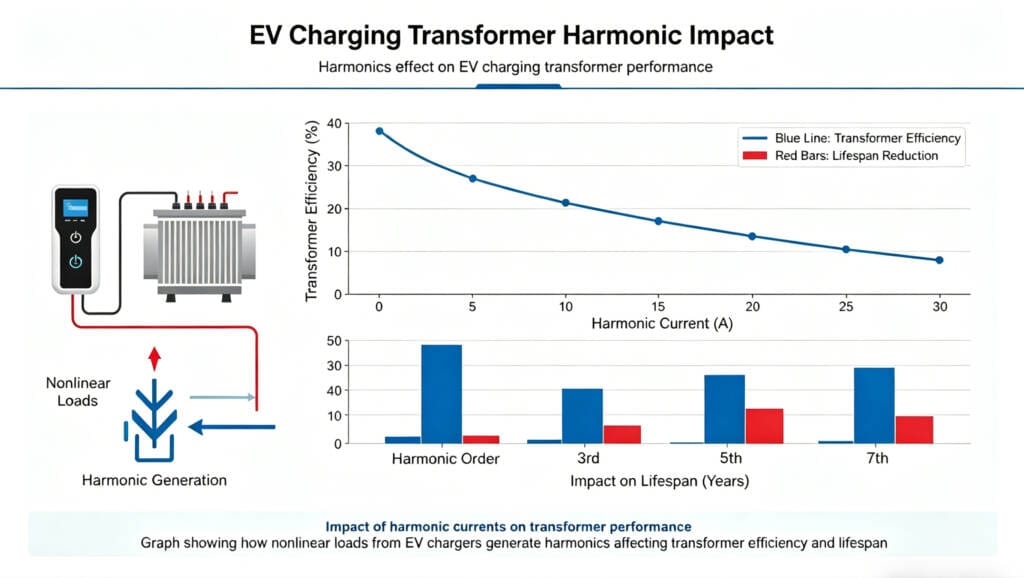
EV chargers rely on power electronic converters, which generate nonlinear currents and introduce harmonic distortion into the electrical system. These harmonics can significantly impact the performance of an electric vehicle charging station transformer.
Key Impacts:
- Increased eddy current losses in windings
- Excessive heating and insulation stress
- Reduced transformer lifespan
- Interference with nearby electrical equipment
Engineering Solutions:
To mitigate these effects, modern EV charger transformers are designed with:
- K-factor rating (e.g., K-13, K-20)
- Optimized winding configurations
- Improved core materials to reduce losses
In harmonic-rich environments, selecting a properly rated EV power distribution transformer is critical to maintaining system stability and efficiency.
2.Thermal Management
Continuous high load operation requires efficieThermal performance is one of the most critical factors affecting transformer reliability. EV charging stations often operate at high load levels for extended periods, generating significant heat.
If heat is not effectively dissipated, it can accelerate insulation aging and lead to premature failure of the EV charging transformer.
Key Challenges:
- Continuous high-load operation
- Limited cooling in compact installations
- Elevated ambient temperatures
Engineering Solutions:
- Oil immersed cooling systems for high-capacity outdoor applications
- Forced air cooling (AF/AN) for dry type transformers
- Advanced thermal design to ensure uniform heat distribution
A well-designed transformer for EV infrastructure must maintain acceptable temperature rise even under peak load conditions.
3.Environmental Conditions
EV charging stations are often installed in challenging environments, including outdoor urban areas, highways, and industrial zones. These conditions can directly affect transformer performance and durability.
Common Environmental Factors:
- High ambient temperature
- Dust and sand (especially in desert regions)
- Humidity and corrosion
- Rain and water exposure
Engineering Solutions:
To ensure long-term reliability, EV charging station transformers are typically designed with:
- Sealed tank construction (for oil transformers)
- High IP protection levels
- Anti-corrosion coatings
- Temperature-resistant insulation materials
These features enable the EV charging transformer solution to operate reliably in diverse environmental conditions.
4.Rapid Load Fluctuations
Unlike traditional power loads, EV charging demand can change rapidly and unpredictably. Multiple vehicles may start or stop charging within seconds, causing sharp load variations.
Key Challenges:
- Sudden load spikes during peak hours
- Frequent load cycling
- Voltage instability risks
Engineering Solutions:
A high-performance EV charging transformer must be capable of:
- Fast response to load changes
- Maintaining voltage stability under dynamic conditions
- Withstanding repeated thermal cycling
Engineers often incorporate conservative design margins and advanced protection systems to ensure stable operation under fluctuating loads.
Table: Key Challenges and Solutions for EV Charging Transformers
| Challenge | Impact on Transformer | Recommended Solution | Benefit |
|---|---|---|---|
| Harmonics | Overheating and losses | K-factor design and optimized windings | Improved reliability |
| Thermal Stress | Vieillissement de l'isolation | Efficient cooling systems | Longer lifespan |
| Harsh Environment | Corrosion and failure | Sealed design and protective coatings | Enhanced durability |
| Load Fluctuation | Voltage instability | Low impedance and thermal margin | Stable performance |
8. Market Opportunities in EV Charging Infrastructure
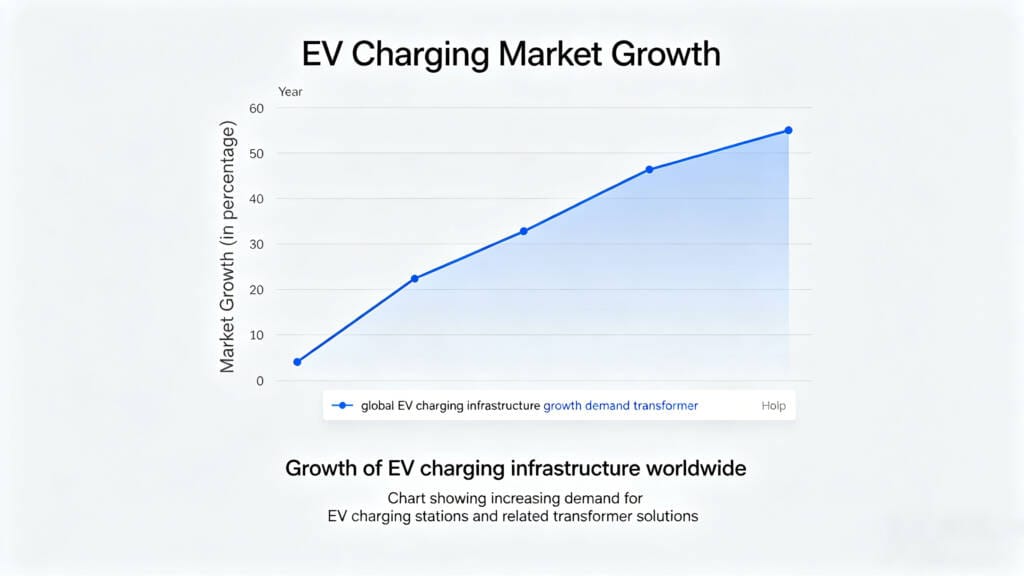
The EV charging market is expanding rapidly worldwide, creating significant demand for EV charging transformers.
Key Drivers
- Government incentives for EV adoption
- Expansion of public charging networks
- Growth of commercial fleet electrification
- Integration with renewable energy systems
Industry Trend
Large-scale charging hubs and ultra-fast charging stations are becoming standard, requiring high-capacity transformers and integrated power solutions.
For transformer manufacturers and suppliers, this represents a long-term growth opportunity with high-value projects and repeat business potential.
9. How to Choose the Right EV Charging Transformer Supplier
Selecting a reliable supplier is critical for the success of any EV infrastructure project. A high-quality EV charging transformer not only ensures stable operation but also reduces long-term maintenance costs and project risks.
However, with many manufacturers in the market, choosing the right EV charging transformer supplier requires a structured evaluation based on technical capability, project experience, and service reliability.
Key Criteria
1.Compliance with International Standards
A qualified supplier must ensure that their electric vehicle charging station transformers comply with recognized international standards such as IEC and ANSI. These standards define requirements for safety, efficiency, insulation performance, and testing procedures.
Working with a compliant transformer for EV infrastructure reduces risks related to certification, grid connection, and long-term operation.
2.Proven Experience in EV Charging Projects
Experience is a key indicator of reliability. Suppliers with a proven track record in EV charging applications better understand real-world challenges such as:
- Harmonic distortion from power electronics
- Rapid load fluctuations
- High utilization rates
An experienced EV charging transformer manufacturer can provide practical solutions based on past projects, rather than theoretical assumptions.
3.Customization Capability
Every EV charging project is different. Factors such as location, load profile, and installation environment require tailored solutions.
A professional EV charging transformer supplier should be able to customize:
- Transformer capacity and voltage levels
- Cooling methods (oil immersed or dry type)
- Enclosure design for specific environments
- Integration with compact substations
Customization ensures that the EV charging transformer solution fits the exact needs of the project, improving performance and cost efficiency.
4.Strong Engineering Support
Beyond manufacturing, engineering support plays a crucial role in project success. A reliable supplier should provide:
- Load calculation and transformer sizing assistance
- Technical drawings and documentation
- Installation and commissioning guidance
- After-sales technical support
This level of support ensures that the selected EV power distribution transformer operates efficiently throughout its lifecycle.
5.Reliable Delivery Timelines
In large-scale EV charging projects, delays in equipment delivery can impact the entire construction schedule.
A dependable EV charging transformer supplier must have:
- Stable production capacity
- Efficient supply chain management
- Proven on-time delivery record
Timely delivery is especially critical for EPC contractors managing multiple project phases.
10. Frequently Asked Questions
What size transformer is needed for an EV charging station
It depends on the number of chargers, power rating, and usage patterns. Typically ranges from 250 kVA to several MVA.
Can one transformer support multiple chargers
Yes, most EV charging stations use a single transformer to supply multiple chargers.
What voltage is required for EV charging
Medium voltage (e.g., 10kV–35kV) is stepped down to low voltage (400V–480V).
Is a dry transformer better for EV charging
Dry transformers are safer for indoor use, while oil transformers are more efficient for large outdoor installations.
11. Conclusion
Le EV charging transformer is a fundamental component in modern EV infrastructure, directly impacting system efficiency, reliability, and scalability.
As EV adoption continues to accelerate, the demand for high-performance transformers will grow significantly. Understanding transformer types, sizing methods, and technical requirements is essential for building efficient and future-ready charging stations.
For businesses entering this market, choosing the right transformer solution and supplier can make a critical difference in both project success and long-term operational performance.
Contact our engineering team for tailored EV charging transformer solutions and competitive pricing.