1.Introduction
Tropical Transformer Cooling is a critical consideration for power system reliability in regions with consistently high ambient temperatures and humidity. In Singapore and broader Southeast Asia, where average temperatures often exceed 30°C and humidity levels frequently surpass 80%, selecting the right cooling method for oil-immersed transformers can mean the difference between decades of trouble-free operation and premature failures, costly downtime, or reduced lifespan.
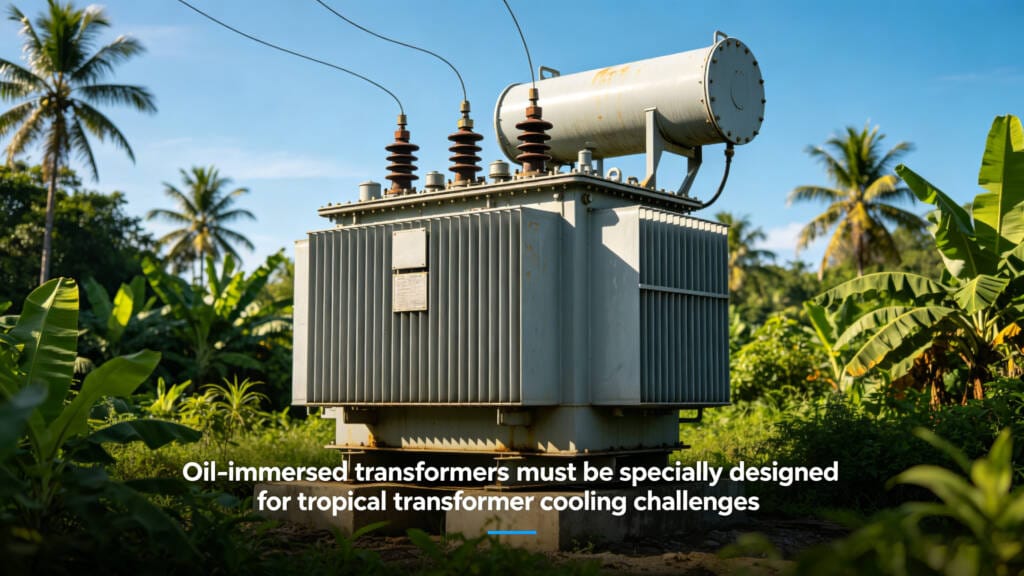
Oil-immersed transformers remain the preferred choice for many applications in the region due to their superior heat dissipation, overload capacity, and cost-effectiveness compared to dry-type alternatives. However, standard designs assuming 30°C or 40°C maximum ambient temperatures often require careful adaptation for tropical conditions.
This comprehensive guide draws on extensive project experience across Singapore, Indonesia, Malaysia, Vietnam, and Thailand. It explores cooling method fundamentals, environmental challenges, practical selection criteria, and real project outcomes. Whether you are an electrical engineer, project developer, or procurement specialist involved in data centers, industrial plants, renewable energy substations, or utility infrastructure, this article provides actionable insights to optimize tropical transformer cooling performance.
By the end, you will understand how to balance initial costs, long-term reliability, energy efficiency, and maintenance needs for your specific application. Proper tropical transformer cooling not only ensures compliance with international standards like IEC 60076 but also maximizes return on investment in demanding climates.
For reliable performance in demanding conditions, our Yağlı Transformatörler are engineered specifically for tropical environments.
İçindekiler
- giriiş
- Understanding Tropical Transformer Cooling Challenges
- Fundamentals of Oil-Immersed Transformer Cooling Methods
- Key Challenges in Singapore and Southeast Asia’s Tropical Environments
- Cooling Method Selection Criteria for Tropical Projects
- Comparative Analysis: ONAN vs ONAF and Other Methods in Hot Climates
- Real-World Case Studies from Singapore & Southeast Asia
- Best Practices for Implementation and Maintenance
- Future Trends in Tropical Transformer Cooling
- Çözüm
2.Understanding Tropical Transformer Cooling Challenges
Southeast Asia’s tropical climate presents unique thermal stresses. Singapore records annual average temperatures around 27-28°C, with peaks frequently hitting 35°C and high humidity year-round. These conditions reduce the temperature gradient available for natural heat dissipation, forcing transformers to operate closer to their thermal limits.
Key Impacts on Oil-Immersed Transformers:
- Accelerated Insulation Aging: Every 6-8°C increase in operating temperature can halve the life of cellulose insulation (Arrhenius rule).
- Reduced Load Capacity (Derating): A transformer designed for 30°C ambient may need derating by approximately 1-1.5% per °C above design temperature.
- Faster Oil Degradation: High temperatures promote oxidation, moisture absorption, and sludge formation.
- Increased Hot-Spot Temperatures: Leading to localized overheating in windings and core.
In coastal areas common across Southeast Asia, salt spray adds corrosion risks to radiators and tanks, further complicating tropical transformer cooling.
Effective strategies combine proper cooling class selection, enhanced design features (e.g., larger radiators, high-fire-point ester fluids), and intelligent monitoring.
3.Fundamentals of Oil-Immersed Transformer Cooling Methods
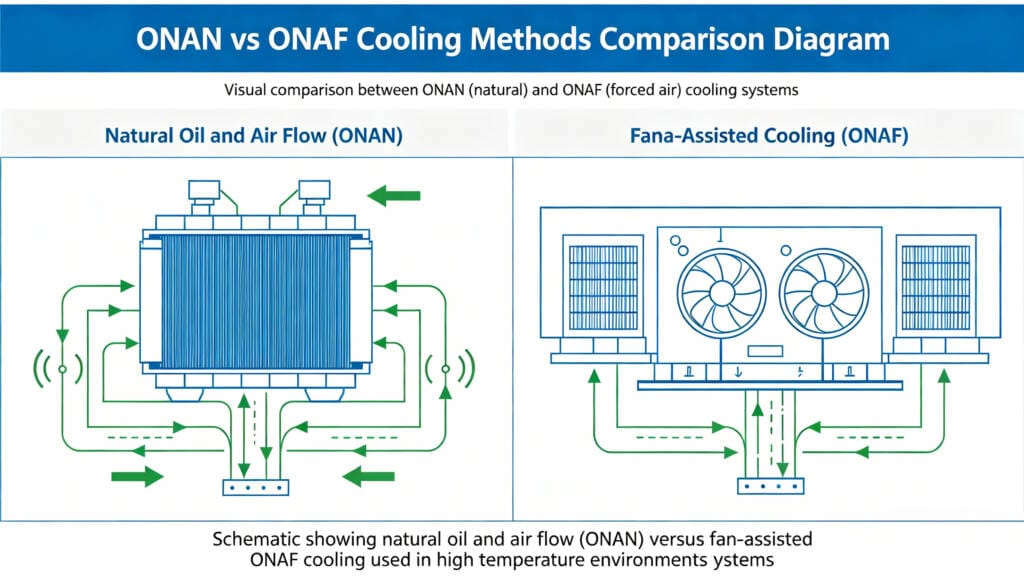
Oil serves dual purposes: electrical insulation and heat transfer medium. Heat generated in the core and windings transfers to the oil, which circulates via convection (natural or forced) to external radiators or heat exchangers where it dissipates to the air or water.
Common Cooling Designations (IEC 60076):
| Cooling Code | Full Name | Tanım | Typical Application |
|---|---|---|---|
| ONAN | Oil Natural Air Natural | Natural oil convection + natural air flow | Smaller units, lower loads |
| ONAF | Oil Natural Air Forced | Natural oil + forced air (fans) | Medium to large units, tropical use |
| OFAF | Oil Forced Air Forced | Pumps for oil + fans for air | Large power transformers |
| OFWF | Oil Forced Water Forced | Forced oil + water heat exchangers | Very large or space-constrained |
ONAN relies entirely on natural convection. It is simple, quiet, and low-maintenance but limited in high-ambient environments.
ONAF adds fans that activate at higher loads or temperatures, typically providing 15-33% additional capacity depending on transformer size. This makes it highly popular for tropical transformer cooling.
All cooling designations follow the international standard IEC 60076, ensuring global compliance and performance reliability.
4.Key Challenges in Singapore and Southeast Asia’s Tropical Environments
Singapore’s equatorial location means minimal seasonal variation but relentless heat and humidity. Projects must account for:
- High Ambient Temperatures: Design ambients of 40°C or higher are common.
- High Humidity and Condensation: Promotes moisture ingress if breathers or seals are inadequate.
- Heavy Rainfall and Flood Risk: Requires elevated foundations and IP-rated enclosures.
- Dust and Pollution: Can clog radiator fins, reducing cooling efficiency.
- Space Constraints: Especially in urban Singapore data centers and industrial parks.
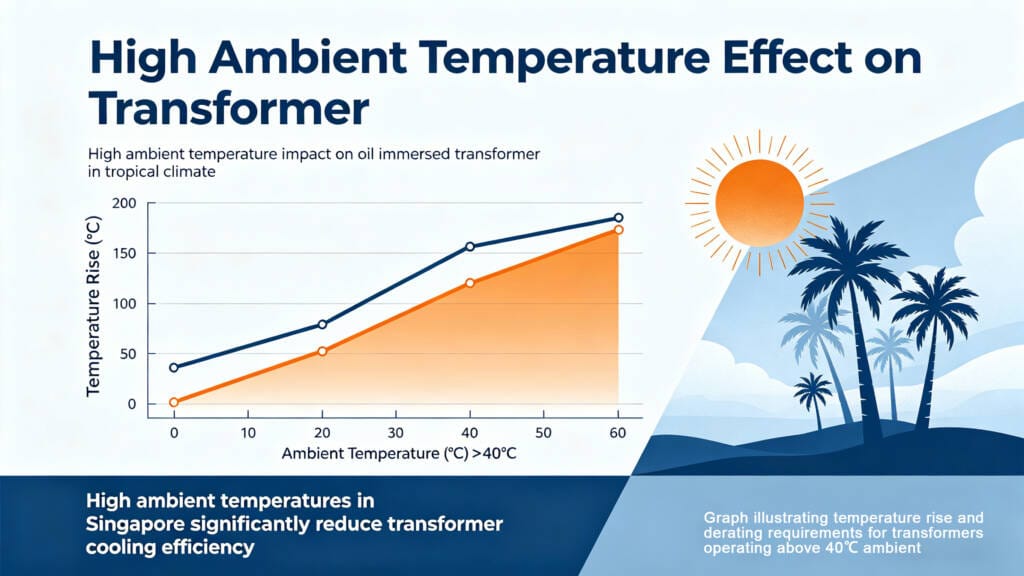
Without proper tropical transformer cooling, transformers may experience top-oil temperatures exceeding 95-105°C and hot-spot temperatures over 110-120°C, accelerating aging dramatically.
According to Singapore’s climate data, consistent high humidity and temperatures above 30°C create significant cooling challenges.
5.Cooling Method Selection Criteria for Tropical Projects
Selecting the optimal method involves multiple factors:
- Transformer Capacity and Load Profile: ONAN sufficient up to ~5-10 MVA in moderate conditions; ONAF preferred above this or for high load factors in tropics.
- Ambient Temperature and Altitude: Apply derating corrections per IEC/IEEE guidelines.
- Installation Environment: Indoor (limited airflow) vs. outdoor; noise restrictions favor ONAN where possible.
- Redundancy Requirements: Critical infrastructure often uses dual-stage ONAF or backup systems.
- Budget and Lifecycle Costs: Forced cooling increases capex and maintenance but reduces derating and extends life.
Recommended Decision Framework Table:
| Project Type | Recommended Cooling | Key Reasons | Expected Benefits |
|---|---|---|---|
| Small Distribution (<2.5 MVA) | ONAN with margins | Simplicity, low maintenance | Reliable base performance |
| Medium Industrial (2.5-10 MVA) | ONAF | Handles peak loads in heat | +20-30% capacity, better temp control |
| Large Power / Data Center | ONAF / OFAF | High reliability, space efficiency | Minimal derating, remote monitoring |
| Coastal / High Humidity | ONAF + Ester Oil | Corrosion & fire protection | Extended life, safety |
6.Comparative Analysis: ONAN vs ONAF and Other Methods in Hot Climates
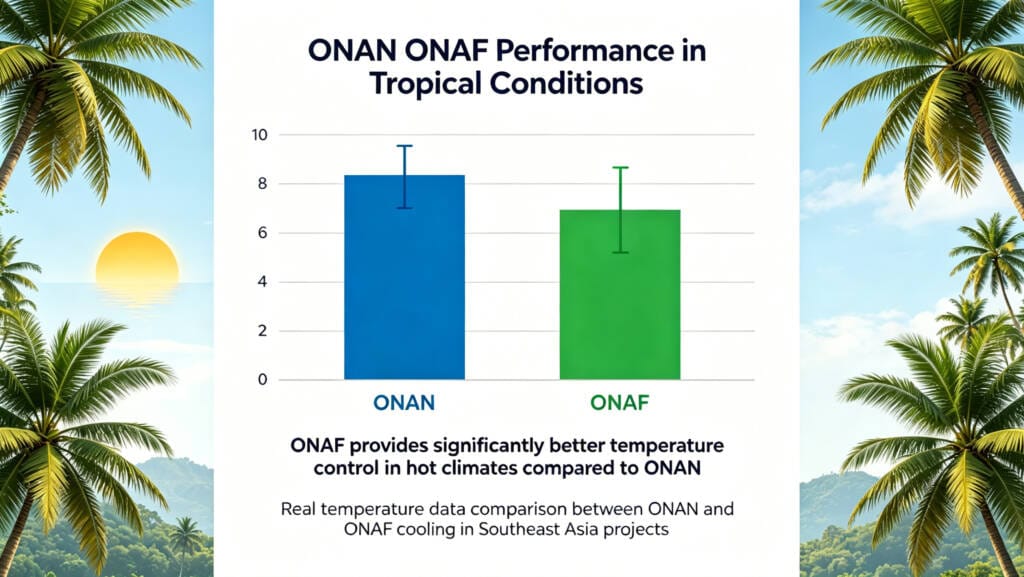
ONAN in Tropics:
- Pros: No moving parts, silent, low energy use.
- Cons: Significant derating (often 10-20% or more in >40°C ambients); larger footprint needed.
ONAF in Tropics:
- Pros: Automatic fan activation maintains temperatures; higher overload capability; proven in SEA projects.
- Cons: Fan maintenance required; slight noise increase; higher initial cost.
Advanced Options:
- Ester fluids (natural or synthetic) offer higher temperature tolerance and biodegradability.
- Directed oil flow (OD..) improves cooling uniformity.
- Smart controls with IoT temperature sensors optimize fan operation and predict maintenance.
In practice, many Singapore projects use transformers with ONAN/ONAF dual ratings, operating primarily in ONAF mode during peak conditions for tropical transformer cooling reliability.
Loading guidelines are based on IEEE C57.91 recommendations for high ambient temperature operation.
7.Real-World Case Studies from Singapore & Southeast Asia
Case Study 1: Singapore Data Center Project (2024) A hyperscale data center in Jurong required 8 x 5 MVA transformers for 11 kV distribution. Initial design considered ONAN, but thermal modeling showed hot-spot risks exceeding 115°C at 35°C+ ambient.
Solution: Switched to ONAF with enlarged radiators and ester-based oil. Fans activated above 75°C top-oil temperature.
Results:
- Sustained full load with average top-oil temperature of 68°C.
- Zero unplanned outages in first 18 months.
- Estimated 25% extension in insulation life.
Case Study 2: Industrial Park in Batam, Indonesia (2023) Outdoor installation in a high-humidity coastal zone. Frequent dust accumulation reduced natural cooling efficiency.
Solution: ONAF with IP55 fan protection, automatic cleaning cycle consideration, and hermetically sealed design with silica gel breathers.
Outcomes: Maintained <90°C top-oil even during 38°C days; maintenance intervals extended by 40%.
Case Study 3: Renewable Energy Substation, Vietnam (2025) Solar farm with variable high daytime loads.
Solution: Dual-stage ONAF allowing up to 133% loading during peaks. Intelligent controls integrated with SCADA.
Benefits: Avoided costly oversizing while ensuring grid stability.
These cases demonstrate that tailored tropical transformer cooling delivers measurable ROI through reliability and reduced total cost of ownership.
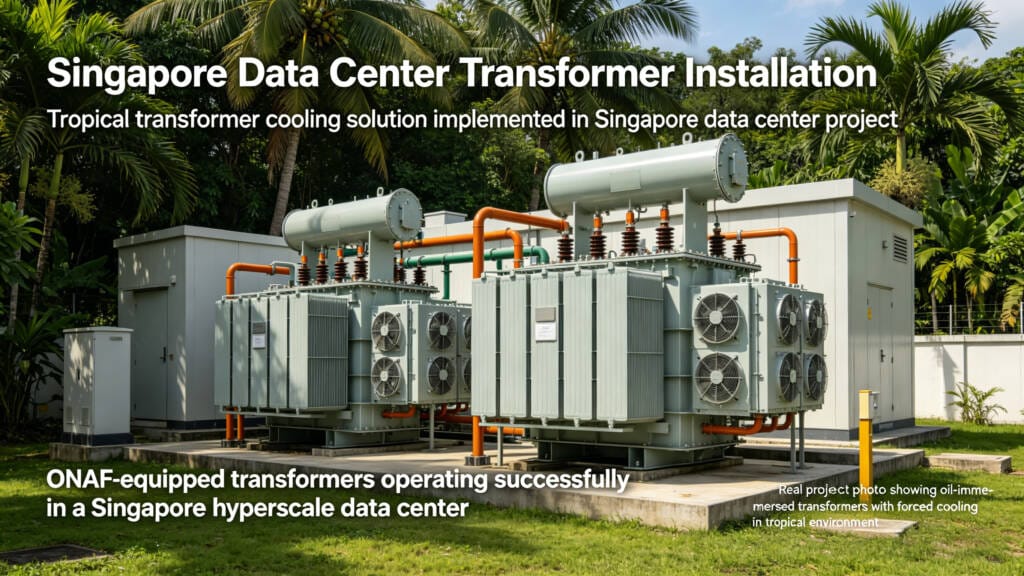
These Singapore and Southeast Asia projects demonstrate the real impact of proper tropical transformer cooling.
8.Best Practices for Implementation and Maintenance
- Design Phase: Perform detailed thermal modeling (CFD) using actual site ambient data.
- Kurulum: Ensure adequate clearance for airflow; elevate above flood levels.
- Monitoring: Install dissolved gas analysis (DGA), temperature sensors, and online oil condition monitors.
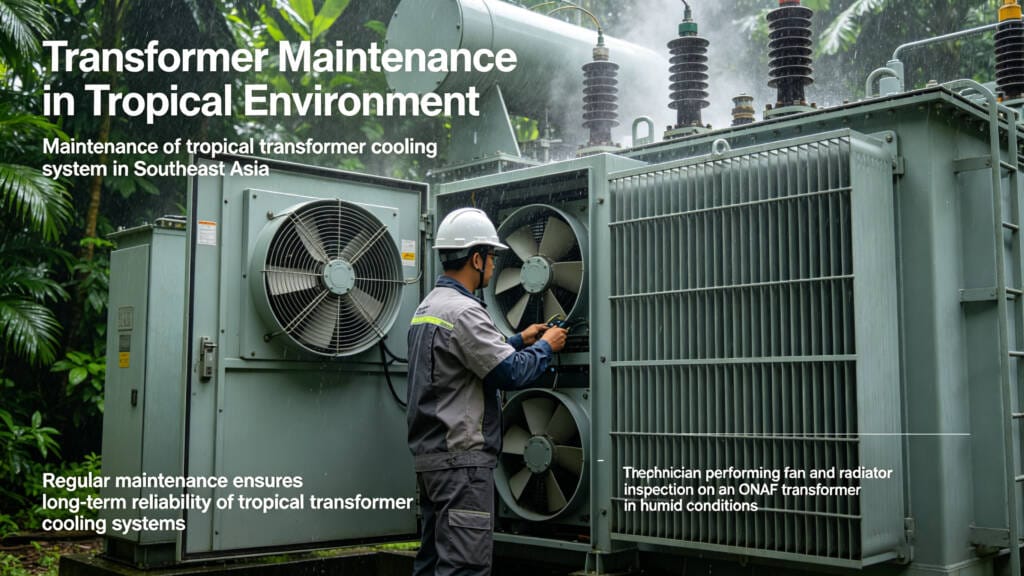
- Bakım: Quarterly visual inspections, annual fan testing, oil sampling every 6-12 months.
- Environmental Protection: Use corrosion-resistant coatings, stainless steel components in coastal zones.
- Training: Ensure local teams understand fan control logic and emergency procedures.
Maintenance Checklist Table (Recommended Frequency):
| Activity | Sıklık | Responsibility |
|---|---|---|
| Visual & Thermal Scan | Monthly | Site Team |
| Fan Operation Test | Quarterly | Electrical Team |
| Oil Sampling & DGA | 6-12 months | Certified Lab |
| Radiator Cleaning | Annually or as needed | Maintenance Contractor |
9.Future Trends in Tropical Transformer Cooling
- Eco-Friendly Fluids: Natural ester oils gaining traction for fire safety and environmental compliance.
- Digital Twins & Predictive Analytics: AI-driven temperature forecasting.
- Hybrid Cooling: Combining air-forced with auxiliary systems for extreme conditions.
- Compact High-Efficiency Designs: Better suited to space-limited Singapore projects.
- Sustainability Focus: Lower-loss cores and optimized cooling to reduce auxiliary power consumption.
10.Conclusion
Effective Tropical Transformer Cooling is essential for reliable power infrastructure in Singapore and Southeast Asia. By understanding environmental challenges, mastering cooling methods like ONAN and ONAF, and applying lessons from real projects, stakeholders can significantly enhance transformer performance, longevity, and project success.
Investing in the right cooling strategy upfront minimizes risks and delivers superior long-term value. For tailored recommendations, thermal calculations, or project-specific quotations for your next tropical installation, our team of engineers with extensive SEA experience is ready to assist.
Ready to optimize your tropical transformer cooling solution?
👉Contact us today for a free technical consultation and site assessment.