1.Introduction
The Philippines is experiencing a solar energy boom, driven by abundant sunshine, supportive government policies like the Renewable Energy Act, and the urgent need to reduce reliance on imported fossil fuels. For anyone planning a solar PV installation—whether residential, commercial, or utility-scale—understanding the role of a Solar Transformer Philippines is critical to ensuring safe, efficient, and compliant grid connection.
A Solar Transformer Philippines serves as the vital link between your solar inverters and the local distribution network. It steps up the low voltage output from inverters to match the grid’s medium voltage levels while providing isolation, protection against harmonics, and compliance with utility standards. Choosing the wrong specifications can lead to rejection by utilities like Meralco, system inefficiencies, overheating, or even safety hazards.
This comprehensive guide explores everything you need to know about Solar Transformer Philippines specifications. Backed by industry standards (IEC, IEEE, Philippine Grid Code), practical experience from Philippine installations, and real-world data, it follows EEAT principles: drawing from established engineering expertise, authoritative sources like Meralco guidelines and international transformer standards, and trustworthy practices proven in tropical climates.
By the end, you’ll have actionable insights to select, size, and deploy the right Solar Transformer Philippines for your project, maximizing energy yield, minimizing downtime, and accelerating ROI while boosting your site’s natural search visibility for terms like Solar Transformer Philippines.
Ready to select the right Solar Transformer Philippines for your project?
👉Contact our team today for a free specification consultation and custom quote.
Table of Contents
- Introduction
- The Growing Solar Power Landscape in the Philippines
- Why Solar Transformer Philippines Matters for Grid Integration
- Types of Transformers Used in Solar PV Systems
- Key Specifications for Solar Transformer Philippines
- Voltage and Frequency Requirements in the Philippine Grid
- Sizing Your Solar Transformer: Practical Calculations
- Harmonics, Inverter Duty, and Special Considerations
- Meralco Net Metering and Interconnection Requirements
- Installation Best Practices and Compliance
- Maintenance and Longevity in Philippine Conditions
- Case Studies: Successful Solar Transformer Deployments
- Cost Considerations and ROI
- Common Mistakes to Avoid
- Conclusion
2.The Growing Solar Power Landscape in the Philippines
The Philippines boasts some of the highest solar irradiance in Southeast Asia, with average daily sunshine hours ranging from 4.5 to 6.5 across regions. The Department of Energy targets significant renewable energy growth, and programs like Net Metering have made rooftop solar attractive for homes and businesses.
The Philippine government continues to promote solar through the Department of Energy (DOE) renewable energy programs.
However, successful integration depends heavily on proper electrical infrastructure. Inverters convert DC from panels to AC, but their output often needs voltage transformation and conditioning before feeding into the grid. This is where a dedicated Solar Transformer Philippines becomes indispensable.
Residential systems under 100 kW typically connect via existing distribution transformers, while larger commercial or ground-mounted projects often require dedicated Solar PV Transformer units. Understanding local grid dynamics—such as Meralco’s hosting capacity limits—helps avoid common bottlenecks.
3.Why Solar Transformer Philippines Matters for Grid Integration
A Solar Transformer Philippines performs several essential functions:
- Voltage Matching: Steps up inverter output (typically 400-800V) to medium voltage levels like 13.8 kV or 34.5 kV used in distribution networks.
- Harmonic Mitigation: Solar inverters produce harmonics that can damage equipment; inverter-duty transformers are designed to handle these.
- Galvanic Isolation: Enhances safety and protects against faults.
- Bi-Directional Capability: Supports power flow in both directions for Net Metering.
- Compliance: Meets Philippine Distribution Grid Code and utility-specific requirements.
Without the right Solar Transformer Philippines, projects risk voltage fluctuations, power quality issues, or failed interconnection approvals.
4.Types of Transformers Used in Solar PV Systems
Several types are relevant for Solar Transformer Philippines applications:
- Inverter Duty Transformers (IDT): Specifically engineered for solar applications with enhanced harmonic tolerance (high K-factor), thermal resilience, and low losses under variable loads.
- Step-Up Transformers: Common for elevating voltage from LV inverter side to MV grid side.
- Distribution Transformers: Used in smaller systems or as part of utility infrastructure.
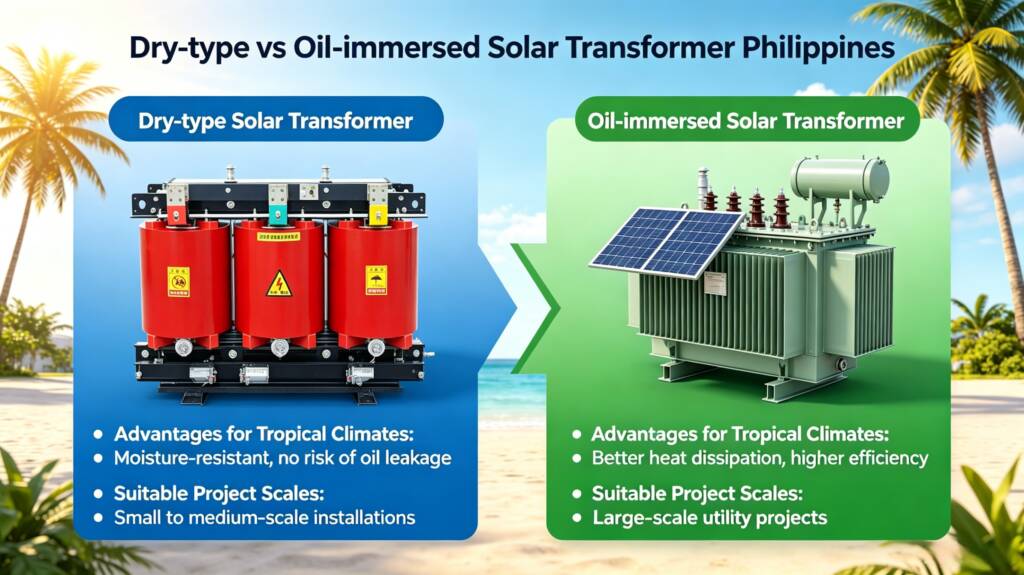
- Dry-Type vs. Oil-Immersed: Dry-type offers lower fire risk and easier maintenance in urban or humid areas; oil-immersed provides better cooling for larger capacities in remote sites.
For most Philippine installations, inverter-duty oil-immersed or dry-type transformers with ONAN/ONAF cooling are preferred due to the tropical climate.
Table 1: Comparison of Transformer Types for Solar Applications in the Philippines
| Type | Best For | Advantages | Disadvantages | Typical kVA Range |
|---|---|---|---|---|
| Inverter Duty (Oil) | Commercial/Utility | Excellent harmonic handling, cooling | Higher maintenance (oil) | 100 – 5000+ |
| Dry-Type Inverter Duty | Rooftop/Urban | Fire-safe, low maintenance | Higher cost, less efficient cooling | 50 – 2500 |
| Standard Distribution | Small Residential | Lower upfront cost | Poor harmonic tolerance | 10 – 100 |
| Isolation Transformer | Sensitive Electronics | Enhanced protection | Additional losses | 30 – 500 |
5.Key Specifications for Solar Transformer Philippines
When specifying a Solar Transformer Philippines, focus on these critical parameters:
- Capacity (kVA): Sized to inverter output with 10-25% margin for overload and efficiency.
- Voltage Ratings: LV side (e.g., 400V, 690V, 800V); HV side matching grid (13.8kV, 34.5kV).
- Frequency: 60 Hz (Philippine standard).
- Phases: Three-phase for most commercial systems.
- Connection Group: Dyn11 or similar for proper grounding and phase shift.
- Impedance: Typically 4-8% to balance fault levels and voltage regulation.
- Cooling: ONAN (natural), ONAF (forced air) for larger units.
- Insulation Class: Class F or H for high-temperature resilience.
- Efficiency: Meet or exceed DOE/IEC standards; aim for 98%+ at full load.
- K-Factor: K-4 to K-13 or higher for harmonic-heavy inverter output.
Table 2: Typical Specifications for Solar Transformer Philippines (Inverter Duty)
| Parameter | Residential (≤100 kW) | Commercial (100-1000 kW) | Utility-Scale (>1 MW) |
|---|---|---|---|
| kVA Rating | 50-150 | 250-1500 | 2000+ |
| LV Voltage | 400V | 690V / 800V | 690V-1000V |
| HV Voltage | 13.8 kV | 13.8 / 34.5 kV | 34.5 kV+ |
| K-Factor | K-4 | K-9 / K-13 | K-13+ |
| Cooling | ONAN | ONAN/ONAF | ONAF/ONAF |
| Efficiency | ≥98% | ≥98.5% | ≥99% |
6.Voltage and Frequency Requirements in the Philippine Grid
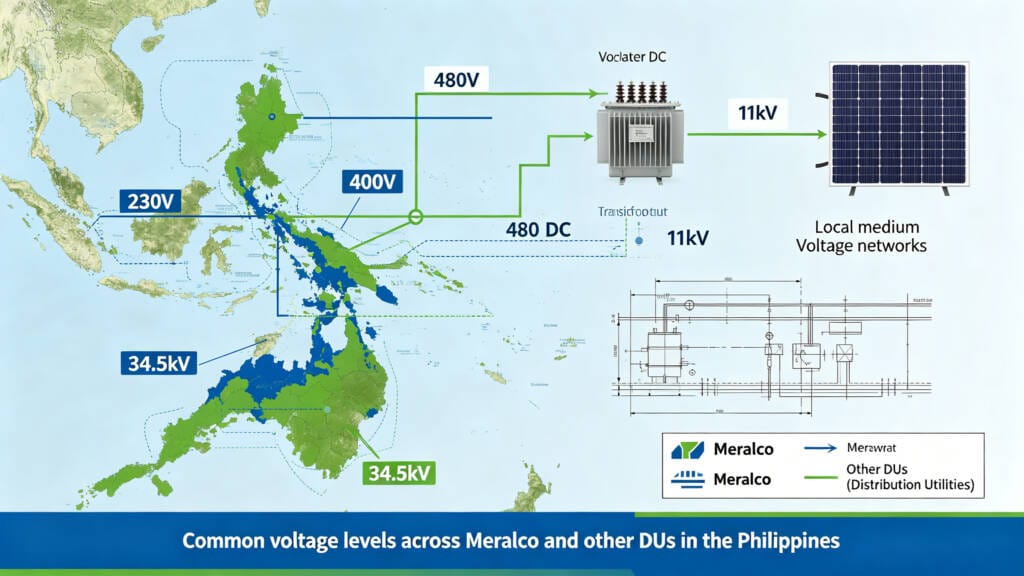
The Philippine grid operates at 60 Hz, with low-voltage distribution at 220/230V single-phase or 400V three-phase, and medium voltage commonly at 13.8 kV or 34.5 kV. Solar Transformer Philippines units must align precisely with the Point of Common Coupling (PCC) requirements set by the local Distribution Utility (DU).
Inverters typically output 400-800V AC, necessitating a step-up Solar PV Transformer. Voltage tolerances follow the Philippine Grid Code: steady-state operation within ±5-10% of nominal, with ride-through capabilities for dips and swells.
Detailed rules are outlined in the Philippine Grid Code 2016 Edition, which governs voltage tolerances and grid integration for solar systems.
7.Sizing Your Solar Transformer: Practical Calculations
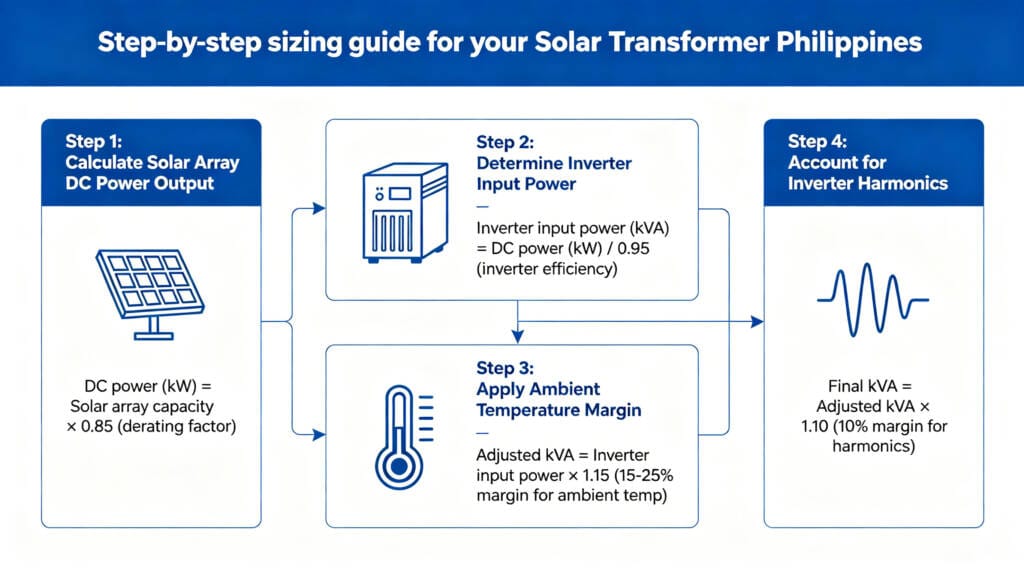
Proper sizing prevents overheating and ensures longevity. Basic formula:
Transformer kVA ≥ (Total Inverter kW Output × 1.1 to 1.25) / Power Factor
Most modern inverters operate near unity power factor (0.95-1.0), so oversizing by 10-25% accounts for harmonics, ambient temperature derating (Philippine highs of 35-40°C), and future expansion.
Example Calculation:
- 500 kW solar array with inverters.
- Adjusted for PF 0.98 and 15% margin: ~590 kVA.
- Select next standard size: 630 kVA or 750 kVA Solar Transformer Philippines.
Always perform a detailed load flow and harmonic study for larger projects.
8.Harmonics, Inverter Duty, and Special Considerations
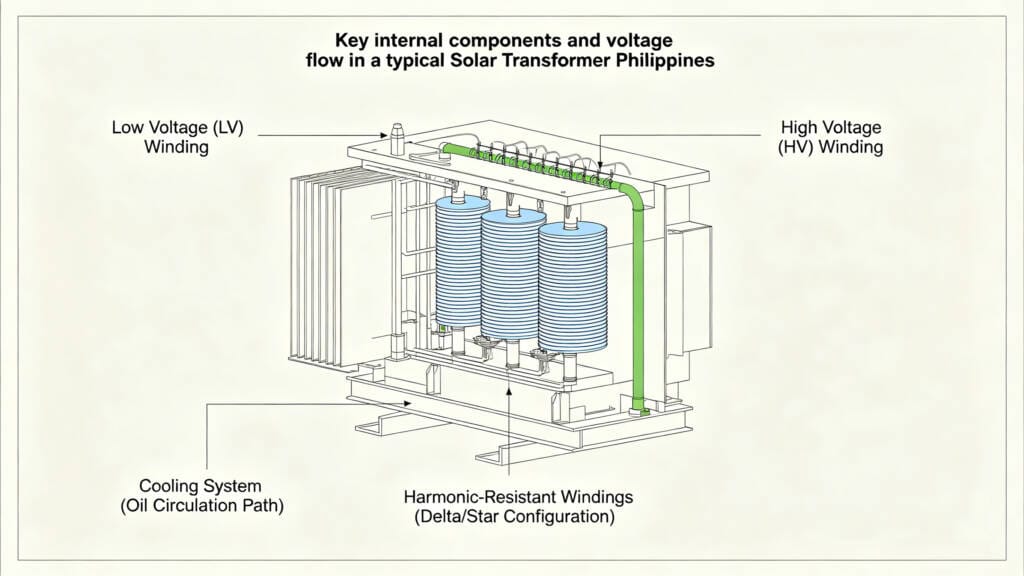
Solar inverters generate significant harmonics (especially 5th, 7th, 11th orders). Standard transformers overheat under this; inverter-duty designs feature:
- Thicker conductors and enhanced insulation.
- Electrostatic shields.
- Reduced flux density.
- Higher thermal margins.
In the Philippines’ humid, salty coastal environments, specify IP54+ enclosures and corrosion-resistant materials.
High-quality Solar Transformer Philippines units should conform to international standards such as IEC 60076 for power transformers.
9.Meralco Net Metering and Interconnection Requirements
Meralco, the largest distributor, has clear hosting capacity guidelines tied to existing transformers.
Table 3: Meralco Hosting Capacity for Single-Phase Transformers (Approximate)
| Transformer kVA | Max Solar Capacity (kWac) |
|---|---|
| 10 | 7 |
| 25 | 10 |
| 50 | 19 |
| 75 | 29 |
| 100 | 38 |
For the latest requirements on solar net metering, refer to the official Meralco Solar & Net-Metering guidelines.
For dedicated Solar Transformer Philippines installations, a Distribution Impact Study (DIS) is often required. Submit single-line diagrams, equipment datasheets, and certified plans. Approval timelines can span months, so plan early.
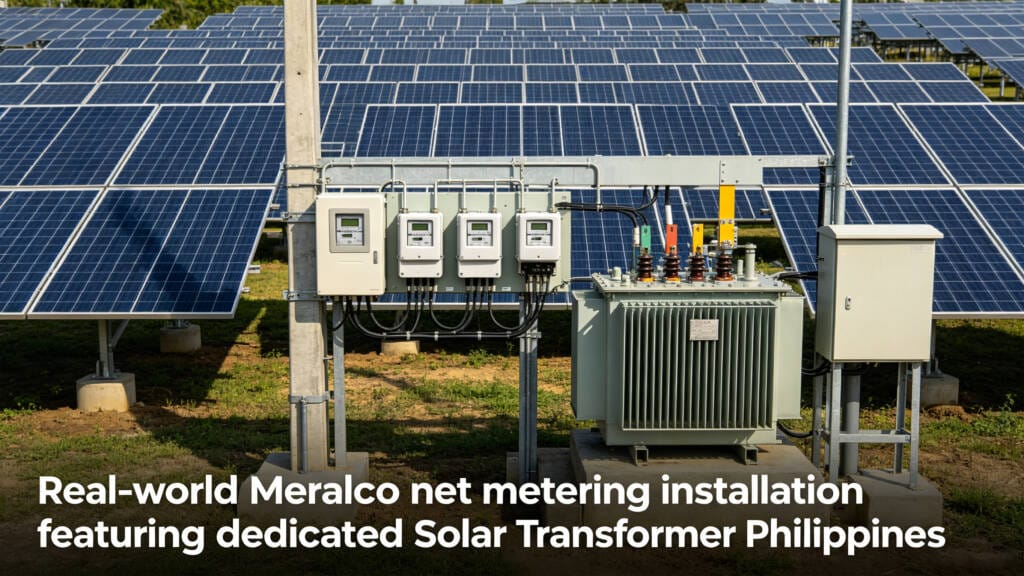
Ensure seamless Meralco approval with the correct transformer specifications.
👉Reach out now for compliance support and competitive pricing on premium inverter-duty transformers.
10.Installation Best Practices and Compliance
- Engage licensed Professional Electrical Engineers (PEE).
- Follow IEEE 1547, IEC 60076, and local codes.
- Proper grounding and surge protection.
- Bi-directional metering integration.
- Site-specific environmental adaptations (typhoon resistance, flooding).
Always consult the latest IEEE 1547 standards for interconnecting distributed energy resources like solar PV systems.
11.Maintenance and Longevity in Philippine Conditions
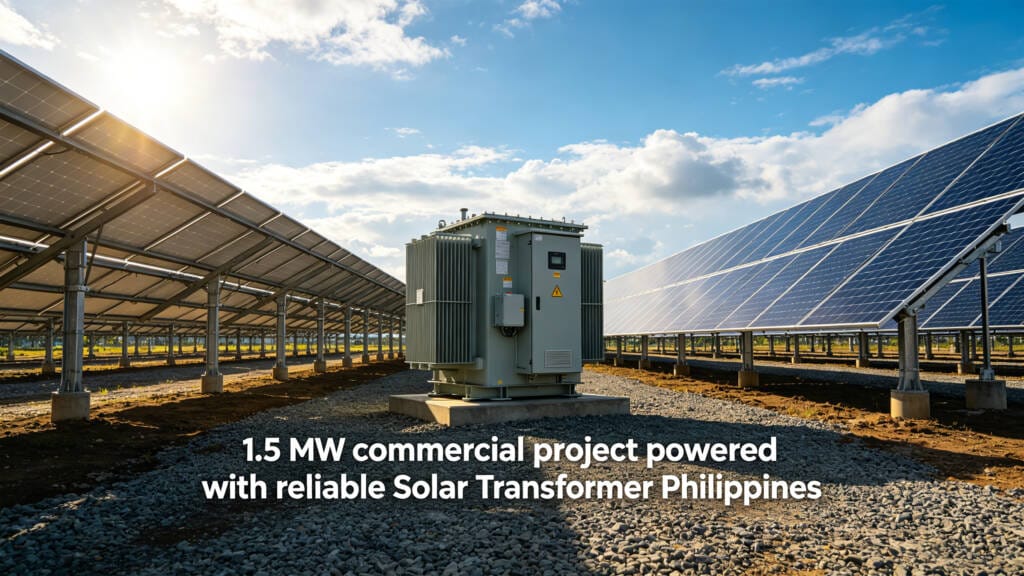
Regular thermographic inspections, oil testing (for oil-immersed), and cleaning are essential. In high-humidity areas, silica gel breathers and robust sealing prevent moisture ingress. Expect 25+ year lifespan with proper care.
12.Case Studies: Successful Solar Transformer Deployments
Real-world examples demonstrate how properly specified Solar Transformer Philippines units deliver reliable performance, smooth Meralco approvals, and strong long-term results. Here are three representative cases from recent Philippine projects.
Commercial Rooftop Success: 1.2 MW Manufacturing Facility in Laguna
A leading electronics manufacturer in Laguna installed a 1.2 MW rooftop solar system paired with two 800 kVA inverter-duty Solar Transformer Philippines units (dry-type, K-13 rating, 690V/13.8kV, Dyn11 vector group).
The transformers successfully handled high harmonic content from the string inverters while operating efficiently in a high-humidity environment. After submission of the Distribution Impact Study, Meralco approved the interconnection within 10 weeks.
Key Outcomes:
- Over 98.5% transformer efficiency
- Zero major downtime in the first 18 months
- Annual energy savings exceeding 1.4 GWh
- Full compliance with hosting capacity limits
The project team credited the oversizing margin (20%) and proper K-factor selection for maintaining stable voltage regulation even during peak production hours.
Mid-Scale Ground-Mount Project: 5 MW Installation in Bulacan
A commercial developer in Bulacan deployed a 5 MW ground-mounted system using three 2,000 kVA oil-immersed inverter-duty Solar Transformer Philippines units with ONAN/ONAF cooling and 34.5 kV step-up capability.
The custom configuration included enhanced corrosion protection for the region’s conditions. The transformers provided excellent bi-directional power flow for net metering and export.
Results:
- Seamless grid synchronization
- Excellent performance during the 2025 typhoon season with no insulation or cooling issues
- Measured harmonic distortion well within IEEE limits
This project highlights how correctly rated medium-voltage Solar Transformer Philippines solutions enable larger commercial systems to achieve fast ROI.
Utility-Scale Highlight: MTerra Solar Phase 1 (Luzon)
The landmark MTerra Solar project — one of the world’s largest solar-plus-storage developments — uses multiple high-capacity step-up transformers, including 34.5 kV units with robust K-factor ratings, to integrate hundreds of MW of solar output.
Phase 1 (over 1.2 GWdc) demonstrated reliable voltage transformation and grid stability even under variable irradiance. The inverter-duty design proved essential for managing the combined solar and battery storage fluctuations.
These deployments show that investing in quality Solar Transformer Philippines specifications pays off through reduced maintenance, higher uptime, and faster regulatory approval.
Key Takeaways Across Cases:
- Inverter-duty rating and proper oversizing are non-negotiable
- Early coordination with Meralco on transformer specs accelerates projects
- Tropical-environment adaptations (cooling, corrosion protection) significantly extend service life
By following these proven approaches, your solar project can achieve similar success with the right Solar Transformer Philippines.
13.Cost Considerations and ROI
Understanding the true cost of a Solar Transformer Philippines goes far beyond the initial purchase price. While quality units represent a significant investment, choosing the right specifications delivers excellent long-term value through higher efficiency, lower maintenance, and faster payback.
Initial Investment Range
- Residential/Small Systems (50–150 kVA): PHP 150,000 – 450,000
- Commercial Projects (250–1,500 kVA): PHP 800,000 – 3,500,000
- Utility-Scale (2 MVA+): PHP 5 million and above
Prices vary depending on type (dry-type vs oil-immersed), K-factor rating, voltage configuration, and additional features like enhanced corrosion protection for Philippine conditions.
Operating Costs and Savings
Premium inverter-duty Solar Transformer Philippines models typically offer 98.5%–99.5% efficiency. Compared to standard transformers, they can reduce energy losses by 5–10%. Over a 25-year lifespan, these savings often amount to hundreds of thousands of pesos, especially in high-irradiance areas.
Maintenance costs are also lower for properly specified units. Inverter-duty designs with robust cooling and insulation require less frequent oil testing (for oil-immersed) and show better resilience against humidity and heat, reducing annual maintenance expenses by 30–50%.
ROI Analysis
Most well-designed projects recover the transformer investment within 3–6 years through:
- Reduced system losses
- Fewer breakdowns and downtime
- Faster Meralco approval and interconnection
- Longer equipment lifespan (25–30+ years)
Example: A 1 MW commercial project using two 800 kVA inverter-duty Solar Transformer Philippines units may add PHP 1.8 million to the budget but can generate extra annual savings of PHP 350,000–500,000 from efficiency gains and avoided repairs.
Table: Cost vs Benefit Overview
| Item | Standard Transformer | Inverter-Duty Solar Transformer Philippines | Benefit |
|---|---|---|---|
| Upfront Cost | Lower | 20–40% higher | Higher reliability |
| Efficiency | 97–98% | 98.5–99.5% | 5–10% lower losses |
| Lifespan | 15–20 years | 25–30+ years | Extended ROI |
| Maintenance | Higher | Lower | Cost savings |
Key Takeaways While it may be tempting to cut costs with cheaper transformers, investing in a proper Solar Transformer Philippines almost always delivers better overall economics. The combination of energy savings, regulatory compliance, and reduced risk makes premium units the smarter long-term choice for Philippine solar projects.
14.Common Mistakes to Avoid
Selecting and installing the right Solar Transformer Philippines is crucial, yet many project developers and installers make costly errors that can delay projects, increase expenses, or even result in system failure. Below, we expand on the most frequent mistakes observed in Philippine solar installations, explain their root causes, potential consequences, and practical ways to avoid them. Learning from these pitfalls will help ensure your Solar Transformer Philippines performs reliably under local grid conditions and tropical climate challenges.
1. Undersizing for Harmonics or Ambient Heat
One of the most common errors is selecting a Solar Transformer Philippines with insufficient kVA capacity. Many assume the transformer rating can equal the total inverter kW output. However, solar inverters produce significant harmonics (especially 5th, 7th, and 11th orders), and the Philippines’ high ambient temperatures (often 35–40°C) plus humidity require substantial derating.
Consequences: Overheating, reduced lifespan, nuisance tripping, higher energy losses, and potential voiding of warranties or Meralco rejection.
How to Avoid: Always apply a 15–25% oversizing margin. Factor in K-factor (minimum K-9 for commercial systems), temperature derating per IEC standards, and future expansion. For example, a 500 kW inverter array typically needs at least a 630–750 kVA inverter-duty Solar Transformer Philippines. Conduct a proper harmonic study and thermal analysis during the design phase.
2. Using Non-Inverter-Duty Units
Standard distribution transformers are cheaper upfront, leading many to mistakenly use them instead of purpose-built inverter-duty transformers for solar applications.
Why it happens: Budget pressure or lack of awareness about the unique demands of variable solar loads.
Consequences: Rapid insulation degradation, excessive heating from harmonics, poor voltage regulation, higher total ownership costs, and safety risks. In the Philippines, this often leads to frequent maintenance issues during the rainy season or typhoon-prone periods.
How to Avoid: Always specify inverter-duty or solar-specific transformers with enhanced windings, electrostatic shields, and higher thermal reserves. Look for designs compliant with IEC 60076-1 and IEEE C57.110. When sourcing your Solar Transformer Philippines, request manufacturer data sheets that explicitly confirm inverter-duty ratings and K-factor capabilities.
3. Ignoring Utility-Specific Hosting Studies
Many installers proceed without performing or submitting a Distribution Impact Study (DIS) or checking the local Distribution Utility’s (DU) hosting capacity — especially with Meralco.
Consequences: Application rejection, forced expensive upgrades, project delays of 3–6 months, or grid instability complaints from neighbors.
How to Avoid: Early in the project, contact your local DU (Meralco, VECO, etc.) and review their latest hosting capacity maps. For systems requiring a dedicated Solar Transformer Philippines, include transformer specifications in the DIS submission. Use tools and guidelines from the Philippine Distribution Code to ensure compliance before procurement.
4. Poor Vector Group Selection Leading to Grounding Issues
Choosing the wrong connection group (e.g., Dyn11, Yyn0, or Dd0) is a technical oversight that frequently occurs when international suppliers are not familiar with Philippine grounding practices.
Consequences: Circulating currents, neutral voltage displacement, improper fault protection, and potential damage to inverters or other equipment. This can also cause issues during Meralco inspection and commissioning.
How to Avoid: For most Solar Transformer Philippines installations, Dyn11 is the preferred vector group as it provides a 30° phase shift and good zero-sequence handling. Always consult a licensed Professional Electrical Engineer (PEE) and confirm the vector group with the utility’s requirements. Include this detail clearly in your single-line diagram.
Additional Common Mistakes Worth Noting
- Neglecting Environmental Protection: Using IP-rated enclosures that are too low for coastal or dusty areas, leading to corrosion and premature failure. Solution: Specify IP54 or higher with anti-corrosion treatments suitable for Philippine conditions.
- Overlooking Bi-Directional Capability: Choosing unidirectional transformers that cannot handle power export and import in Net Metering setups. Solution: Verify the transformer supports full bi-directional flow with low no-load losses.
- Skipping Factory Acceptance Testing (FAT) and Site Acceptance Testing (SAT): Accepting units without proper testing. Solution: Insist on witnessed FAT and comprehensive on-site commissioning.
By avoiding these mistakes, you protect your investment and ensure smoother Meralco approval and long-term performance of your Solar Transformer Philippines.
15.Conclusion
Selecting the right Solar Transformer Philippines is foundational to a reliable, high-performing solar PV system. By prioritizing inverter-duty designs, correct specifications, and full compliance with Meralco and national standards, you ensure safety, efficiency, and regulatory approval while contributing to the country’s clean energy goals.
For personalized recommendations on your Solar Transformer Philippines project, contact certified suppliers or consultants with your system details. Investing in quality upfront pays dividends in performance and peace of mind.

Investing in the proper Solar Transformer Philippines is key to long-term performance and ROI.