1.Introduction
In the rapidly growing solar energy sector, PV inverter transformer matching is one of the most critical aspects of system design and long-term reliability. As photovoltaic (PV) installations scale from residential rooftops to utility-scale power plants, ensuring seamless compatibility between PV inverters and transformers has become essential for maximizing efficiency, minimizing downtime, and preventing costly failures.
Proper PV inverter transformer matching involves aligning voltage ratings, power capacities, impedance characteristics, harmonic handling capabilities, and grounding configurations. Mismatches can lead to overheating, reduced system efficiency, insulation breakdown, and even complete system shutdowns. This comprehensive guide explores everything you need to know about inverter transformer compatibility, with practical advice drawn from real-world engineering experience in solar projects worldwide.
Whether you are a solar installer, electrical engineer, project developer, or system owner, understanding PV inverter transformer matching will help you avoid common pitfalls and optimize your renewable energy investments. By the end of this article, you will have a clear, actionable framework for successful matching.
Table 1: Quick Benefits of Proper PV Inverter Transformer Matching
| Benefit | Impact |
|---|---|
| Improved Efficiency | Up to 2-5% higher system yield |
| Reduced Downtime | Fewer unexpected failures |
| Extended Equipment Life | 20-30% longer transformer lifespan |
| Lower Maintenance Costs | Significant savings over 25 years |
| Better Grid Compliance | Meets stringent harmonic standards |
This guide follows industry best practices and draws on expertise from solar power plant deployments. Let’s dive deep into the fundamentals of PV inverter transformer matching.
For more details on industry standards, refer to the IEEE 1547 guidelines for interconnecting distributed energy resources.
Whether you’re planning a new installation or optimizing an existing system, proper PV inverter transformer matching is key to success.
👉Contact our team today for a free compatibility assessment.
TOC
- Introduction
- Understanding PV Inverters and Transformers
- Why PV Inverter Transformer Matching Matters
- Key Parameters for PV Inverter Transformer Matching
- Common Compatibility Issues in PV Inverter Transformer Systems
- Step-by-Step Guide to Effective PV Inverter Transformer Matching
- Inverter Duty Transformers vs. Standard Transformers
- Best Practices and Real-World Case Studies
- Maintenance and Troubleshooting Tips
- Conclusion
2.Understanding PV Inverters and Transformers
What is a PV Inverter?
A PV inverter converts the direct current (DC) generated by solar panels into alternating current (AC) suitable for grid connection or local consumption. Modern PV inverters handle maximum power point tracking (MPPT), voltage regulation, and advanced grid support functions. They come in various types: string inverters, central inverters, and hybrid models.
The Role of Transformers in PV Systems
Transformers in PV systems step up or step down voltage levels, provide galvanic isolation, and help manage power flow to the grid. In many installations, especially medium and large-scale plants, a transformer is placed between the inverter output and the point of interconnection (POI).
PV inverter transformer matching ensures the inverter’s AC output characteristics align perfectly with the transformer’s input requirements. Without proper coordination, even high-quality components can underperform.
Key transformer types relevant to PV systems include:
- Isolation transformers
- Step-up transformers
- Inverter Duty Transformers (IDT)
3.Why PV Inverter Transformer Matching Matters
Poor inverter transformer compatibility is a leading cause of issues in solar projects. Inverters produce non-sinusoidal waveforms with significant harmonics, which standard distribution transformers are not designed to handle continuously. This leads to excessive heating, core losses, and premature aging.
Statistics and Real Impact:
- Harmonic distortion from inverters can increase transformer losses by 20-50% if not properly addressed.
- Voltage mismatches contribute to frequent tripping and reduced energy yield.
- In utility-scale plants, transformer failures due to incompatibility can cost hundreds of thousands in downtime and repairs.
Effective PV inverter transformer matching delivers higher return on investment (ROI) through better performance and reliability. It also ensures compliance with grid codes such as IEEE 1547, IEC standards, and local utility requirements.
According to industry reports, improper matching can significantly reduce system efficiency. Learn more about transformer losses in solar applications from this NREL technical report on PV system components.
4.Key Parameters for PV Inverter Transformer Matching
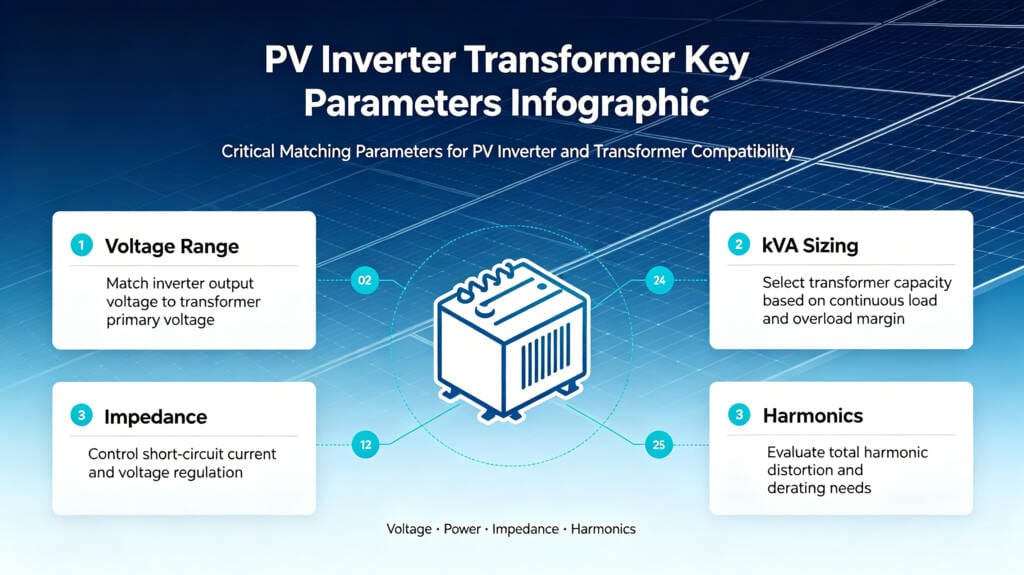
Successful PV inverter transformer matching revolves around several technical parameters. Here is a detailed breakdown:
1. Voltage Matching
Ensure the inverter’s AC output voltage range matches the transformer’s primary winding rating. Common configurations include 400V, 480V, 690V, or medium voltage (MV) step-up. Proper voltage matching is critical. For in-depth calculations on voltage drop, refer to this excellent ABB guide to transformer selection for renewable energy.
Considerations:
- Account for voltage drop over cables.
- Verify maximum and minimum operating voltages under varying loads.
2. Power Capacity and Sizing
Inverters are rated in kW (active power), while transformers use kVA (apparent power). A typical oversizing factor of 1.1 to 1.25 is recommended for PV inverter transformer matching.
Table 2: Recommended Sizing Guidelines for PV Inverter Transformer Matching
| Inverter Capacity (kW) | Recommended Transformer (kVA) | Oversizing Factor |
|---|---|---|
| Up to 100 | 110 – 125 | 1.1 – 1.25 |
| 100 – 500 | 550 – 625 | 1.1 – 1.25 |
| 500+ (Central) | Custom calculation required | Site-specific |
3. Impedance Matching
Transformer impedance affects short-circuit currents, voltage regulation, and parallel operation. Typical values range from 5-10% for PV applications. Mismatched impedance can cause circulating currents in paralleled systems.
4. Harmonic Handling
PV inverters generate harmonics (especially 5th, 7th, and higher orders). Inverter Duty Transformers feature enhanced winding designs, lower flux density, and better cooling to withstand K-factor loads (K-4, K-13, or higher).
5. Grounding and Isolation
Decide between grounded and floating configurations based on inverter topology (transformerless vs. transformer-based inverters). Proper grounding prevents PID (Potential Induced Degradation) and ensures safety.
6. Environmental and Cooling Factors
Consider ambient temperature, altitude, and enclosure ratings. Liquid-immersed or dry-type transformers have different thermal characteristics.
5.Common Compatibility Issues in PV Inverter Transformer Systems
Despite careful planning, inverter transformer compatibility issues frequently arise. Here are the most common problems and how to address them:
Overheating and Thermal Stress
Cause: High harmonic content and continuous full-load operation. Symptoms: Elevated oil/winding temperatures, reduced lifespan. Solution: Specify IDT with proper K-factor rating and adequate cooling.
Voltage and Frequency Mismatches
Cause: Incorrect turns ratio or poor regulation. Impact: Inverter shutdowns, nuisance tripping. Prevention: Detailed load flow studies during design phase.
Insulation Failure
Cause: Moisture ingress, overvoltage spikes, or aging accelerated by harmonics. Solution: Regular insulation resistance testing (Megger) and proper sealing.
Harmonic Resonance and Power Quality Issues
Cause: Interaction between inverter output filters and transformer inductance. Solution: Use harmonic filters or specially designed transformers.
Table 3: Common Issues and Mitigation Strategies
| Issue | Root Cause | Mitigation Strategy | Expected Outcome |
|---|---|---|---|
| Overheating | Harmonics + Undersizing | IDT with K-13 rating | Lower losses, longer life |
| Voltage Imbalance | Poor regulation | Tap-changing transformers | Stable operation |
| Circulating Currents | Impedance mismatch | Matched %Z in parallel setups | Efficient paralleling |
| Insulation Breakdown | Moisture / Transients | Regular testing + dry-type options | Improved reliability |
6.Step-by-Step Guide to Effective PV Inverter Transformer Matching
Follow this proven process for reliable PV inverter transformer matching:
Step 1: Gather Specifications
Collect detailed datasheets for all inverters, including AC output voltage, current, power factor range, harmonic distortion (THDi), and protection settings.
Step 2: Perform System Load Analysis
Calculate peak and average loads, future expansion plans, and site-specific conditions (temperature, altitude).
Step 3: Select Transformer Type
Choose Inverter Duty Transformers for most modern PV applications due to their superior harmonic tolerance.
Step 4: Verify Technical Compatibility
Use simulation software (ETAP, PSCAD, or manufacturer tools) to model the system and check for resonances or overloads.
Step 5: Review Standards and Certifications
Ensure compliance with UL 1561, IEC 60076, and relevant grid codes.
Step 6: Factory Acceptance Testing (FAT) and Site Commissioning
Perform thorough testing before and after installation, including no-load/loss measurements, heat runs, and harmonic analysis.
Step 7: Documentation and Handover
Maintain detailed records for future maintenance and warranty claims.
Ready to implement these PV inverter transformer matching strategies in your project?
7.Inverter Duty Transformers vs. Standard Transformers
Inverter Duty Transformers (IDT) are specifically engineered for PV applications, while standard distribution transformers often fall short.
Key Differences:
- Winding Design: IDTs use transposed conductors and robust insulation to handle harmonics.
- Core Flux Density: Lower in IDTs to reduce core losses.
- Cooling: Enhanced radiators or forced cooling options.
- K-Factor: Rated for non-linear loads.
Using a standard transformer with a PV inverter often voids warranties and leads to early failure. Investing in proper PV inverter transformer matching with IDTs pays off quickly through reduced operational expenses.
8.Best Practices and Real-World Case Studies
Case Study 1: Utility-Scale Plant in Sunny Region A 50 MW project initially used standard transformers, resulting in frequent overheating. After retrofitting with properly matched IDTs, efficiency improved by 3.2% and transformer temperatures dropped significantly.
Case Study 2: Commercial Rooftop System Mismatched voltage led to constant inverter derating. Correct inverter transformer compatibility adjustments restored full output.
Best Practices Summary:
- Always oversize transformers slightly.
- Incorporate monitoring systems for real-time temperature and vibration data.
- Work with experienced manufacturers who understand PV-specific requirements.
- Plan for future expansion in initial matching calculations.
9.Maintenance and Troubleshooting Tips
Ongoing maintenance is vital for sustained PV inverter transformer matching performance:
- Quarterly visual inspections and thermal imaging.
- Annual oil analysis (for oil-filled units) and insulation testing.
- Monitor harmonic levels at the inverter output.
- Keep detailed logs of loading patterns and any anomalies.
Troubleshooting Checklist:
- Check for alarm logs on inverters and transformers.
- Measure actual voltage and current values.
- Analyze power quality data.
- Consult manufacturer support with complete system documentation.
10.Conclusion
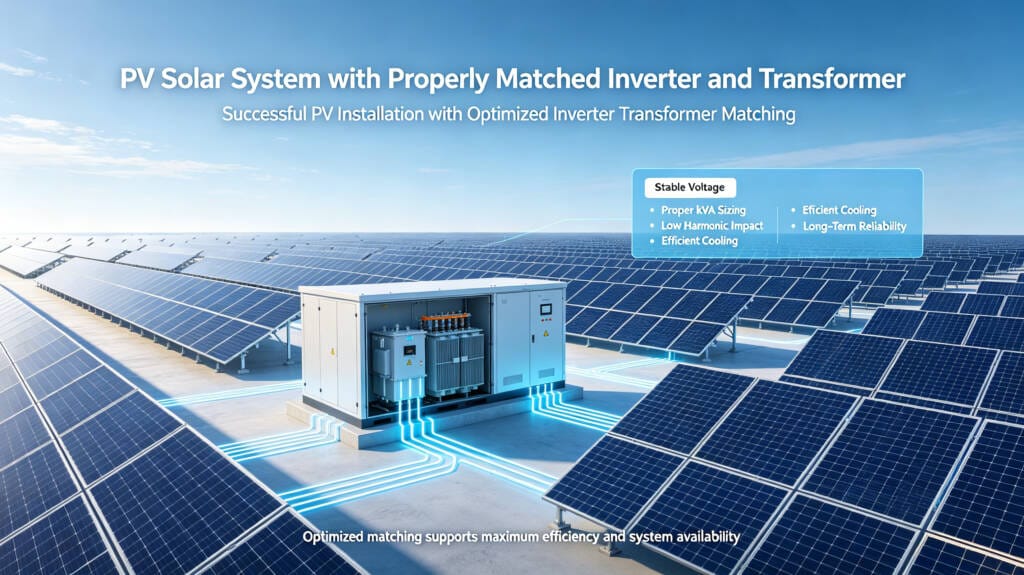
Mastering Inverter Transformer Matching is fundamental to building efficient, reliable, and future-proof solar power systems. By understanding key parameters, avoiding common compatibility issues, and following the step-by-step guide outlined here, you can significantly reduce risks and enhance overall system performance.
Proper inverter transformer compatibility not only protects your investment but also contributes to the broader goal of sustainable energy adoption. For complex projects, partnering with specialists who have deep experience in Inverter Transformer Matching can provide additional peace of mind.
Ready to optimize your PV system?