1.Introduction
The global maritime industry is undergoing a profound transformation driven by decarbonization goals, stricter environmental regulations, and the push toward smarter, more reliable port infrastructure. At the heart of this evolution is marine transformer, essential components that ensure safe, efficient, and stable power distribution in ports and shipyards.
Marine transformers (also known as marine duty transformers, shipyard transformers, or shore power transformers) play a critical role in converting and isolating electrical power for vessels at berth, supporting electrified cargo handling equipment, and enabling high-voltage shore connections. As ports adopt shore power systems (also called cold ironing or Onshore Power Supply – OPS), the demand for robust marine transformers continues to grow.
This comprehensive guide explores the requirements, challenges, and best practices for port and shipyard transformer solutions. Whether you manage a container terminal, oversee shipyard operations, or design electrical infrastructure for green ports, this article provides actionable insights based on industry standards and real-world experience. By understanding these elements, stakeholders can enhance operational reliability, ensure regulatory compliance, and reduce long-term costs.
With IMO targets aiming for net-zero emissions and regulations like California’s At-Berth rule, investing in properly specified marine transformers is no longer optional—it’s a strategic necessity for sustainable port operations.
Discover how the right marine transformer can transform your port or shipyard operations. Need expert advice?
Table of Contents
- Introduction
- Understanding Marine Transformers in Ports and Shipyards
- Key Requirements for Marine Transformers
- Major Challenges in Port and Shipyard Applications
- Proven Best Practices for Selection, Installation, and Maintenance
- Case Studies: Real-World Success in Port Electrification
- Future Trends and Conclusion
2.Understanding Marine Transformers in Ports and Shipyards
Marine transformers are specialized electrical devices engineered to withstand the harsh conditions of marine and coastal environments. Unlike standard industrial transformers, they must handle vibration, salt spray, humidity, temperature fluctuations, and dynamic loads common in ports and shipyards.
Key applications include:
- Shore-to-ship power supply systems
- Power distribution for shipyard repair facilities
- Electrification of cranes, straddle carriers, and other cargo handling equipment
- Offshore platform and harbor infrastructure support
Dry-type marine transformers, particularly cast resin or vacuum pressure impregnated (VPI) models, dominate modern installations due to their fire safety, lower maintenance needs, and environmental resilience compared to oil-immersed alternatives.
The global marine transformer market is expanding steadily, driven by port electrification projects worldwide. Purpose-built marine transformers differ significantly from repurposed land-based units, offering superior performance in variable frequency (50/60 Hz), high-voltage scenarios, and space-constrained installations.
3.Key Requirements for Marine Transformers
Selecting the right marine transformer requires careful attention to environmental, technical, and regulatory demands.
1. Environmental and Durability Requirements
Ports and shipyards expose equipment to extreme conditions:
- High salinity and corrosion
- Constant vibration from heavy machinery and waves
- Wide temperature swings (-25°C to +45°C or more)
- High humidity and potential water ingress
Marine transformers must feature robust enclosures (IP54, IP65, or higher), marine-grade coatings, and corrosion-resistant materials such as stainless steel hardware.
2. Certification and Compliance Standards
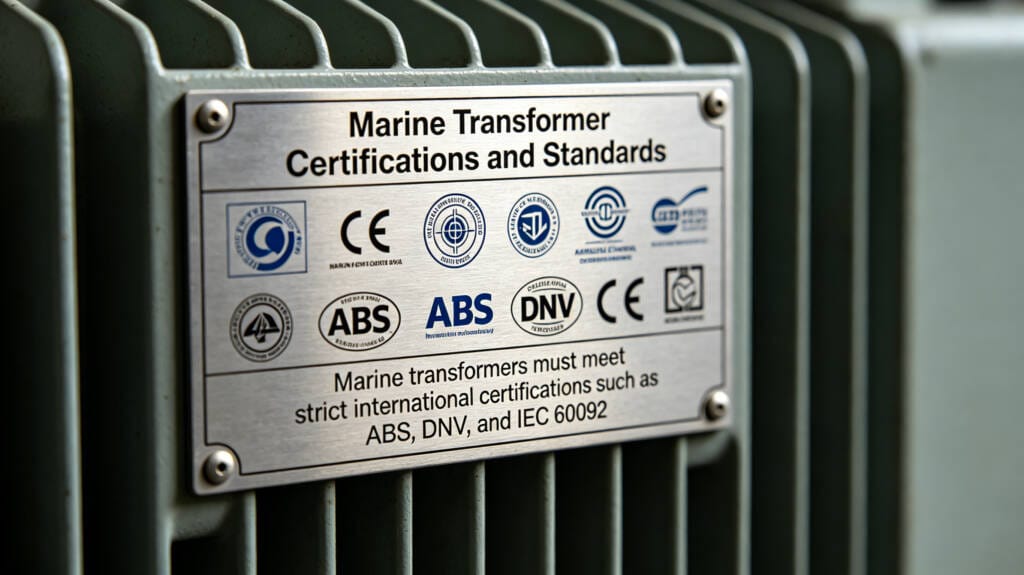
Certification is non-negotiable for marine duty transformers. Primary standards include:
| Certification | Issuing Body | Key Focus Areas |
|---|---|---|
| ABS | American Bureau of Shipping | Design, construction, and vessel integration |
| DNV | Det Norske Veritas | Safety, reliability, and environmental performance |
| Lloyd’s Register | Lloyd’s | Marine electrical installations |
| IEC 60092 | International Electrotechnical Commission | Electrical installations in ships |
| IEC 60076 | IEC | Power transformers (general) |
| CCS | China Classification Society | Regional compliance for Asian markets |
Additional relevant standards: IEC/IEEE 80005-1 for high-voltage shore connections and ISO 12944 for corrosion protection (C5-M category).
All high-quality marine transformers for port applications should hold ABS Type Approval certification to ensure safety and reliability.
3. Technical Specifications
Typical requirements for port and shipyard transformers:
- Power rating: 500 kVA to several MVA
- Voltage levels: Up to 15 kV primary, with flexible secondary configurations
- Frequency: Dual 50/60 Hz capability
- Insulation: Class F or H with temperature rise limits
- Efficiency: High-efficiency designs to minimize energy losses
- Harmonic handling: K-factor rated or harmonic-mitigating designs
For shore power applications, isolation transformers are often essential to prevent galvanic corrosion and ensure safety during vessel connection.
4. Performance Under Load Variations
Ports experience highly variable loads. Marine transformers must accommodate sudden load changes from crane operations or multiple vessel connections without excessive voltage drops or overheating.
Selecting the correct marine transformer specifications is critical.
4.Major Challenges in Port and Shipyard Applications
Despite their importance, deploying marine transformers comes with several challenges.
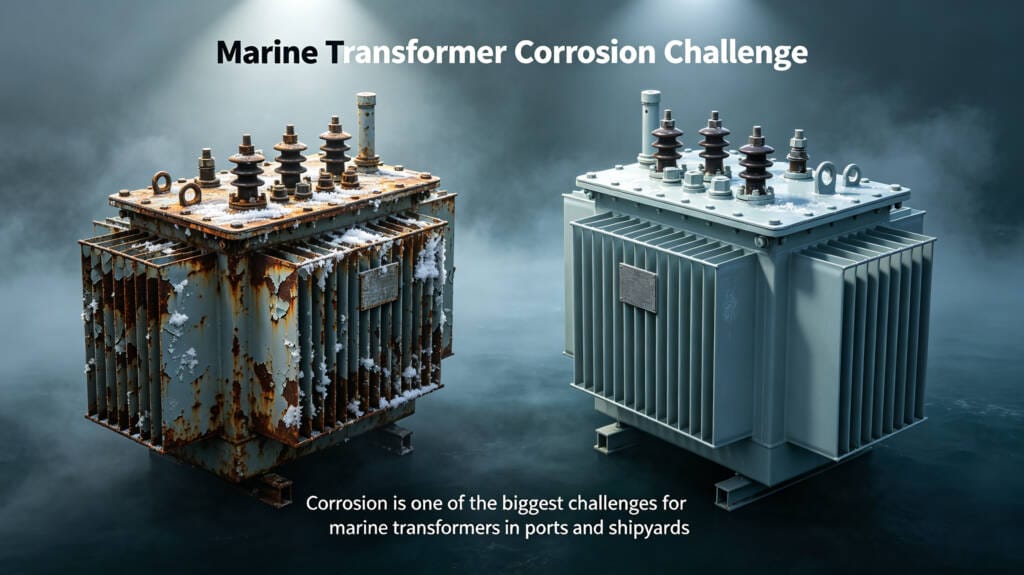
Challenge 1: Corrosion and Environmental Degradation
Salt-laden air accelerates corrosion of enclosures, terminals, and cooling surfaces. Coastal transformers face combined threats of humidity, salt spray, and pollution.
Impact: Reduced lifespan, insulation breakdown, and increased maintenance costs.
Challenge 2: Harmonic Distortion and Power Quality
Modern ports use numerous variable frequency drives (VFDs), LED lighting, and power electronics that generate harmonics. These increase eddy current losses, overheating, and premature aging of standard transformers.
Challenge 3: Space Constraints and Installation Complexity
Shipyards and dockside areas often have limited space. Transformers must be compact yet accessible for maintenance while meeting vibration isolation and safety clearance requirements.
Challenge 4: Regulatory and Grid Integration Issues
Meeting multiple classification society rules while integrating with shore power systems and existing grid infrastructure can be complex. Voltage and frequency mismatches between ports and vessels add further difficulty.
Challenge 5: Total Cost of Ownership (TCO) vs Initial Investment
While high-spec marine transformers cost more upfront, poor choices lead to frequent failures, downtime, and higher lifecycle costs.
DNV certification is widely recognized for marine duty transformers operating in demanding offshore and port environments
5.Proven Best Practices for Selection, Installation, and Maintenance
Adopting best practices helps overcome these challenges and maximizes the performance of marine transformers.
Best Practice 1: Comprehensive Needs Assessment
- Conduct detailed load studies, including peak and harmonic profiles
- Evaluate site-specific environmental conditions (distance from sea, wind patterns)
- Define redundancy requirements for critical operations
Best Practice 2: Specification and Design Optimization
Choose dry-type marine transformers with:
- Enhanced K-factor (K-4 to K-13 or higher) for harmonic mitigation
- Forced air cooling options for high-load scenarios
- Advanced monitoring capabilities (temperature, vibration, partial discharge)
Use multi-layer corrosion protection systems per ISO 12944 C5-M.
Comparison Table: Transformer Types for Marine Applications
| Feature | Dry-Type Cast Resin | Oil-Immersed | VPI Dry-Type |
|---|---|---|---|
| Fire Safety | Excellent | Moderate | Good |
| Maintenance | Low | Higher | Low |
| Corrosion Resistance | High (with coatings) | Moderate | High |
| Weight & Size | Compact | Heavier | Compact |
| Harmonic Handling | Good (with design) | Standard | Excellent |
| Typical Port Use | Shore Power, Cranes | Legacy Systems | General Marine |
Best Practice 3: Professional Installation
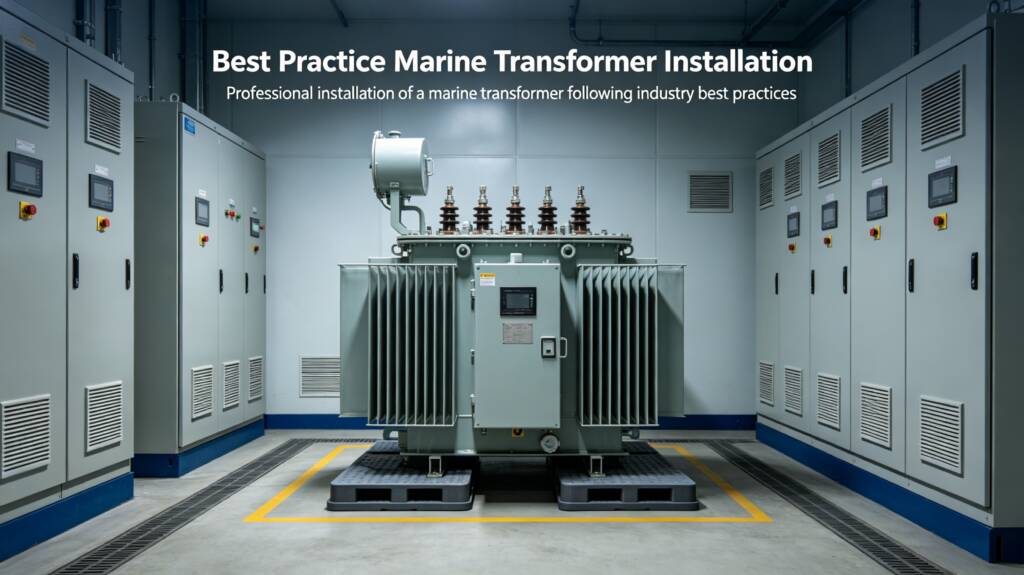
- Use vibration dampers and proper foundation design
- Ensure adequate ventilation and clearance
- Implement correct grounding and isolation practices
- Coordinate with classification societies for witness testing
Best Practice 4: Proactive Maintenance and Monitoring
- Schedule regular thermographic inspections and insulation testing
- Deploy IoT-based condition monitoring
- Maintain detailed service records for compliance audits
- Plan for spare parts availability in remote port locations
Best Practice 5: Integration with Broader Electrification Strategies
Marine transformers should integrate seamlessly with energy storage, renewable sources, and smart grid systems to support full port electrification.
Ready to implement these best practices?
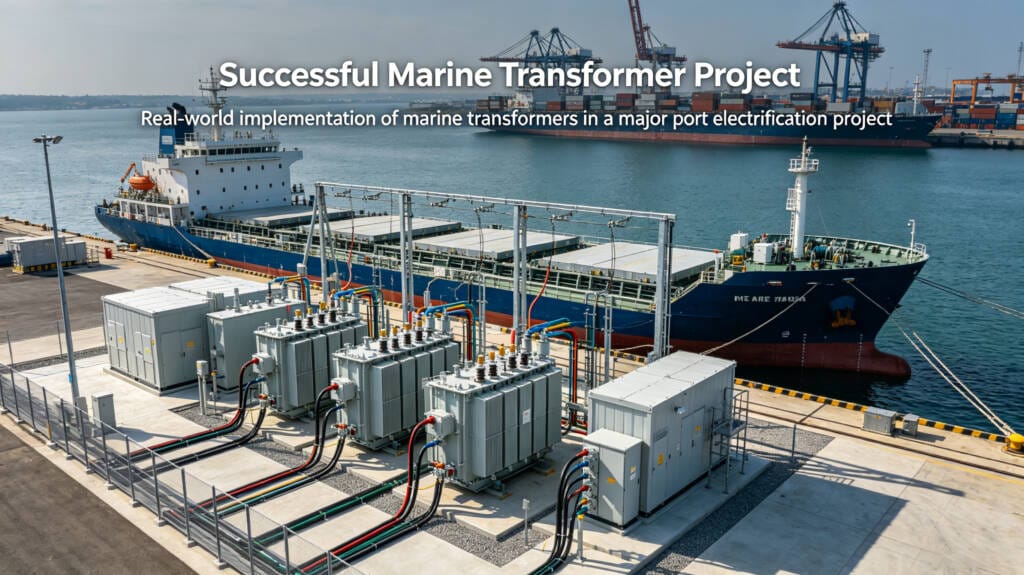
6.Case Studies: Real-World Success in Port Electrification
Case Study 1: European Cruise Port Shore Power Implementation
A major Mediterranean port installed multiple MVA shore power transformers compliant with IEC/IEEE 80005-1. The project used cast resin marine transformers with advanced harmonic filtering. Results included:
- 80%+ reduction in emissions while vessels at berth
- Improved power quality and reduced vessel auxiliary engine runtime
- Payback period under 7 years through energy savings and regulatory incentives
Case Study 2: Asian Shipyard Electrical Upgrade
A large shipbuilding facility in Asia replaced aging transformers with ABS-certified marine duty transformers. Key upgrades addressed vibration and corrosion. Outcomes:
- 30% reduction in unplanned downtime
- Extended equipment lifespan by over 40%
- Better support for simultaneous vessel repairs
These examples demonstrate how properly engineered marine transformer solutions deliver both environmental and economic benefits.
7.Future Trends and Conclusion
The future of marine transformers in ports and shipyards points toward greater digitalization, higher efficiency, and tighter integration with renewable energy microgrids. Expect increased adoption of smart transformers with real-time analytics, modular designs for easier scalability, and enhanced compatibility with battery storage systems.
In conclusion, successful deployment of port and shipyard transformer solutions requires balancing stringent requirements, addressing key challenges head-on, and following proven best practices. By prioritizing certified, purpose-built marine transformers, port operators and shipyard managers can achieve reliable power distribution, regulatory compliance, and meaningful progress toward green maritime operations.
Ready to optimize your port or shipyard electrical infrastructure?