Transformer protection—it’s critical. Part of any power system protection strategy. Actually, a huge part. It makes sure transformers operate safely. Reliably. Efficiently. Under different working conditions. Or at least that’s what it’s supposed to do. A complete transformer protection system—wait, let me break that down: transformer protection relays. Monitoring devices. Control mechanisms. They detect faults. Isolate the transformer. Before serious damage happens. Before.
In modern electrical networks, transformer protection is more advanced. Than ever. Honestly, it’s a different game now. Digital transformer protection relay systems. They monitor current. Voltage. Temperature. Other parameters. In real time. Which means faster fault detection. Better system stability. Or—faster detection leads to better stability. That’s the connection. Whether it’s substations. Industrial plants. Renewable energy projects. Power transformer protection—actually, let me just call it transformer protection—it plays a key role. Preventing equipment failure. Reducing downtime. That’s the bottom line.
This guide explains the main types of transformer protection, including differential protection of transformer, overcurrent protection, restricted earth fault (REF) protection, and mechanical protection devices such as Buchholz relays. It also covers transformer protection schemes, relay selection, and real-world applications to help you understand how transformer protection systems work in practice.
Learn about advanced digital protection relay solutions to prevent internal and external faults.
Table of Contents (TOC)
- What is Transformer Protection
- Why Transformer Protection is Important
- Types of Transformer Faults
- Main Types of Transformer Protection Systems
- Electrical Transformer Protection Schemes
- Mechanical Protection in Transformers
- Transformer Protection Relay & Control System
- Protection Coordination (Primary vs Backup)
- Applications of Transformer Protection
- FAQs
1.What is Transformer Protection
Transformer protection is a complete system that includes protection relays, monitoring devices, and control mechanisms used to detect abnormal conditions in transformers and disconnect them before damage occurs.
A modern transformer protection system is not just a single relay. It is a combination of:
- Electrical protection relays
- Mechanical protection devices
- Monitoring sensors
- Control and automation systems
These components work together to ensure that the transformer operates safely under all conditions.
In simple terms, transformer protection is designed to:
- Detect faults quickly
- Isolate faulty sections
- Prevent further damage
- Ensure system reliability
In today’s digital substations, transformer protection relay systems are integrated with intelligent electronic devices (IEDs), making them more accurate and responsive.
2.Why Transformer Protection is Important
Transformers are among the most expensive—and, honestly, critical—pieces of equipment in power systems. They step voltage up or down, which is basically what makes efficient, safe electricity delivery possible. When a transformer fails, it’s not just about costly repairs—you’re looking at extended downtime, safety hazards, and sometimes even cascading effects across the grid. Which is kind of terrifying, when you think about it. So having a robusttransformer protection system—actually, let me put it this way: it’s absolutely essential for reliable energy distribution and keeping things operationally stable.
Here are the main reasons why transformer protection is vital:
Key reasons include:
1. Prevent Equipment Damage
Transformers are high-value assets, often costing hundreds of thousands to millions of dollars. Internal faults, such as winding short circuits or insulation breakdown, can rapidly escalate into catastrophic failures if not detected early.
A well-designed transformer protection—actually, let me be more specific: that includes differential protection relays, overcurrent relays, and mechanical devices like Buchholz relays—makes sure that any abnormal condition triggers immediate isolation. Which means you prevent irreversible damage, extend transformer life, and—well, it also saves a huge amount on repair or replacement costs.
Example: In a 110 kV substation, an internal winding fault without differential protection could destroy the transformer within seconds, leading to downtime and costly replacement.
2. Improve Power System Stability
Transformers are critical nodes in the electrical grid. A fault in one transformer can cause voltage fluctuations. Or frequency instability. Or even widespread outages.
Using advancedtransformer protection—actually, let me list them: restricted earth fault protection. REF for short. Overcurrent coordination. These help utilities isolate the fault quickly. While still maintaining service. On the unaffected parts of the grid.
That ensures a continuous supply. Stable supply. And minor faults don’t escalate. Into major blackouts.
Key point: Stable transformer operation is essential for industries, hospitals, data centers, and other critical infrastructure.
3. Enhance Safety
ransformer failures are not just financial issues—they are major safety concerns. Internal faults can produce:
- High currents causing overheating
- Oil decomposition leading to gas formation
- Explosion or fire hazards
A properly implemented transformer protection system mitigates these risks. Actually—mitigates. That’s the word. Devices like pressure relief valves. Buchholz relays. Thermal sensors. They detect early signs. Overheating. Gas accumulation. Pressure buildup.
When a fault happens—when it happens—the system automatically disconnects. The transformer. Not the whole substation. Just the transformer. That protects personnel. Equipment. And nearby facilities. Well—personnel first, obviously.
Real-world example: Oil-filled transformers with a Buchholz relay have prevented potential explosions by triggering alarms and shutting down the transformer before catastrophic damage occurred.
4. Reduce Downtime
Downtime in power systems can be extremely costly. Industrial production. Commercial operations. Residential supply. All of it gets hit. Fast fault detection is critical. Automatic isolation too. To minimize downtime—actually, to keep things running.
Modern digital transformer protection relays. Remote monitoring systems. They can detect anomalies in milliseconds. Milliseconds. That’s fast. And they provide real-time alerts. To control centers. Or wherever the monitoring team is. This lets maintenance teams respond quickly. Schedule repairs.
Restore service efficiently. Wait—efficiently. That’s the goal.
Benefit: Reducing transformer downtime not only protects revenue but also strengthens trust and reliability for consumers and businesses alike.
📊 Table: Impact of Transformer Failure
| Impact Type | Description |
|---|---|
| Financial Loss | High replacement cost |
| Downtime | Power interruption |
| Safety Risk | Fire or explosion |
| System Instability | Grid disturbance |
3.Types of Transformer Faults
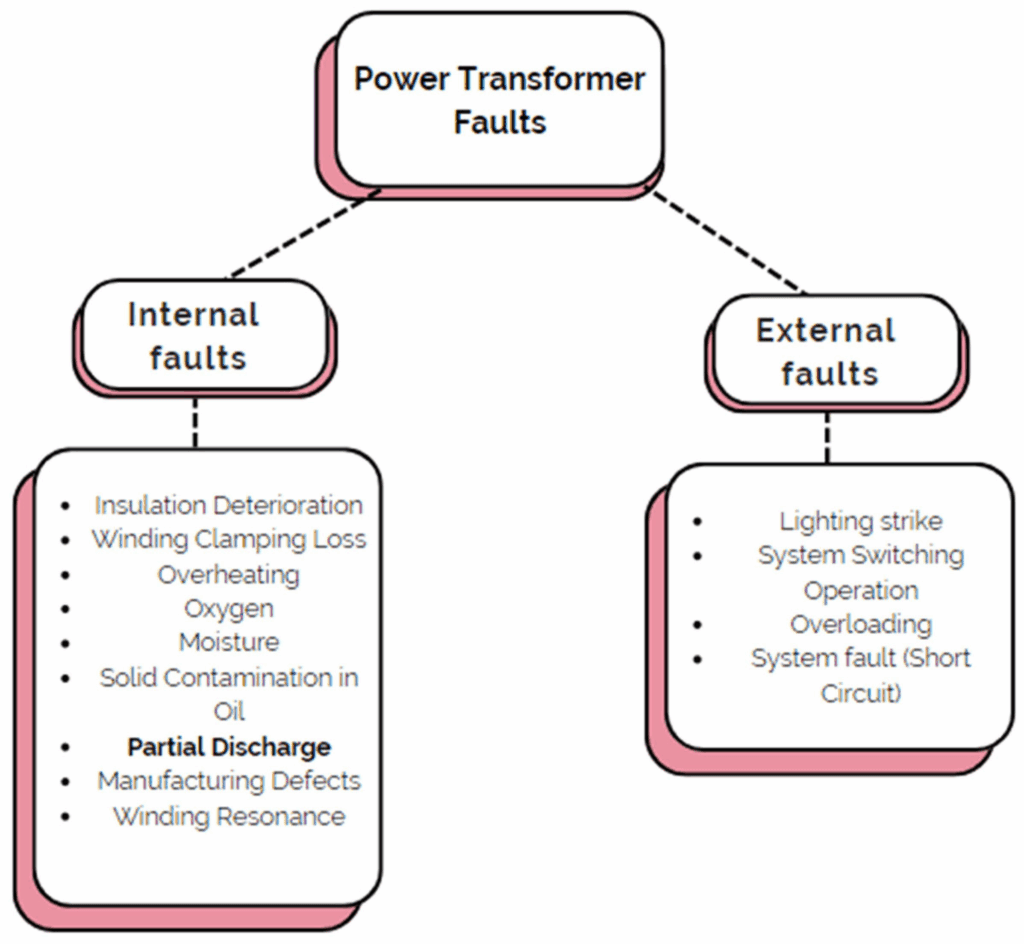
Transformers are critical components in power systems, and understanding the types of faults that can occur is essential for designing effective transformer protection systems. Faults can be broadly classified into internal faults and external faults, each requiring specific protection strategies. Properly detecting and isolating these faults ensures safety, reliability, and long-term transformer operation.
Internal Faults
Internal faults occur within the transformer itself and are among the most dangerous types of failures. These faults can escalate quickly, potentially causing catastrophic damage, fire, or explosion if not detected by fast-acting transformer protection relays.
Common Internal Faults
- Winding Short Circuits
- Occur when the insulation between windings fails, causing a sudden surge of current.
- Can lead to severe overheating and melting of conductor material.
- Requires differential protection (87 relay) for instant detection.
- Inter-turn Faults
- Small faults between turns of the same winding.
- Often start subtly but can quickly escalate into major short circuits.
- Detected by sensitive differential or overcurrent protection relays.
- Insulation Failure
- Aging, moisture ingress, or thermal stress weakens the insulation.
- Leads to dielectric breakdown and internal arcing.
- Continuous thermal and insulation monitoring helps prevent such faults.
- Core Faults
- Occur in the magnetic core due to lamination insulation failure or loose components.
- Can create circulating currents that overheat the transformer.
- Requires overfluxing protection (V/Hz) and thermal monitoring.
- Tap Changer Faults
- On-load tap changers may fail mechanically or electrically due to wear or switching stress.
- Can cause sudden current spikes, affecting both the transformer and connected network.
- Detected using overcurrent protection and tap position monitoring systems.
Key point: Internal faults are always handled by primary transformer protection schemes because of their high risk. Early detection protects both the transformer and personnel.
Real-world Example
In a 220 kV substation, a winding short circuit occurred due to insulation aging. The differential relay detected the fault within milliseconds, triggering circuit breakers and preventing transformer destruction. Without such protection, the repair costs would have exceeded $500,000 and caused major outages.
External Faults
External faults occur outside the transformer, but they still affect its operation. While usually less severe than internal faults, they can still damage equipment or disrupt the power system if not addressed.
Common External Faults
- Overload
- When the transformer is subjected to loads exceeding its rated capacity.
- Leads to gradual overheating and reduced insulation life.
- Managed by thermal overload relays and load monitoring systems.
- External Short Circuits
- Faults in the network connected to the transformer, such as line-to-line or line-to-ground faults.
- Cause a sudden spike in current flowing through the transformer.
- Handled by backup overcurrent protection.
- Lightning Surge
- High-voltage transients caused by lightning strikes.
- Can penetrate transformer windings and insulation.
- Mitigated using surge arresters and protective grounding.
- Overvoltage
- Sustained voltage above the transformer’s rating due to switching operations or grid instability.
- Can lead to insulation stress and accelerated aging.
- Managed through voltage protection relays and tap changer adjustments.
Key point: External faults are generally handled by backup protection schemes such as overcurrent relays or surge protection devices. They ensure the transformer is protected even when faults originate outside its own system.
Need Professional Transformer Protection?
4.Main Types of Transformer Protection Systems
Transformer protection systems are broadly divided into:
Electrical Protection
Electrical protection uses electrical parameters such as:
- Actuel
- Tension
- Fréquence
- Impedance
It provides primary protection for transformers.
Mechanical Protection
Mechanical protection monitors physical conditions such as:
- Temperature
- Oil level
- Gas formation
- Pressure
It provides secondary or backup protection.
5.Electrical Transformer Protection Schemes
This section is the core of any transformer protection guide.
Differential Protection of Transformer (87)
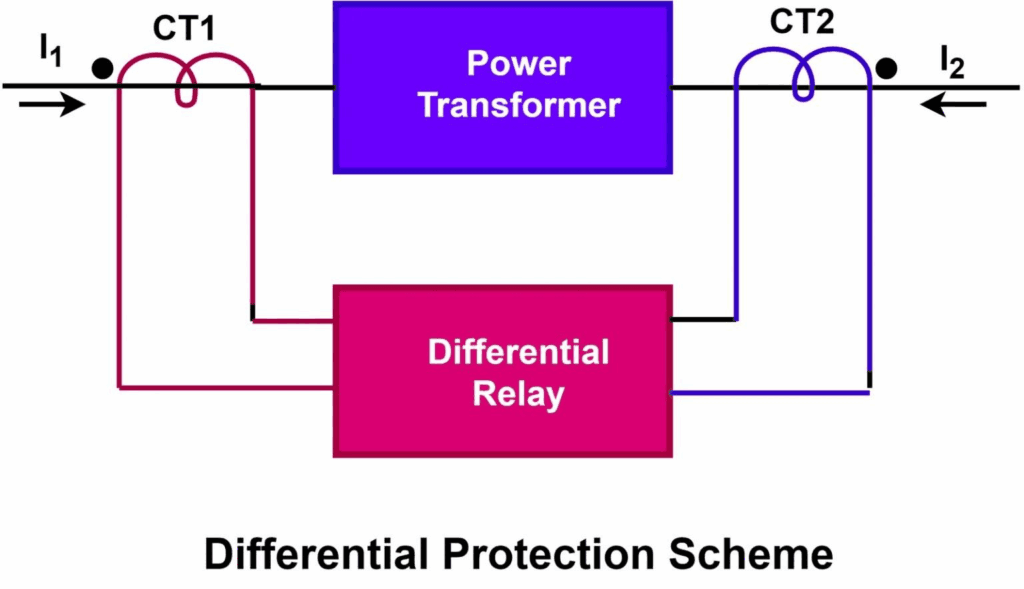
Differential protection is the most important protection method.
It works on the principle that:
👉 The current entering the transformer should equal the current leaving it.
If there is a difference, a fault is detected.
Advantages:
- Fast operation
- High sensitivity
- Reliable detection of internal faults
Applications:
- Power transformers
- Large substations
Overcurrent Protection (50/51)
Overcurrent protection is widely used as backup protection.
It operates when current exceeds a preset value.
Features:
- Simple design
- Low cost
- Suitable for distribution transformers
Restricted Earth Fault Protection (REF)
REF protection detects earth faults in a limited zone.
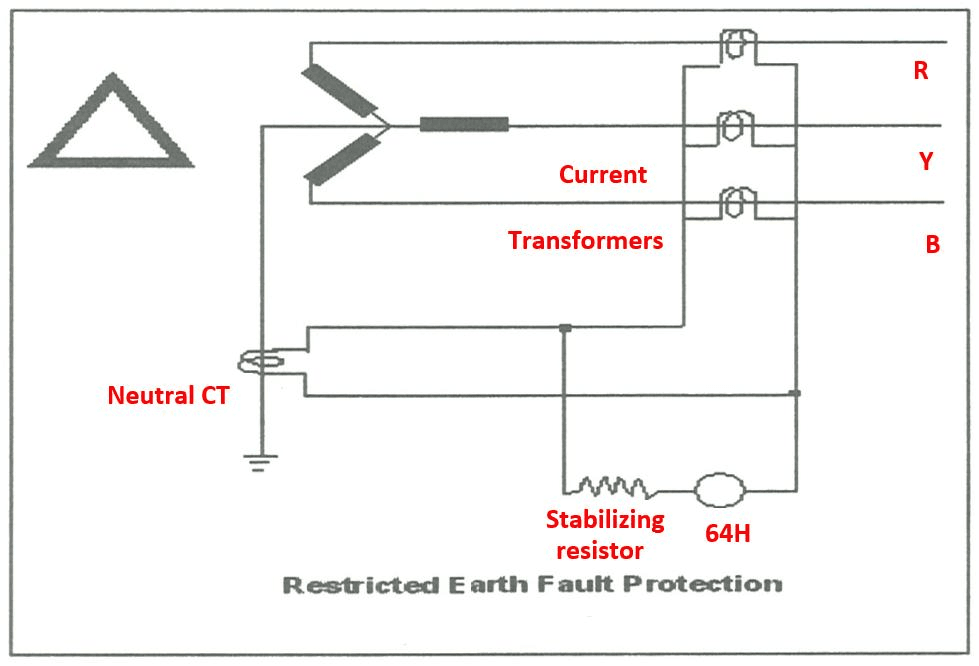
Benefits:
- High sensitivity
- Fast response
- Accurate fault detection
Overfluxing Protection (V/Hz)
Overfluxing occurs when voltage is too high or frequency is too low.
This causes:
- Core saturation
- Excessive heating
Voltage Protection (27/59)
Protects against:
- Overvoltage
- Undervoltage
Thermal Overload Protection (49)
Thermal protection monitors heat inside the transformer.
It prevents:
- Insulation damage
- Overheating
📊 Electrical Protection Summary Table
| Protection | Function | Importance |
|---|---|---|
| Differential | Internal faults | Critical |
| Overcurrent | Backup | Moyen |
| REF | Earth fault | Haut |
| Overfluxing | Core safety | Moyen |
| Thermal | Heat control | Haut |
6.Mechanical Protection in Transformers
Mechanical protection devices play a vital role in transformer safety.
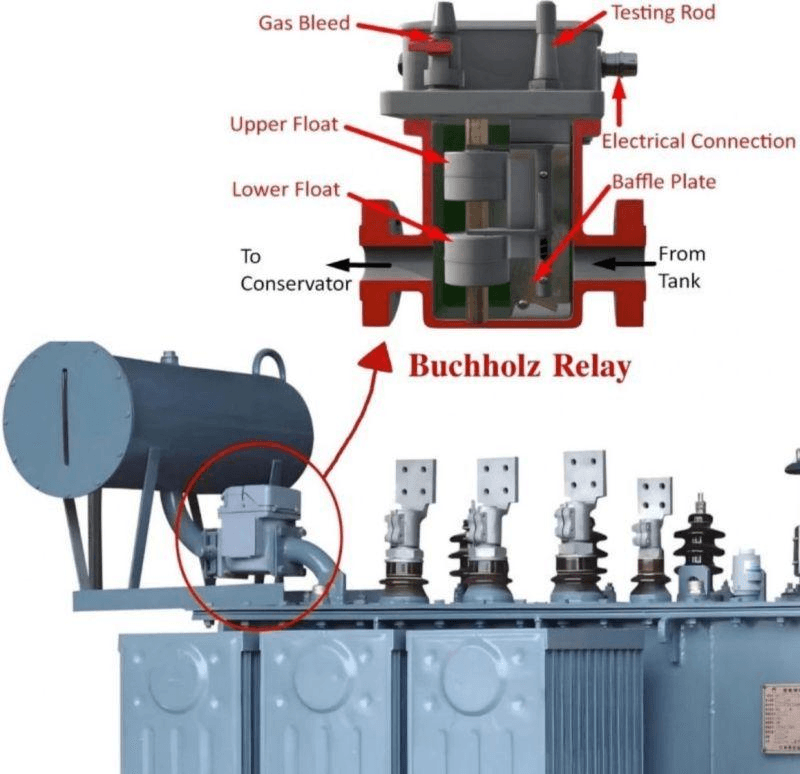
Buchholz Relay
Used in oil-filled transformers.
Detects:
- Gas formation
- Oil movement
It provides early warning of internal faults.
Temperature Protection
Includes:
- Oil Temperature Indicator (OTI)
- Winding Temperature Indicator (WTI)
These devices prevent overheating.
Pressure Relief Device (PRD)
PRD protects the transformer from internal pressure buildup.
It prevents explosion by releasing pressure.
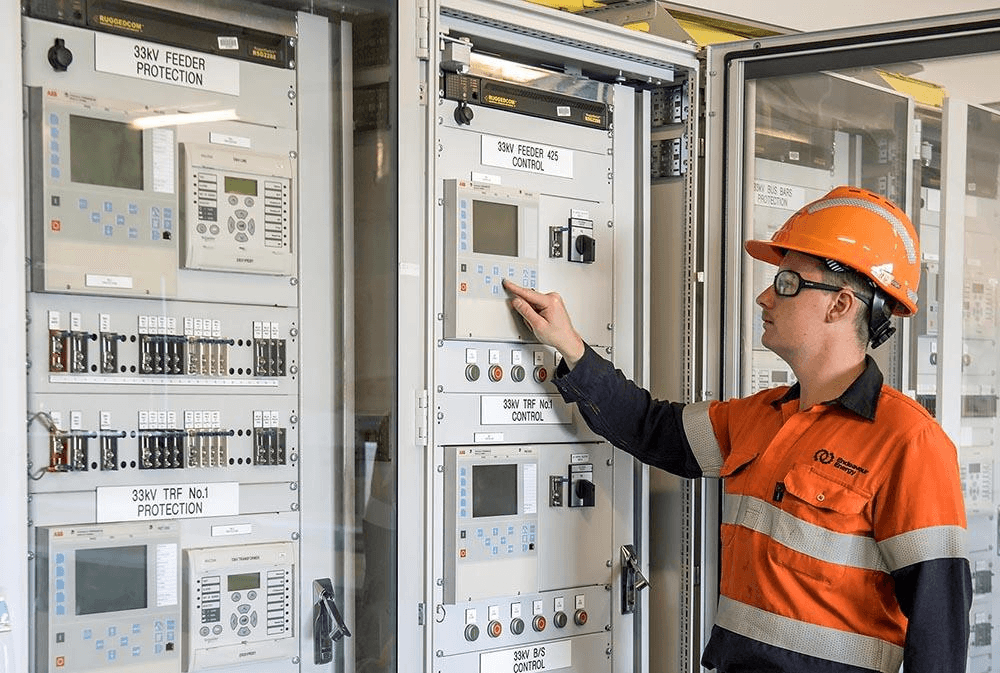
7.Transformer Protection Relay & Control System
Modern power transformers—they increasingly rely on digital systems. Digital electrical transformer safeguarding systems. That’s the term. Or wait—transformer protection systems. Same idea.
They ensure fast detection. Reliable. Precise. Fault detection, that is. Traditional electromechanical relays? Different story. Digital systems integrate advanced intelligence. Monitoring. Control capabilities.
All in one. Which gives operators greater visibility. Control. Over the transformer’s operation. Actually—visibility first. Then control. That makes more sense.
Key Components of a Digital Transformer Protection System
- Intelligent Electronic Devices (IEDs)
- IEDs serve as the heart of modern transformer protection systems.
- They continuously monitor electrical parameters such as current, voltage, temperature, and frequency, and make real-time decisions to trip circuit breakers or activate alarms when abnormal conditions are detected.
- Example devices include differential protection relays (87T), overcurrent relays, and restricted earth fault (REF) relays.
- SCADA Integration
- Supervisory Control and Data Acquisition (SCADA) systems allow operators to remotely monitor and control transformer operations.
- Data collected from IEDs can be used for trend analysis, fault diagnostics, and predictive maintenance, improving system reliability.
- SCADA integration ensures that multiple transformers in a substation or across a grid can be monitored centrally.
- Remote Monitoring
- Remote monitoring systems allow engineers to access transformer status in real time via secure communication channels.
- They provide notifications for abnormal conditions such as overcurrent, overheating, or tap changer failures, enabling proactive maintenance and minimizing downtime.
- Event Recording and Analysis
- Modern IEDs record detailed event logs of faults, alarms, and operational changes.
- Event analysis helps identify the root cause of faults, improve protection schemes, and comply with regulatory requirements.
Compliance with International Standards
Digital transformer protection systems must comply with international standards to ensure safety, interoperability, and reliability. The most widely recognized standards include:
- International Electrotechnical Commission (IEC)
- Institute of Electrical and Electronics Engineers (IEEE)
- IEEE standards provide guidelines for relay settings, testing, and protection coordination.
- For example, IEEE C37 series covers power system relays and protective devices.
Key point: Adherence to IEC and IEEE standards ensures that transformer protection relays operate reliably, communicate effectively, and integrate seamlessly into modern power networks.
Benefits of Digital Transformer Protection
- Fast Fault Detection: Millisecond-level detection reduces transformer damage.
- Enhanced Safety: Immediate isolation prevents fires and explosions.
- Operational Transparency: SCADA and event logs provide clear visibility of transformer health.
- Predictive Maintenance: Trend data enables proactive scheduling of inspections and repairs.
Example: A utility company using IEC 61850-compliant digital relays was able to detect and isolate a phase-to-phase fault in a high-voltage transformer within 50 milliseconds, preventing significant damage and avoiding prolonged outages.
Upgrade to Digital Protection Systems for real-time monitoring and automatic fault isolation.
👉Explore our IEC/IEEE-compliant protection relays.
8.Protection Coordination (Primary vs Backup)
A well-designed electrical transformer safeguarding system—actually, let’s call it transformer protection—it does more than detect faults. It has to ensure proper coordination. Between primary and backup protection.
That coordination? Crucial.
For power system stability. Equipment safety. Minimal downtime. Or—stability first. Then safety. Then downtime. Properly coordinated protection makes sure only the faulted section is isolated. Not the whole network. Just that section.
Which prevents unnecessary outages. To the rest of the system. Wait—that’s the point. Keep everything else running.
Primary Protection
Primary protection is the first line of defense for transformers. It is designed to detect internal faults quickly and accurately and disconnect the transformer from the network before significant damage occurs.
Key types of primary protection include:
- Differential Protection (87T)
- Compares currents on the primary and secondary sides of the transformer.
- Detects internal faults such as winding short circuits ou inter-turn faults almost instantaneously.
- Highly sensitive and selective, making it ideal for internal fault detection.
- Restricted Earth Fault (REF) Protection
- Detects ground faults within a defined portion of the transformer winding.
- Provides additional sensitivity for detecting low-magnitude earth faults that may not trigger differential protection.
- Often used in large oil-immersed or power transformers for enhanced reliability.
Key point: Primary protection is fast, selective, and sensitive to internal transformer faults, ensuring minimal damage and operational risk.
Backup Protection
Backup protection serves as a safety net when primary protection fails or is delayed. While less sensitive than primary protection, it ensures that faults are still isolated to protect the transformer and the network.
Common types of backup protection include:
- Overcurrent Protection
- Monitors current exceeding the rated limits of the transformer.
- Operates for both internal and external faults if primary protection fails.
- Can be time-delayed to coordinate with primary protection.
- Distance Protection (Impedance-Based)
- Detects faults based on the voltage-to-current ratio.
- Useful for external faults, such as line-to-ground or line-to-line faults, that affect transformer operation.
- Often integrated with backup relay schemes in transmission networks.
Key point: Backup protection ensures system reliability and fault isolation, even if the primary protection malfunctions or is undergoing maintenance.
Coordination Principles:
Designing a coordinated transformer protection system involves three fundamental principles:
- Selectivity
- Only the faulted equipment is disconnected.
- Prevents unnecessary tripping of healthy transformers or circuits.
- Speed
- Primary protection must operate faster than backup protection to isolate the fault quickly.
- Reduces the risk of equipment damage and fire hazards.
- Reliability
- Protection devices must operate consistently under all fault conditions.
- Redundant protection ensures that even if one device fails, the system still responds.
Example: In a 132 kV substation, differential protection acts within milliseconds to clear an internal winding fault, while overcurrent backup protection is set to trip only if the primary relay fails. This ensures transformer safety without affecting the rest of the grid.
9.Applications of Transformer Protection
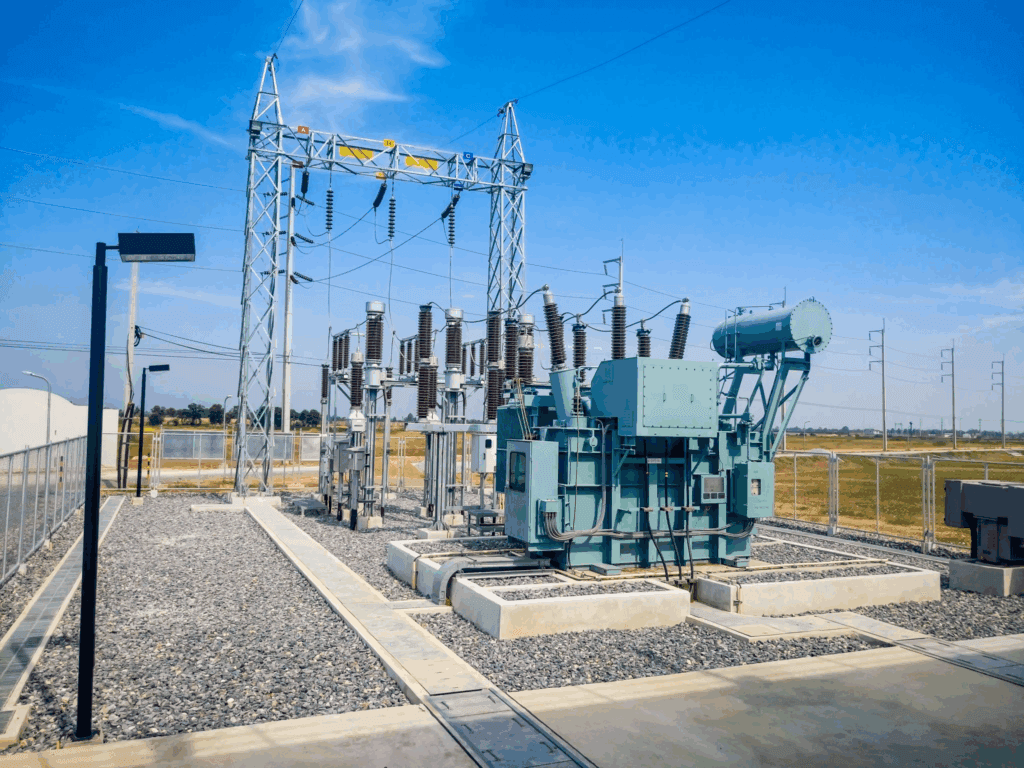
Electrical transformer safeguarding systems are widely used in:
- Power substations
- Industrial plants
- Renewable energy systems
- Transmission networks
10.FAQs
Q1. What is transformer protection and why is it important?
A: Transformer protection ensures safe and reliable operation by detecting faults such as internal short circuits, overloads, or earth faults, preventing damage, fire, and grid instability.
Q2. What are the main types of transformer faults?
A: Transformer faults are classified as internal faults (winding short circuits, insulation failure, inter-turn faults) and external faults (overload, short circuit, lightning, overvoltage).
Q3. What is differential protection for transformers?
A: Differential protection compares current between primary and secondary windings to detect internal faults. It is fast, sensitive, and selective, protecting transformers from severe damage.
Q4. What is restricted earth fault (REF) protection?
A: REF protection detects ground faults in a defined winding zone. It complements differential protection, improving sensitivity for low-magnitude earth faults.
Q5. How does transformer backup protection work?
A: Backup protection, such as overcurrent or distance relays, operates when primary protection fails or is delayed, ensuring the faulted section is isolated without affecting healthy transformers.
Q6. What are digital transformer protection systems?
A: Digital systems use Intelligent Electronic Devices (IEDs), SCADA integration, remote monitoring, and event recording to provide fast, accurate, and automated fault detection.
Q7. Why is protection coordination between primary and backup important?
A: Proper coordination ensures selectivity, speed, and reliability, so only the faulted equipment is disconnected while keeping the rest of the grid stable.
Q8. How can transformer protection reduce downtime?
A: By detecting faults quickly and isolating the transformer, protection relays prevent cascading failures, allowing maintenance teams to respond faster and minimize outages.
Protect Your Transformer Assets and Minimize Downtime!