I. Introduction
Modern electrical systems rely on several types of power infrastructure to ensure the safe, stable, and efficient delivery of electricity. Although terms like sous-station, switching station, power distribution room, and compact substation seem similar, each represents a different form of equipment configuration, installation method, and functional purpose. Many engineers, facility managers, EPC contractors, and international buyers often confuse these terms when selecting electrical equipment for industrial, commercial, or utility-scale projects. Considering environmental conditions and minimizing environmental impact are essential when planning installations. A well-designed substation offers reliable operation, keeps operations substations safe, and can be effectively integrated into urban areas to meet power distribution requirements.
Understanding these differences is essential for successful project planning, cost optimization, long-term reliability, and electrical safety. Choosing the wrong type of power infrastructure can lead to:
- voltage incompatibility,
- insufficient load capacity,
- transformer overload,
- increased maintenance cost,
- regulatory non-compliance,
- delayed project commissioning.
This blog helps you clearly distinguish the four categories of electrical infrastructure. We will explain each concept, list the functional features, compare them using engineering logic, and show you how to choose the right solution for your project.
II. What Is a Substation?
UN sous-station is a critical point in the power grid that transforms voltage levels, distributes electrical energy, and provides protection, switching, metering, and control. Properly designed substations offer reliable performance while keeping operations substations safe. They usually connect transmission networks, distribution networks, and end-user loads. Engineers must consider local environmental conditions to minimize environmental impact, especially when installing substations in urban areas.
When people search Google for what is a substation, they’re typically looking for explanations of:
- its functions,
- components,
- voltage levels,
- application scenarios,
- operational requirements.
Below is a detailed engineering explanation.
2.1 Definition
UN sous-station is an installation where voltage is transformed from high to low or low to high, circuits are switched, and electricity is controlled and regulated. Substations form the backbone of regional and national grids.
Substations typically operate at:
- High voltage (HV): 66 kV to 220 kV
- Extra-high voltage (EHV): 330 kV to 500 kV
- Ultra-high voltage (UHV): ≥ 800 kV
- Medium voltage (MV): 10 kV to 35 kV (for distribution substations)
High-ranking SEO keywords for this section include:
- high voltage substation
- electrical substation components
- substation design
- substation working principle
2.2 Functions of a Substation
A substation performs several key functions in the power system:
1. Voltage Transformation
This is its primary role—changing voltages from:
- Transmission-level → Distribution-level
- Distribution-level → Utilization-level
Transformers in substations handle huge power loads, often hundreds of MVA.
2. System Protection
Substations include:
- circuit breakers,
- relays,
- protection panels,
- grounding systems.
These ensure the grid remains safe during faults such as short circuits, overloads, and lightning events.
3. Switching Operations
Substations reroute electricity:
- for maintenance,
- during emergencies,
- when optimizing the grid load.
4. Power Quality Control
They regulate:
- voltage stability,
- reactive power,
- harmonic suppression.
5. Metering and Monitoring
Modern substations include SCADA, sensors, and advanced monitoring software.
2.3 Types of Substations
Substations can be categorized by various criteria. Different regions may use different naming conventions, but some universal types include:
1. Step-Up Substations
Used at generating plants (solar farms, wind farms, thermal plants) to raise voltage for long-distance transmission.
2. Step-Down Substations
Most common. They reduce high transmission voltage to distribution voltage levels.
3. Distribution Substations
Located near communities, factories, or commercial areas.
4. Switching Substations
Used for routing power without voltage transformation. (This will be compared later with switching stations.)
5. GIS / AIS Substations
- GIS (Gas Insulated Substation): compact, expensive, urban use
- AIS (Air Insulated Substation): large footprint, affordable, rural use
2.4 Components of a Substation
Typical substation components include:
- Power Transformers
- High-voltage Switchgear (GIS/AIS)
- Circuit Breakers
- Disconnectors
- Surge Arresters
- Control Panels
- Battery Banks & DC System
- Busbars
- Cables
- SCADA
- Protection Relays
- Grounding Network
- Fire Protection
SEO keywords included:
- substation equipment list, substation components, GIS vs AIS substation
2.5 Applications
Substations are used in:
- National and regional grids
- Large solar and wind farms
- Industrial zones
- Railway systems
- Oil & gas fields
- Urban distribution networks
III. What Is a Switching Station?
UN switching station (also called a switchyard) is a facility that routes electrical power without transforming voltage. Many users confuse it with substations, making substation vs switching station a high-traffic keyword.
3.1 Definition
UN switching station is an installation where:
- circuits are connected,
- isolated,
- rerouted,
- controlled,
but no transformer is typically involved.
It primarily performs switching operations for grid stability and power routing.
3.2 Key Characteristics
1. No Transformers
This is the fundamental difference.
2. Used for Power Routing
It’s often built where multiple transmission lines intersect.
3. Enhances Grid Redundancy
Switching stations improve system reliability by providing alternate paths in case of faults.
4. Smaller Than Substations
Because it lacks transformers, it’s structurally simpler.
3.3 Common Components
Switching stations typically include:
- Circuit breakers
- Disconnect switches
- Busbars
- Control room
- Relays & protection devices
- Instrument transformers (CT/VT)
3.4 Applications
Switching stations are used in:
- Transmission line junctions
- Grid expansion projects
- Renewable energy interconnections
- System reliability reinforcement
3.5 Advantages and Limitations
✔ Advantages
- Lower cost than substations
- Easier maintenance
- Smaller footprint
- Improves system routing flexibility
✘ Limitations
- Cannot change voltage
- Limited functional scope
- Does not supply end-users directly
IV. What Is a Power Distribution Room? (PDR)
UN power distribution room is a low- and medium-voltage equipment room responsible for receiving electricity from substations and distributing it to local loads.
4.1 Definition
UN power distribution room (PDR) is an indoor room housing:
- switchgear,
- distribution cabinets,
- metering systems,
- protective devices,
- capacitor banks,
- fire protection systems.
It usually handles 400V – 35kV, depending on the building type.
4.2 Key Functions
- Indoor distribution of LV/MV
- Short-circuit and overload protection
- Power metering
- Load management
- Control of equipment such as pumps, HVAC, elevators, manufacturing lines
4.3 Components
- MV switchgear (e.g., 10/11/33kV)
- LV switchboards
- Distribution panels
- Busway
- Cables and trays
- UPS, battery systems
- Fire alarms
- Environmental monitoring
- Emergency lighting
4.4 Applications
Power distribution rooms are commonly used in:
- Factories
- Shopping malls
- High-rise buildings
- Data centers
- Hospitals
- Airports
- Schools
- Industrial plants
4.5 Advantages and Limitations
✔ Advantages
- safe indoor environment
- easy maintenance
- supports complex building loads
- long-term operational flexibility
✘ Limitations
- Not suitable for outdoor or harsh environments
- Construction cost for building + ventilation
- Requires professional operation
V. What Is a Compact Substation?
Now we come to the highly searched keyword: compact substation
Also known as:
- package substation
- prefabricated substation
- kiosk substation
- pad-mounted substation
5.1 Definition
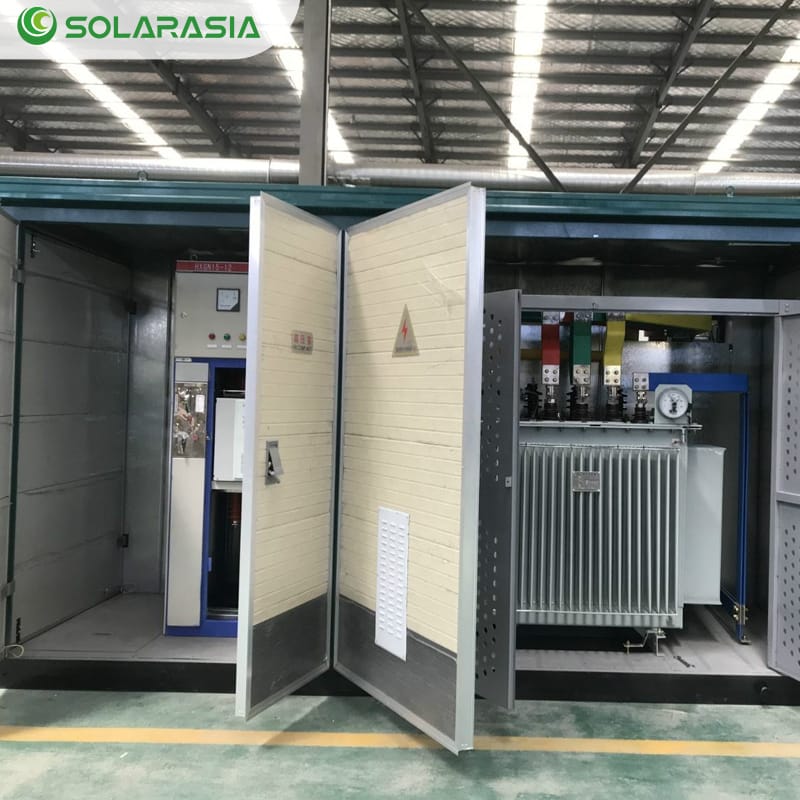
UN compact substation integrates:
- MV switchgear
- Transformateur
- LV distribution cabinet
all within a sealed metal enclosure or prefabricated housing.
It is a modular, factory-assembled, plug-and-play solution.
5.2 Construction Features
- Steel or composite enclosure
- Fully enclosed transformer chamber
- MV incoming panel
- LV outgoing panel
- Cable compartment
- Ventilation system
- Fire-resistant internal design
5.3 Functions
- Step down MV to LV
- Local power distribution
- Overload and short-circuit protection
- Metering & monitoring
- Outdoor power supply
5.4 Applications
Compact substations are widely used because of their convenience:
- Urban power supply
- Construction sites
- Oil fields & mines
- Residential communities
- Solar PV plants
- Wind farms
- Commercial complexes
- Rural electrification
5.5 Advantages and Limitations
✔ Advantages
- Easy transportation
- Quick installation
- Space-saving
- High safety
- Lower civil engineering cost
- Modular, customizable
✘ Limitations
- Not suitable for extremely large loads
- Cooling performance may limit power rating
VI. Key Differences: Substation vs Switching Station vs PDR vs Compact Substation
6.1 Comparative Factors
We compare them by:
- voltage levels
- functions
- transformer presence
- installation location
- cost
- complexity
- maintenance
- typical users
1. Transformer Presence
| Facility | Transformer Included? |
|---|---|
| Substation | Oui |
| Switching Station | No |
| Power Distribution Room | Sometimes (usually no) |
| Compact Substation | Yes (integrated) |
2. Primary Function
| Facility | Main Function |
|---|---|
| Substation | Voltage transformation + distribution |
| Switching Station | Routing and switching only |
| PDR | Indoor LV/MV distribution |
| Compact Substation | MV→LV distribution in compact form |
3. Installation Location
| Facility | Location |
|---|---|
| Substation | Outdoor large site |
| Switching Station | Outdoor |
| PDR | Indoor |
| Compact Substation | Outdoor (small footprint) |
4. Users
| Facility | Typical Users |
|---|---|
| Substation | Utilities, power plants |
| Switching Station | Transmission operators |
| PDR | Buildings, factories |
| Compact Substation | Developers, EPC, renewable energy |
5. Cost
From highest to lowest:
- Substation
- Switching station
- Power distribution room
- Compact substation
VII. How to Choose the Right Solution
7.1 Step 1: Identify Voltage Level Requirements
Typical voltage mappings:
- 220–110 kV → Transmission
- 35–10 kV → Distribution
- 400V → End-use
7.2 Step 2: Determine Load Capacity
Industrial loads require consideration of:
- peak demand
- starting current
- load growth in 5–10 years
7.3 Step 3: Consider Installation Space
- If you have small land, choose compact substation
- If indoor installation is needed, choose PDR
- If you need grid connection, you need a substation
7.4 Step 4: Evaluate Budget
- Substations cost millions
- Compact substations cost a fraction
7.5 Step 5: Consider Local Regulations
Different countries have different grid access requirements (important keyword for B2B buyers).
7.6 Recommended Choice by Scenario
| Scenario | Recommended Facility |
|---|---|
| Solar/Wind project 1–20MW | Compact Substation |
| Industrial Park | Substation |
| High-rise building | PDR |
| Grid routing | Switching Station |
VIII. How to Ensure Project Success
8.1 Compliance
Choose equipment that meets:
- IEC / IEEE
- ISO9001
- Type test certificates
- Routine test reports
8.2 Choose the Right Manufacturer
Check:
- factory capability
- test lab
- QA system
- engineering team
8.3 Provide Complete Technical Data
- Single-line diagram
- Load list
- Transformer parameters
- Short-circuit level
8.4 Conduct Professional Installation and Commissioning
- grounding
- relay testing
- cable termination
- thermal imaging
- SCADA integration
8.5 Maintenance Strategy
- annual inspection
- temperature monitoring
- oil analysis (for oil transformers)
- spare parts availability
IX. Common Mistakes to Avoid
Confusing a compact substation with a distribution room can lead to improper equipment selection and operational issues.
Failing to account for future load growth may cause insufficient capacity and frequent upgrades.
Overlooking utility requirements can result in delays, compliance problems, or rejected connections.
Opting for the cheapest solution over the safest often increases long-term risk and maintenance costs.
Neglecting to review transformer losses and efficiency may lead to higher energy costs and reduced system performance.
X. Conclusion
If you want:
- single-line diagram design
- professional technical selection
- project consultation
- transformer & compact substation quotation