Transformer selection for mining stands as one of the most critical engineering decisions in any mining operation. Mining sites operate under some of the harshest conditions on Earth—extreme dust, vibration, temperature fluctuations, moisture, and high mechanical loads. A well-chosen mining transformer ensures reliable power distribution, minimizes downtime, enhances safety, and reduces total cost of ownership (TCO). Conversely, poor choices lead to frequent failures, safety incidents, regulatory violations, and substantial financial losses.
This comprehensive 2026 guide covers every aspect of transformer selection for mining projects, from understanding unique site challenges to detailed sizing calculations, type comparisons, standards compliance, and real-world best practices. Whether you manage surface mines, underground operations, mineral processing plants, or remote exploration sites, this resource provides actionable insights for engineers, procurement specialists, project managers, and operations teams.
Tabla de contenido
- Introduction to Transformers in Mining Operations
- Unique Challenges in Mining Power Systems
- Types of Mining Transformers: Dry-Type vs Oil-Immersed and More
- Step-by-Step Transformer Selection for Mining Projects
- Transformer Sizing and kVA Calculation for Mining Loads
- Key Specifications and Standards for Mining Duty Transformers
- Common Selection Mistakes and How to Avoid Them
- Real-World Case Studies in Mining Transformer Applications
- Maintenance and Lifecycle Management Best Practices
- Conclusión
1.Introduction to Transformers in Mining Operations
Mining transformers serve as the backbone of electrical power distribution on mine sites. They step voltage up or down to deliver safe, usable power from utility grids, on-site generators, or renewable sources to heavy equipment including electric shovels, crushers, conveyors, pumps, ventilation fans, lighting systems, and processing machinery.
In modern mining, where operations run 24/7 with high continuous loads, the right transformer selection for mining directly influences productivity. Industry data shows that power-related downtime can cost operations tens of thousands of dollars per hour in lost production. Reliable transformers reduce this risk significantly.
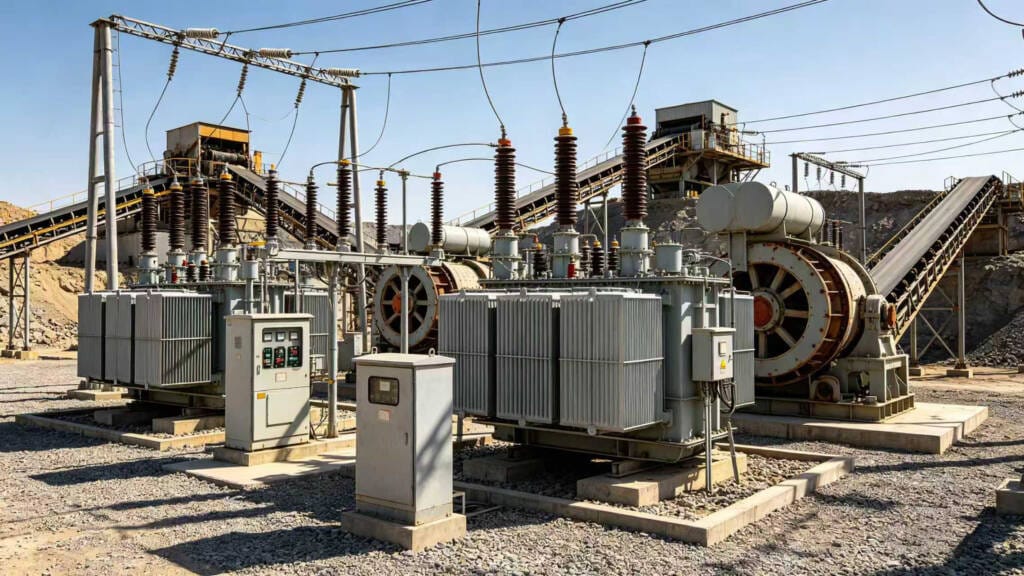
Key benefits of optimized selection include:
- Enhanced operational uptime and equipment longevity
- Improved energy efficiency and lower electricity bills
- Better compliance with stringent safety and environmental regulations
- Reduced maintenance costs over the asset’s lifecycle
- Support for future mine expansion and load growth
This guide emphasizes harsh environment transformers designed specifically for mining duty. These units incorporate reinforced construction, superior insulation, vibration resistance, and appropriate protection ratings. As mining projects push into more remote and challenging locations, proper selection becomes even more vital for long-term success.
Need help with transformer selection for mining on your project?
→Our team offers free initial consultations and load assessments. Get Your Free Consultation
2.Unique Challenges in Mining Power Systems
Mining environments differ dramatically from standard industrial or commercial settings. Understanding these challenges forms the foundation of effective transformer selection for mining projects.
Environmental Stressors:
- High dust and particulate levels that can clog cooling systems and degrade insulation
- Extreme temperature variations (from -40°C in arctic sites to +50°C or higher in desert operations)
- High humidity, rainfall, or corrosive chemicals from ore processing
- Constant heavy vibration from blasting, drilling, and heavy machinery
- Potential for explosive atmospheres in underground coal or gas-prone mines
Electrical Demands:
- High inrush currents from frequent motor starts (crushers, mills, conveyors)
- Significant harmonic distortion caused by variable frequency drives (VFDs), rectifiers, and electronic controls
- Variable load profiles with peaks during full production and lower periods during maintenance
- Remote power sources often involving long transmission lines or on-site generation with voltage fluctuations
Operational and Safety Factors:
- Limited access for maintenance in underground or remote sites
- Strict regulatory requirements for fire safety, explosion protection, and environmental containment
- Need for scalability as mines expand reserves or increase throughput
These conditions make standard commercial transformers inadequate. Specialized mining duty transformers feature robust enclosures (high IP ratings), enhanced cooling options, vibration-dampening mounts, and materials rated for extreme conditions. Ignoring any of these factors during selection often results in premature failures and safety risks.
3.Types of Mining Transformers: Dry-Type vs Oil-Immersed and More
Successful transformer selection for mining requires a clear understanding of available types and their suitability for different applications.
Dry-Type Transformers for Mining
Dry-type transformers use air or solid dielectric materials (such as epoxy resin) for insulation and cooling. They eliminate oil-related risks entirely.
Key Advantages in Mining:
- Superior fire safety — ideal for underground mines and confined spaces where fire hazards must be minimized
- Lower maintenance requirements (no oil sampling or spill containment needed)
- Environmentally friendly with no risk of oil leaks contaminating soil or water
- Suitable for indoor or semi-enclosed substations
Limitations:
- Generally lower efficiency in very high kVA ratings compared to oil-immersed units
- More sensitive to heavy dust unless equipped with high IP-rated enclosures and proper filtration
- Higher initial cost for equivalent capacity
👉Learn more about our range of dry-type transformers for mining here.
Transformadores sumergidos en aceite
These units use mineral oil or environmentally friendly ester fluids for both insulation and superior heat dissipation.
Ventajas:
- Excellent cooling performance, making them suitable for large capacities and hot climates
- Typically more cost-effective for high-power outdoor applications
- Proven long service life (often 30+ years) with proper maintenance
- Better overload capability in many scenarios
Challenges in Mining:
- Higher fire and explosion risk requires additional protections (containment bunds, fire suppression)
- Regular oil testing and maintenance essential
- Less ideal for underground or high-safety zones without extensive engineering controls
Specialized Mining Transformer Variants
- Pad-Mounted Transformers: Compact, tamper-resistant designs for surface operations
- Skid-Mounted or Mobile Units: For temporary camps, exploration sites, or relocating equipment
- K-Factor Rated Transformers: Specifically designed to handle harmonic loads from VFDs and power electronics (K-4, K-13, or higher)
- Substation Transformers: For main power intake and distribution
- Grounding Transformers: Essential for system protection and fault current management
Detailed Comparison Table: Dry-Type vs Oil-Immersed in Mining Contexts
| Característica | Transformadores de tipo seco | Transformadores sumergidos en aceite |
|---|---|---|
| Cooling Medium | Air / Solid Resin | Mineral Oil or Ester Fluid |
| Fire & Explosion Risk | Muy bajo | Higher (requires mitigation) |
| Maintenance Requirements | Bajo | Medium to High (oil analysis critical) |
| Efficiency at High Loads | Good | Generally Superior |
| Best Applications | Underground, indoor, high-safety areas | Outdoor substations, surface mining, large kVA |
| Initial Cost | Higher | Lower |
| Environmental Impact | Minimal | Requires spill containment |
| Dust & Vibration Resistance | Good with proper enclosure | Excellent with robust tank design |
| Typical Lifespan | 20-30+ years | 25-40+ years with maintenance |
Selection between these types should align with site-specific risk assessments, installation location, capacity needs, and regulatory demands.
4.Step-by-Step Transformer Selection for Mining Projects
A systematic approach ensures optimal transformer selection for mining.
Step 1: Conduct Comprehensive Load Assessment Gather data on all equipment, calculate connected loads, apply diversity and demand factors, and project future expansion.
Step 2: Analyze Site and Environmental Conditions Perform detailed surveys covering altitude, ambient temperatures, dust levels, hazardous area classification (Zone 0/1/2 or equivalent), and installation constraints.
Step 3: Define Voltage Requirements Specify primary and secondary voltages, vector groups, and tap changer needs to match grid supply and downstream equipment.
Step 4: Select Transformer Type and Cooling Method Decide between dry-type and oil-immersed based on safety, location, and performance needs. Choose appropriate cooling class (AN, AF, ONAN, ONAF, etc.).
Step 5: Specify Performance and Protection Features Include impedance, efficiency class, BIL (Basic Impulse Level), K-factor, short-circuit withstand, and enclosure ratings.
Step 6: Ensure Compliance with Standards Verify certifications for the target region and mine type.
Step 7: Perform Total Cost of Ownership (TCO) Analysis Compare initial purchase price against efficiency gains, maintenance, downtime risks, and lifecycle costs. Engage reputable suppliers early for custom options.
Applying these seven steps correctly can save your project hundreds of thousands in downtime and maintenance costs.
5.Transformer Sizing and kVA Calculation for Mining Loads
Adecuado transformer sizing prevents overheating, reduces losses, and extends equipment life. A widely recommended practice is to size transformers so they operate around 80% of rated capacity under peak expected loads. This provides headroom for harmonics, inrush currents, and future growth.
Basic Calculation Formulas:
Single-Phase: kVA = (Voltage × Current) / 1000
Trifásico: kVA = (Voltage × Current × √3) / 1000
From kW: kVA = kW / Power Factor
Practical Mining Example: A surface mine section has 1,200 kW of connected motor loads with an average power factor of 0.85. Initial calculation: 1,200 / 0.85 ≈ 1,412 kVA. Adding 25-35% margin for inrush, harmonics, and expansion suggests a 1,750–2,000 kVA transformer. Always select the next standard size upward.
Recommended Sizing Margins Table for Mining Applications
| Tipo de carga | Recommended Margin | Primary Reasons |
|---|---|---|
| Steady Continuous Loads | 15-20% | Basic growth and efficiency |
| Motor-Heavy with Frequent Starts | 25-40% | High inrush currents |
| High Harmonic Content (VFDs) | 30-50% | Additional heating from harmonics |
| Underground Operations | 25-35% | Reliability in difficult access areas |
| Projects with Expansion Plans | 40%+ | Scalability over mine life |
Additional considerations include altitude derating (reduced air density affects cooling), ambient temperature corrections, and detailed load flow studies using software tools. Consult manufacturers for precise recommendations on your specific duty cycle.
6.Key Specifications and Standards for Mining Duty Transformers
Critical specifications for mining transformers include:
- High IP ratings (IP54 or better) for dust and water ingress
- Temperature rise limits and insulation classes (F or H)
- Enhanced mechanical strength for vibration
- Efficiency standards meeting or exceeding IEC or regional requirements
- Harmonic withstand capability (K-factor ratings)
- Appropriate BIL for lightning and switching surges in remote areas
Major Standards:
- CEI 60076 series for power transformers
- ATEX and IECEx for hazardous area equipment (especially underground)
- Local mining regulations (e.g., MSHA in the US, equivalent bodies elsewhere)
- IEEE standards where applicable for North American projects
Compliance ensures safety, insurability, and operational approval.
7.Common Selection Mistakes and How to Avoid Them
- Undersizing for Real Operating Conditions — Ignoring harmonics and inrush leads to overheating. Solution: Always apply proper margins and perform harmonic analysis.
- Choosing Based Solely on Lowest Price — Results in higher lifecycle costs. Solution: Use TCO calculations.
- Neglecting Environmental Matching — Standard units fail quickly in dust or vibration. Solution: Specify mining-duty features.
- Poor Power Quality Consideration — Harmonics shorten life. Solution: Select K-rated units when VFDs dominate.
- Inadequate Supplier Evaluation — Lack of support in remote sites. Solution: Choose manufacturers with proven mining experience and local service networks.
8.Real-World Case Studies in Mining Transformer Applications
Case 1: Underground Coal Mine (Dry-Type Solution) A project in a high-safety zone replaced aging oil units with custom low-profile dry-type transformers. Results included zero fire incidents over five years, reduced maintenance, and better space utilization.
Case 2: Large Surface Copper Mine (Oil-Immersed Upgrade) Switching to properly K-rated, high-efficiency oil-immersed units with forced cooling cut energy losses by 12% and improved reliability during peak production, delivering significant ROI within 18 months.
These examples highlight how expert transformer selection for mining translates directly into measurable operational gains.
9.Maintenance and Lifecycle Management Best Practices
Even the best-selected transformers require proactive care:
- Regular thermographic inspections
- Oil sampling and analysis (for immersed units)
- Insulation resistance testing
- Vibration monitoring
- Online dissolved gas analysis (DGA) for critical assets
- Scheduled cleaning of cooling surfaces
Predictive maintenance programs can extend service life well beyond 30 years while preventing unexpected failures.
10.Conclusion
Transformer selection for mining projects demands careful balancing of technical performance, environmental resilience, safety compliance, and economic factors. By following the structured approach in this guide—assessing loads thoroughly, matching types to conditions, sizing appropriately with margins, and partnering with experienced suppliers—you can build a robust, future-proof power infrastructure.
Ready to optimize power reliability on your site? Contact our mining power specialists today for a free consultation, detailed load assessment support, custom TCO analysis, or a tailored Mining Transformer Selection Checklist. Our team has supported dozens of successful mining projects worldwide and stands ready to help yours succeed.
Proper transformer selection for mining projects is essential for safety, reliability, and profitability in today’s demanding mining environment.