1.Introduction
Selecting the right cooling method is one of the most critical decisions when specifying oil immersed transformers. The ONAN ONAF OFAF selection directly affects a transformer’s load capacity, operational reliability, lifespan, maintenance requirements, and long-term costs.
In solar power plants, industrial facilities, and substations across Southeast Asia — where ambient temperatures frequently exceed 35°C and humidity is high — choosing incorrectly can lead to excessive hotspot temperatures, accelerated insulation aging, forced derating, or unexpectedly high maintenance expenses.
This comprehensive guide focuses on how to choose transformer cooling method among the three most common options for oil immersed transformers: ONAN (Oil Natural Air Natural), ONAF (Oil Natural Air Forced), and OFAF (Oil Forced Air Forced). We go beyond basic explanations to deliver a practical transformer cooling selection guide that engineers, project managers, and procurement teams can use for real-world decision making.
Whether you are designing a new photovoltaic substation or evaluating upgrades for an existing installation, understanding the ONAN vs ONAF vs OFAF differences will help you balance performance, cost, and reliability.
For readers who want foundational knowledge of ONAN and ONAF principles, we recommend our earlier article: “Oil Transformer Cooling Methods: ONAN vs ONAF Explained“.
Inhaltsverzeichnis (TOC)
- Einführung
- Why Proper ONAN ONAF OFAF Selection Matters for Oil Immersed Transformers
- Understanding Transformer Cooling Basics and IEC 60076 Naming
- Detailed Breakdown of ONAN, ONAF, and OFAF Cooling Methods
- ONAN vs ONAF vs OFAF: Comprehensive Comparison Table
- Practical ONAN ONAF OFAF Selection Guide: Key Decision Factors
- Impact of Cooling Method on Transformer Life, Efficiency, and Total Ownership Cost
- Common Mistakes in Transformer Cooling Selection and How to Avoid Them
- ONAN ONAF OFAF Selection for Solar Power Plants and High-Temperature Environments
- FAQ: Frequently Asked Questions about ONAN ONAF OFAF Selection
- Conclusion: Making the Smart Choice for Your Project
2.Why Proper ONAN ONAF OFAF Selection Matters for Oil Immersed Transformers
Oil immersed transformers generate significant heat from core losses (no-load) and copper losses (load). Without effective heat dissipation, the insulating oil and paper insulation degrade rapidly. According to insulation aging principles (often called the “Montsinger rule” or six-degree rule), every 6–8°C increase in hotspot temperature above the design limit can roughly halve the expected service life of the transformer.
ONAN ONAF OFAF selection influences several key performance metrics:
- Maximum continuous and overload capacity
- Hotspot temperature under different ambient conditions
- Noise levels and auxiliary power consumption
- Initial capital cost versus lifecycle ownership cost
- Maintenance complexity and spare parts strategy
In tropical regions like Singapore, Malaysia, Indonesia, and Thailand, high ambient temperatures reduce the transformer’s thermal margin. A poorly chosen cooling method can force operators to derate the unit or face premature failure, directly impacting project ROI in solar energy systems where transformers often operate under variable daytime loads.
Proper selection ensures the transformer stays within IEC 60076 temperature rise limits (typically 60K top-oil and 78K hotspot rise for ONAN/ONAF/OFAF) while optimizing for site-specific conditions.
3.Understanding Transformer Cooling Basics and IEC 60076 Naming
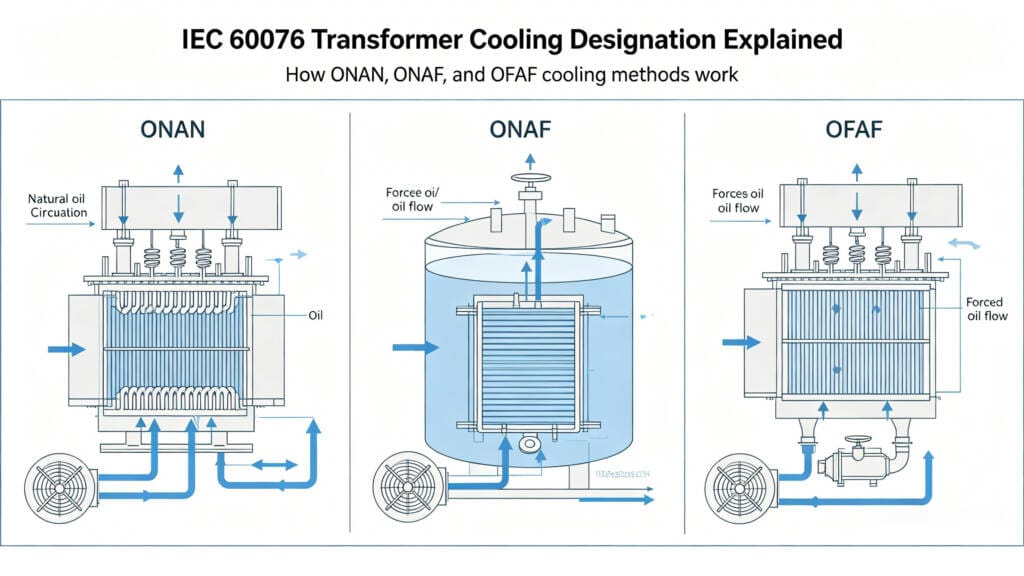
The IEC 60076 standard uses a four-letter code to describe cooling methods clearly:
- First letter (O): Mineral oil (or alternative insulating liquid) as the internal cooling medium.
- Second letter: Circulation method of the oil — N (Natural) or F (Forced, via pumps).
- Third letter: External cooling medium — A (Air).
- Fourth letter: Circulation method of the external medium — N (Natural) or F (Forced, via fans).
This results in the common designations:
- ONAN: Oil Natural – Air Natural
- ONAF: Oil Natural – Air Forced
- OFAF: Oil Forced – Air Forced
Natural circulation in ONAN and ONAF relies on the thermosiphon effect: hotter, less dense oil rises through the windings and radiators, while cooler oil sinks. Forced methods add mechanical assistance (fans or pumps) to dramatically improve heat transfer rates.
Understanding these fundamentals is the first step in any oil immersed transformer cooling selection.
4.Detailed Breakdown of ONAN, ONAF, and OFAF Cooling Methods
ONAN (Oil Natural Air Natural) ONAN is the simplest and most reliable cooling method. Heat is dissipated through natural convection of oil inside the tank and natural airflow over external radiators. No fans or pumps are required during normal operation.
Advantages: Lowest maintenance, silent operation, lowest auxiliary power use, and minimal initial cost. Limitations: Cooling capacity is limited by radiator surface area and ambient conditions. It is best suited for smaller to medium transformers (typically up to 25–30 MVA) with relatively stable loads.
ONAF (Oil Natural Air Forced) ONAF builds on the ONAN design by adding radiator-mounted fans that force air across the cooling surfaces when activated (usually by temperature sensors). Oil circulation remains natural.
This method typically provides a 25% to 40% capacity increase compared to ONAN rating, depending on transformer size and design. For many units, the nameplate shows dual ratings, such as 20/25 MVA (ONAN/ONAF).
Advantages: Significant capacity boost with moderate added cost and complexity. Good for variable or peak loads common in solar plants. Limitations: Fans introduce noise and require periodic maintenance (bearings, motors, controls).
OFAF (Oil Forced Air Forced) OFAF uses oil pumps to force oil through the windings and coolers, combined with fans for air cooling. This creates much higher heat transfer efficiency.
OFAF is typically applied to large power transformers (above 40 MVA) or projects with severe space constraints or very high load densities. It can deliver up to 50–67% or more capacity compared to a pure ONAN base in some designs.
Advantages: Highest cooling performance, excellent for large MVA ratings and overload conditions. Limitations: Highest initial and maintenance costs due to pumps, more complex controls, and higher noise levels.
5.ONAN vs ONAF vs OFAF: Comprehensive Comparison Table
The table below provides a clear side-by-side view to support your ONAN ONAF OFAF selection process:
| Aspect | ONAN (Oil Natural Air Natural) | ONAF (Oil Natural Air Forced) | OFAF (Oil Forced Air Forced) |
|---|---|---|---|
| Oil Circulation | Natural (thermosiphon) | Natural | Forced (oil pumps) |
| Air Cooling | Natural convection | Forced (fans) | Forced (fans) |
| Typical Capacity Range | Up to 25–30 MVA | 10–60 MVA | 40 MVA and above |
| Capacity Increase vs ONAN | Base (100%) | +25% to +40% | Up to +50–67% or higher |
| Initial Cost | Lowest | Medium (+5–10%) | Highest (+15–25% over ONAF) |
| Maintenance Requirements | Minimal | Medium (fan inspection & servicing) | High (pumps + fans) |
| Noise Level | Lowest (silent) | Moderate when fans operate | Highest |
| Auxiliary Power Consumption | None | Low to medium (fans) | Higher (pumps + fans) |
| Footprint / Space Needed | Larger radiators required | Mäßig | More compact for equivalent MVA |
| Best Suited For | Stable loads, smaller units, residential areas | Variable loads, medium power, substations | Large capacity, space-limited, heavy industrial |
| Reliability in High Ambient | Good up to ~40°C with proper sizing | Better thermal margin | Best for extreme conditions |
This comparison highlights why transformer cooling selection guide must consider more than just upfront price.
6.Practical ONAN ONAF OFAF Selection Guide: Key Decision Factors
Effective ONAN ONAF OFAF selection follows a structured evaluation of these factors (in approximate order of importance):
- Transformer Rated Capacity (MVA/kVA)
- Below 10 MVA: ONAN is often sufficient and most economical.
- 10–60 MVA: ONAF provides excellent flexibility.
- Above 40–50 MVA or space-constrained sites: Consider OFAF.
- Load Profile Steady base load favors ONAN. Frequent peaks or daily cycling (common in solar PV) benefit from ONAF or OFAF for better overload capability.
- Ambient Temperature and Environment In Southeast Asia (average 30–35°C, peaks over 40°C), the thermal margin shrinks. ONAF or OFAF often delivers better long-term performance than pure ONAN in hot climates.
- Installation Space and Noise Restrictions Urban or residential areas may limit fan/pump noise, favoring ONAN or carefully controlled ONAF.
- Lifecycle Cost (LCC) Analysis Include capital cost, energy for auxiliaries, maintenance, and downtime. Forced cooling can reduce losses and extend life enough to offset higher upfront investment.
- Maintenance Capability Remote solar plants with limited technical staff usually prefer simpler ONAN or ONAF over OFAF.
Rule-of-Thumb Recommendations:
- Small distribution transformers (< 5 MVA): ONAN
- Medium power transformers with variable solar loads: ONAN/ONAF dual-rated
- Large generation step-up or grid connection transformers: Evaluate OFAF carefully
Always validate with detailed thermal calculations and manufacturer input for your exact site conditions.

7.Impact of Cooling Method on Transformer Life, Efficiency, and Total Ownership Cost
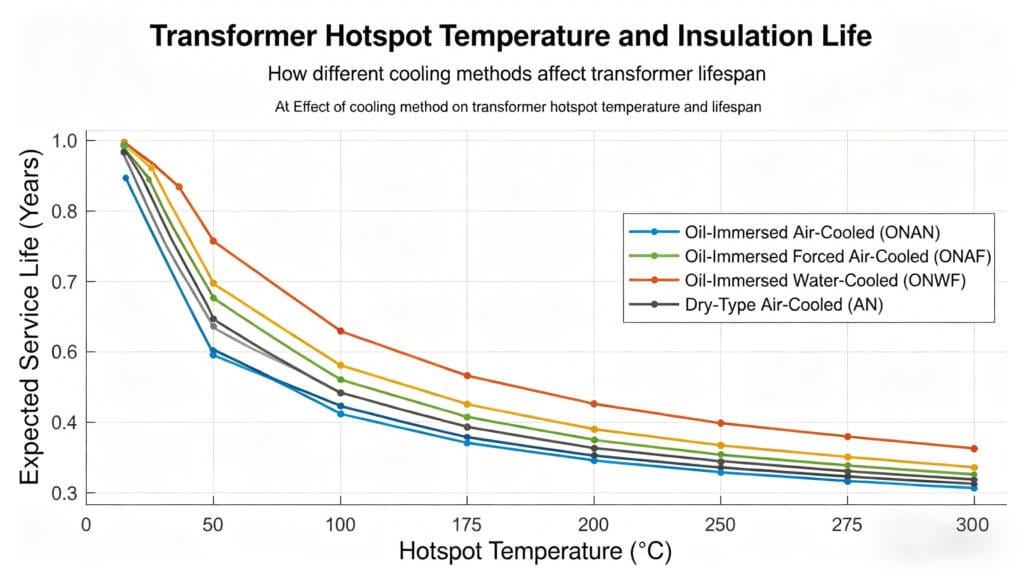
Hotspot temperature is the single most important factor for insulation life. IEC 60076-7 provides loading guides that show how different cooling methods affect thermal performance under various loads and ambients.
In high-temperature environments, ONAN units may reach top-oil temperatures close to limits quickly, while ONAF can keep hotspot temperatures 10–15°C lower under the same load, significantly slowing aging.
Lifecycle Cost Considerations:
- ONAN: Lowest capital and maintenance, but may require a larger unit (more material) to achieve the same effective capacity.
- ONAF: Moderate added cost for fans, but often the sweet spot for cost vs performance in solar applications.
- OFAF: Higher capital and O&M, justified only when capacity density or space is critical.
Studies and field data show that proper ONAN ONAF OFAF selection can reduce total ownership costs by 10–30% over 25–30 years through optimized sizing, lower losses, and extended service life.
When fans or pumps fail, most designs allow temporary derating back to a lower cooling stage, but this must be planned in the specification.
8.Common Mistakes in Transformer Cooling Selection and How to Avoid Them
- Focusing Only on Initial Price — This often leads to undersized ONAN units that require derating later.
- Ignoring Local Ambient Conditions — Using standard 40°C design ratings without adjustment for Southeast Asian climates.
- Over-specifying OFAF — Adding unnecessary pumps and complexity for medium-sized projects, inflating maintenance budgets.
- Neglecting Dual or Triple Ratings — Missing the opportunity to specify ONAN/ONAF or ONAN/ONAF/OFAF for future-proofing.
- Poor Fan/Pump Control Strategy — Automatic staged operation based on temperature/load is essential for efficiency and longevity.
Avoid these by conducting a full technical and economic evaluation with your supplier early in the project.
9.ONAN ONAF OFAF Selection for Solar Power Plants and High-Temperature Environments
Solar PV projects present unique challenges: high daytime loads that drop at night, elevated ambient temperatures near inverters and trackers, and often remote locations with limited maintenance access.
In such applications, ONAF frequently offers the best balance. The forced-air stage activates during peak generation hours, providing the needed thermal headroom without the constant power draw and maintenance burden of oil pumps in OFAF.
For very large central inverters or high-capacity step-up transformers, OFAF may be necessary to minimize footprint inside compact substations.
Key recommendations for solar plants in Southeast Asia:
- Specify transformers with robust corrosion protection and sealed designs.
- Consider ONAN/ONAF dual ratings with smart fan controls.
- Factor in expected overload profiles from PV generation curves.
- Request detailed thermal modeling that includes local weather data.
10.FAQ: Frequently Asked Questions about ONAN ONAF OFAF Selection
Q1: What is the typical capacity gain when moving from ONAN to ONAF?
A: Usually 25–40%, with smaller transformers gaining around 15–25% and larger ones up to 33% or more per fan stage.
Q2: When should I choose OFAF over ONAF?
A: For transformers above ~40–60 MVA, when space is extremely limited, or when very high continuous or emergency overload capability is required.
Q3: How does high ambient temperature affect ONAN ONAF OFAF selection?
A: Higher ambients reduce cooling effectiveness. In tropical climates, ONAF or OFAF often becomes necessary to maintain full rated capacity without excessive aging.
Q4: Can I upgrade an existing ONAN transformer to ONAF later?
A: In many cases yes, if the transformer was designed with future fan mounting provisions. However, professional assessment and possible radiator modifications are required.
Q5: Which cooling method is best for solar power plants?
A: ONAF is the most popular choice for medium-to-large PV substation transformers due to its flexibility and favorable lifecycle cost.
11.Conclusion: Making the Smart Choice for Your Project
There is no universal “best” cooling method — the optimal ONAN ONAF OFAF selection depends on your specific transformer rating, load profile, site ambient conditions, space constraints, noise limits, and total cost of ownership goals.
By following this transformer cooling selection guide, you can make informed decisions that enhance reliability and economics, especially in demanding solar and industrial applications across Southeast Asia.
If you have an upcoming oil immersed transformer project, our team is ready to help. Share your key parameters — capacity, ambient temperature range, load profile, installation location, and any special requirements — and we will provide a professional ONAN ONAF OFAF selection recommendation along with competitive quotations.
👉Contact us today to discuss your transformer cooling needs.