1.Introduction
In today’s healthcare landscape, uninterrupted and safe power supply is not a luxury—it’s a life-critical necessity. Hospitals operate 24/7, powering life-support equipment, operating rooms, diagnostic imaging systems, and thousands of sensitive devices that directly impact patient outcomes. At the heart of this infrastructure lies the hospital transformer, a vital component responsible for stepping down voltage and distributing reliable electricity throughout the facility.
Among the various types available, dry type transformers (also known as cast resin or air-cooled hospital transformers) have emerged as the gold standard for modern medical facilities. Unlike traditional oil-filled transformers, dry type hospital transformers eliminate flammable liquids, significantly reducing fire risks while meeting stringent safety and environmental standards.
This comprehensive guide explores why dry type transformers represent the only truly safe choice for hospital power supply. Drawing from industry best practices, international standards, and real-world performance data, we will examine their technical advantages, compliance benefits, and long-term value. Whether you’re a hospital facility manager, electrical engineer, or healthcare administrator, understanding these systems is essential for ensuring patient safety and operational resilience.
Hospitals face unique challenges: high load variability, zero tolerance for downtime, strict fire codes, and the need for low electromagnetic interference near sensitive equipment. Oil-filled transformers, while common in industrial settings, introduce unacceptable risks in occupied healthcare environments. Dry type hospital transformers address these concerns head-on, offering superior safety, reliability, and compliance.
By the end of this article, you’ll have a clear understanding of why leading healthcare institutions worldwide are transitioning to dry type solutions—and how your facility can benefit.
Ready to ensure your hospital’s power infrastructure meets the highest safety standards?
👉Contact our team for a free preliminary consultation on selecting the right hospital transformer.
Inhaltsverzeichnis (TOC)
- Einführung
- The Unique Power Demands of Hospital Electrical Systems
- Understanding Hospital Transformers: Dry Type vs. Oil-Filled
- Why Dry Type Hospital Transformers Excel in Fire Safety
- Reliability and Continuous Operation in Critical Care
- Regulatory Compliance and Industry Standards
- Additional Benefits: Noise, Environment, and Maintenance
- Real-World Applications and Case Studies
- How to Select the Right Hospital Transformer
- Common Questions About Hospital Transformers (FAQ)
- h-11-conclusion-investing-in-safety-and-reliability
2.The Unique Power Demands of Hospital Electrical Systems
Hospitals are among the most power-intensive and safety-sensitive buildings in existence. A typical large hospital may consume several megawatts of electricity, with critical loads requiring near-perfect uptime. Power failures can lead to catastrophic consequences, from interrupted surgeries to failed life-support systems.
Key requirements for hospital power systems include:
- High Reliability and Redundancy: Essential electrical systems (per NFPA standards) must include backup generators and seamless transfer capabilities. Hospital transformers play a central role in distributing this power safely.
- Fire Safety: Any fire hazard in a hospital can endanger hundreds of immobile patients. Electrical fires from transformers are a documented concern in healthcare settings.
- Low Noise and Vibration: Equipment must operate quietly near patient areas, ICUs, and operating theaters.
- Environmental and Health Safety: No risk of oil leaks contaminating sterile environments or releasing toxic fumes.
- Compliance with Codes: Adherence to NFPA 70 (National Electrical Code), NFPA 99 (Health Care Facilities Code), IEC 60076-11, and local regulations.
Traditional oil-immersed transformers, which use mineral oil for insulation and cooling, have been used historically but pose inherent risks in these environments. Leaks, fire propagation, and the need for special containment vaults make them less suitable indoors. This is where dry type hospital transformers provide a compelling, safer alternative.
Hospitals must also contend with power quality issues, harmonics from medical imaging equipment (MRI, CT scanners), and the need for isolation to protect sensitive electronics. Dry type designs handle these demands effectively while minimizing maintenance disruptions.
3.Understanding Hospital Transformers: Dry Type vs. Oil-Filled
A hospital transformer is typically a distribution transformer that steps down medium voltage (e.g., 11kV or 33kV) to low voltage (400V/230V) for end-use equipment. The two primary categories are dry type and oil-filled (liquid-immersed).
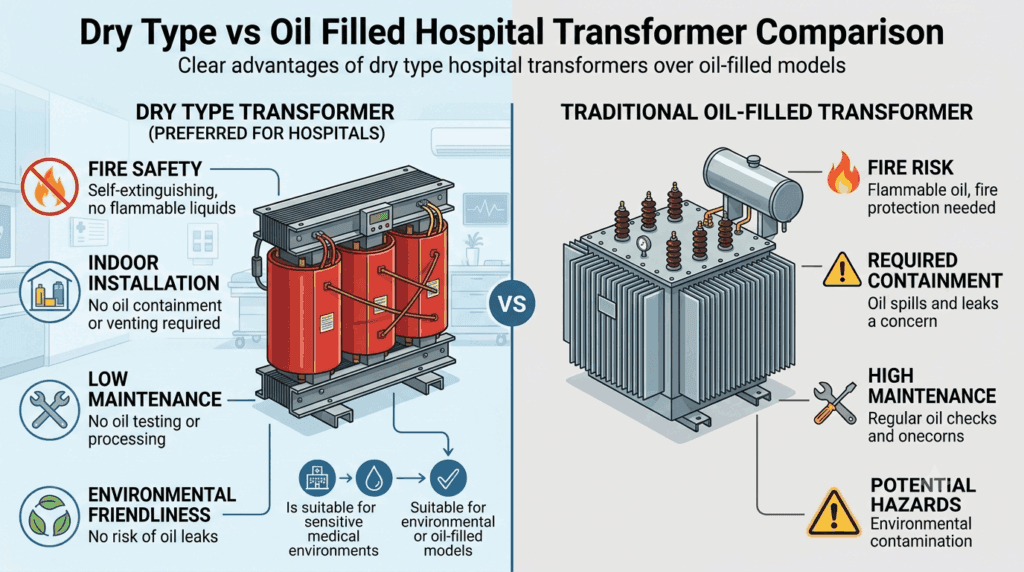
Key Differences: A Comparative Overview
| Besonderheit | Dry Type Hospital Transformer | Oil-Filled Transformer |
|---|---|---|
| Cooling Method | Air (natural/forced) or Cast Resin | Mineral Oil or Ester Fluids |
| Fire Risk | Very Low (Self-extinguishing, F0/F1 rated) | Higher (Flammable liquid) |
| Installation Location | Indoor, near occupied spaces | Often requires outdoor vaults or containment |
| Maintenance | Minimal (Visual inspections) | Regular oil testing, filtration, leak checks |
| Environmental Impact | None (No leaks) | Risk of oil spills and contamination |
| Noise Level | Low (50-60 dB typical) | Higher due to oil circulation |
| Lifespan | 25-40+ years with proper care | Similar, but maintenance-intensive |
| Initial Cost | Higher | Lower |
| Total Cost of Ownership | Lower long-term | Higher due to maintenance & safety measures |
Dry type transformers use solid insulation materials like epoxy resin (cast resin type) or vacuum pressure impregnation (VPI). Cast resin hospital transformers encapsulate windings in resin, providing excellent protection against moisture, dust, and mechanical stress. This makes them ideal for the demanding hospital environment.
Oil-filled units rely on dielectric oil for both insulation and heat dissipation. While efficient for high-power outdoor applications, they are problematic indoors due to fire and spill risks.
In hospitals, dry type options—particularly cast resin models—dominate new installations and retrofits because they align with modern safety priorities.
According to IEC 60076-11, dry type transformers must meet rigorous performance and fire behavior criteria, making them particularly suitable as hospital transformers.
4.Why Dry Type Hospital Transformers Excel in Fire Safety
Fire safety is the paramount reason healthcare facilities choose dry type hospital transformers. Hospitals are classified as high-risk occupancies under fire codes, with patients who may be unable to evacuate quickly.
Dry type transformers are inherently fire-resistant:
- No Flammable Liquids: Eliminates the risk of oil pool fires or explosions.
- Self-Extinguishing Materials: Cast resin designs achieve Class F1 fire behavior (self-extinguishing, low smoke, low toxicity) per IEC 60076-11.
- Lower Fire Load: Significantly reduces the overall combustible load in electrical rooms.
- Compliance with NFPA 70/NEC: Allows indoor installation without the extensive fire suppression or vault requirements often mandated for oil-filled units.
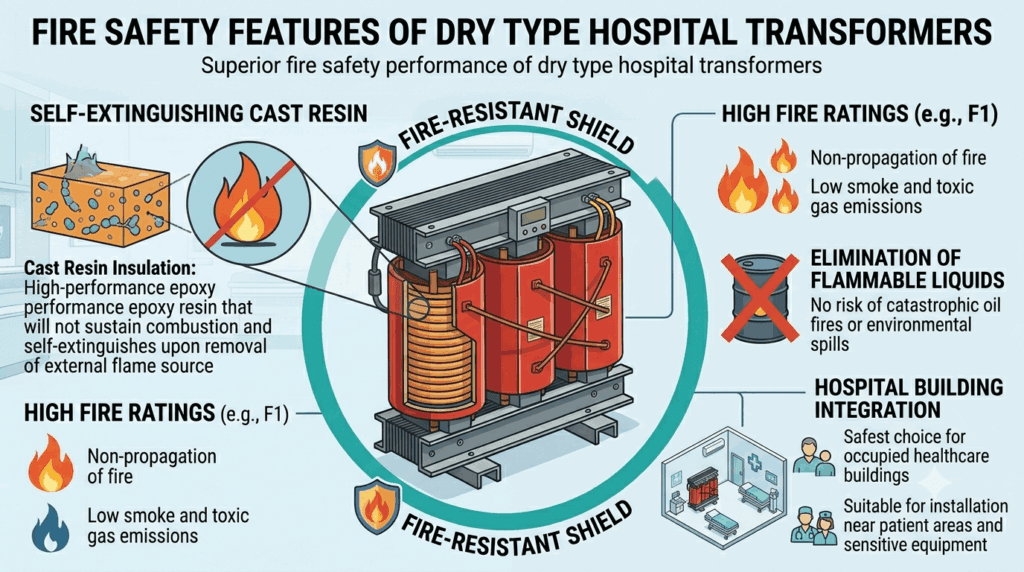
Real-world data and industry reports show that transformer-related fires, though rare, can have devastating effects in healthcare. By choosing dry type solutions, facilities minimize this risk dramatically. Fire marshals and insurers often prefer or require dry type transformers in occupied buildings.
In the event of an internal fault, dry type units are less likely to propagate fire or release toxic gases, protecting both patients and first responders.
5.Reliability and Continuous Operation in Critical Care
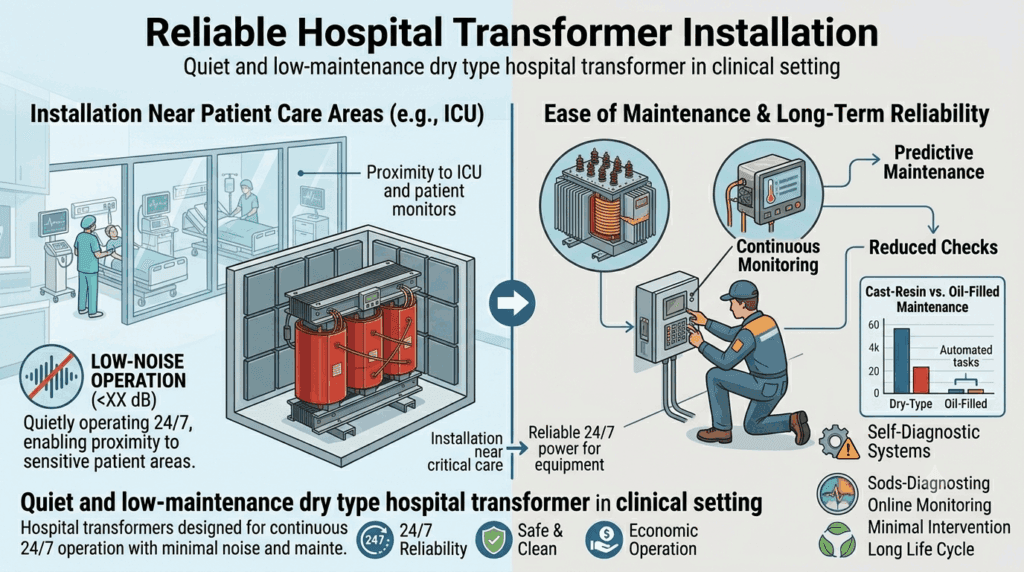
Hospitals cannot afford downtime. Dry type hospital transformers support high reliability through:
- Robust Overload Capability: They handle temporary overloads common during peak demand or emergencies.
- Excellent Thermal Performance: Advanced cooling designs maintain stable operation.
- Resistance to Short Circuits: Cast resin encapsulation provides superior mechanical strength.
- Minimal Partial Discharge: Ensures long-term insulation integrity.
These transformers integrate seamlessly with emergency power systems, including generators and UPS units, ensuring seamless transitions. Their low maintenance profile means fewer scheduled shutdowns, critical for 24/7 facilities.
6.Regulatory Compliance and Industry Standards
Dry type hospital transformers excel in meeting key standards:
- NFPA 70 (NEC) Article 450: Governs transformer installations, favoring non-combustible types indoors.
- NFPA 99: Healthcare-specific requirements for essential electrical systems.
- IEC 60076-11: Dedicated to dry-type power transformers, covering fire behavior and testing.
- IEEE C57.12.01: General requirements for dry-type units.
- Local codes (e.g., in Europe, Asia, or the US) often mandate or strongly recommend dry type for healthcare.
Using compliant hospital transformers simplifies inspections, insurance approvals, and accreditation processes (e.g., Joint Commission).
7.Additional Benefits: Noise, Environment, and Maintenance
Low Noise and Vibration: Critical near patient areas—dry type units operate quieter, improving comfort and reducing interference with sensitive diagnostics.
Environmental Friendliness: No oil means no spill containment, lower environmental risk, and easier end-of-life recycling.
Reduced Maintenance: No oil sampling or dielectric testing required. Periodic visual and thermal checks suffice, lowering operational costs and disruption.
Space Efficiency and Flexibility: Compact designs suit tight electrical rooms; indoor placement reduces cabling runs.
Electromagnetic Compatibility: Lower stray fields benefit MRI and other imaging equipment.
8.Real-World Applications and Case Studies
Numerous hospitals worldwide rely on dry type hospital transformers. In urban medical centers, they enable safe indoor substations close to critical loads. Data centers within hospitals (for EHR systems) also favor them for similar reasons.
Examples include installations in high-rise hospital towers where fire safety and space constraints are paramount. Facilities report improved uptime, easier compliance, and reduced insurance premiums after upgrading to dry type solutions.
9.How to Select the Right Hospital Transformer
Consider these factors:
- Capacity and Voltage: Match to load profile (e.g., 500kVA–5MVA common).
- Insulation Class: Class F or H for better thermal margins.
- Protection Rating: IP ratings for dust/moisture.
- Kühlung: AN (natural air) or AF (forced air) for higher loads.
- Efficiency Standards: Meet or exceed DOE or local efficiency mandates.
- Accessories: Temperature monitoring, surge protection.
Consult qualified engineers and work with experienced suppliers for custom solutions tailored to hospital needs.
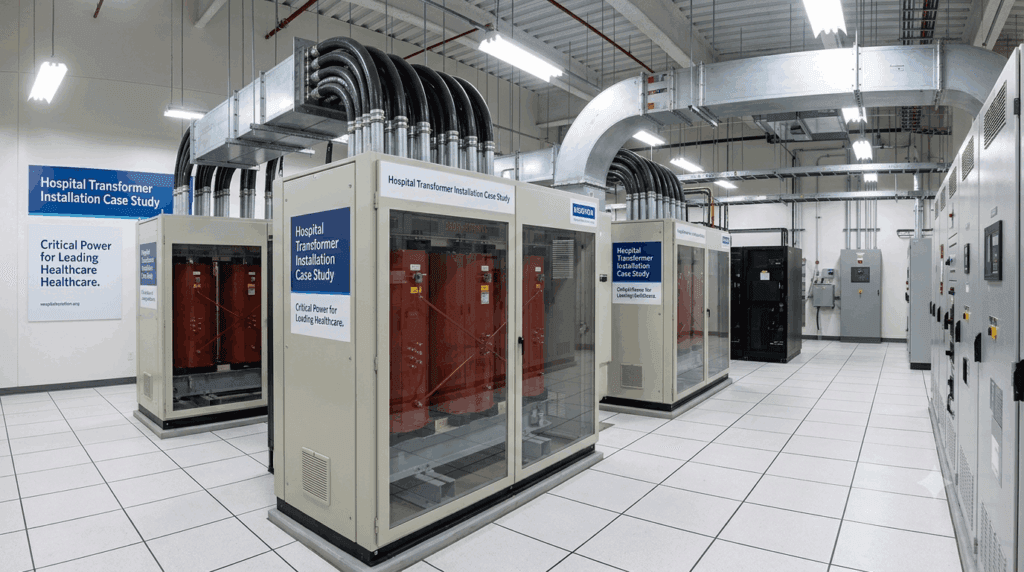
Choosing the right hospital transformer requires careful evaluation of load, environment, and compliance needs.
10.Common Questions About Hospital Transformers (FAQ)
Q: Are dry type hospital transformers more expensive?
A: Higher upfront cost, but lower TCO due to safety, maintenance, and longevity benefits.
Q: Can they handle hospital peak loads?
A: Yes, with proper sizing and overload capabilities.
Q: What about maintenance?
A: Significantly less than oil-filled; focus on cleanliness and connections.
Q: Do they comply with all standards?
A: When properly specified, yes—NFPA, IEC, etc.
Q: Are they suitable for retrofits?
A: Often yes, with planning for space and ventilation.
11.Conclusion: Investing in Safety and Reliability
Dry type hospital transformers are not just an alternative—they are the only safe, responsible choice for modern healthcare power supply. By eliminating fire risks, ensuring compliance, reducing maintenance, and supporting uninterrupted operation, they protect patients, staff, and infrastructure while delivering excellent long-term value.
As healthcare demands grow—with more technology, stricter regulations, and higher patient expectations—investing in the right hospital transformer is crucial. Facilities managers should prioritize dry type solutions in new builds and upgrades.
If your hospital is evaluating power infrastructure upgrades, consult experts for a tailored assessment. The safety of your patients and the reliability of your operations depend on it.
Ready to enhance your hospital’s power safety?
👉Contact our team for a free consultation, load study, or dry type transformer recommendation.