1.Introduction to Transformer Price Factors
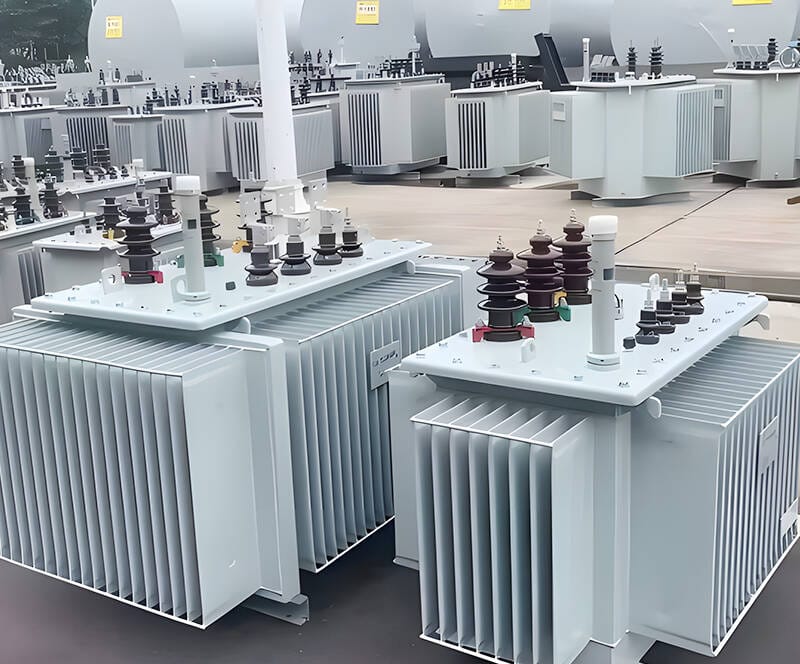
Understanding transformer price factors is essential for any business involved in power distribution, industrial systems, or renewable energy projects. Transformer pricing is not fixed. It varies widely depending on technical specifications, material selection, engineering design, and market conditions.
Many buyers assume that transformer cost depends only on capacity. In reality, multiple factors affecting transformer price work together to determine the final quotation. Two transformers with the same kVA rating can differ in price by 30%–70% depending on design, efficiency, and customization.
This guide explains the most important transformer cost factors in detail. It also provides practical insights to help you make informed purchasing decisions and avoid costly mistakes.
If you are evaluating different transformer price factors, working with an experienced transformer manufacturer can help you better understand specifications, pricing structures, and customization options for your project.
جدول المحتويات
- Introduction to Transformer Price Factors
- Capacity (kVA/MVA) – The Primary Transformer Price Factor
- Voltage Level and Insulation Requirements
- Core and Winding Materials (Copper vs Aluminum)
- Cooling Method as a Key Transformer Price Factor
- Transformer Design and Configuration
- Efficiency and Energy Loss Considerations
- Customization and Special Requirements
- Standards, Certifications, and Testing
- Market Conditions and Raw Material Prices
- Total Cost of Ownership (TCO)
- How to Reduce Transformer Cost Without Sacrificing Quality
- Real Transformer Price Example (For Buyers)
- Conclusion: Understanding Transformer Price Factors Before Buying
- التعليمات
2. Capacity (kVA/MVA) – The Primary Transformer Price Factor
Capacity is the most fundamental transformer price factor.
The larger the transformer capacity, the higher the cost. This increase is driven by:
- More copper or aluminum windings
- Larger magnetic core
- Increased insulation materials
- Bigger tank and cooling system
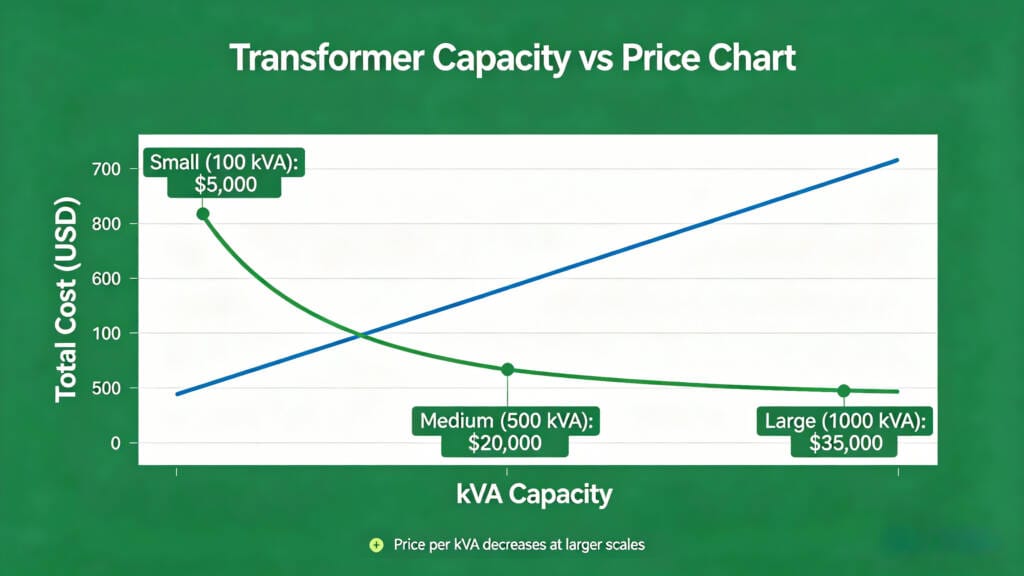
However, transformer cost does not grow linearly with capacity. Instead, it follows a scaling curve:
- Small transformers (≤100 kVA): low cost per unit
- Medium transformers (500 kVA – 5 MVA): optimized cost range
- Large transformers (>50 MVA): exponential cost increase
For example, if your project requires a medium-capacity unit, selecting the right 500 kVA transformer أو 1000 kVA transformer can help balance performance and cost efficiency.
Why capacity impacts price significantly
Higher capacity requires stronger electromagnetic design and thermal management. Manufacturers must ensure stability under full load conditions, which increases engineering complexity.
Key takeaway
When evaluating transformer price per kVA, remember that:
- Larger units may offer better cost efficiency per kVA
- But total investment rises sharply
3. Voltage Level and Insulation Requirements
Voltage level is one of the most critical transformer price factors.
As voltage increases, insulation requirements become significantly more complex. This directly affects cost.
Key cost drivers in high voltage transformers
- Advanced insulation systems
- Increased clearance distances
- High-grade bushings
- Additional testing and safety margins
For example:
A 50 MVA transformer at 132 kV can cost nearly twice as much as the same capacity at 33 kV.
Why voltage drives cost
Electrical stress increases with voltage. To prevent breakdown, manufacturers must use better materials and stricter design standards.
Keywords naturally covered
- high voltage transformer price factors
- insulation cost transformer
4. Core and Winding Materials (Copper vs Aluminum)
Material selection is one of the largest transformer cost factors, often accounting for over 60% of total cost.
Copper vs Aluminum Windings
Copper:
- Higher conductivity
- Smaller size
- Better efficiency
- Higher cost
Aluminum:
- Lower cost
- Larger size required
- Slightly lower efficiency
Core Materials
The core material also significantly impacts transformer pricing:
- Conventional silicon steel → standard cost
- High-grade silicon steel → higher efficiency, higher price
- Amorphous metal core → premium cost, lowest losses
Depending on the material selection and application environment, both المحولات المغمورة بالزيت و dry type transformers offer different advantages in terms of cost, efficiency, and maintenance.
Market impact
Copper and steel prices fluctuate globally. This makes transformer price fluctuation highly sensitive to raw material markets.
Key takeaway
Material choice directly affects:
- Initial cost
- Operating efficiency
- Long-term savings
5. Cooling Method as a Key Transformer Price Factor
Cooling systems play a vital role in transformer performance and pricing.
Common cooling types
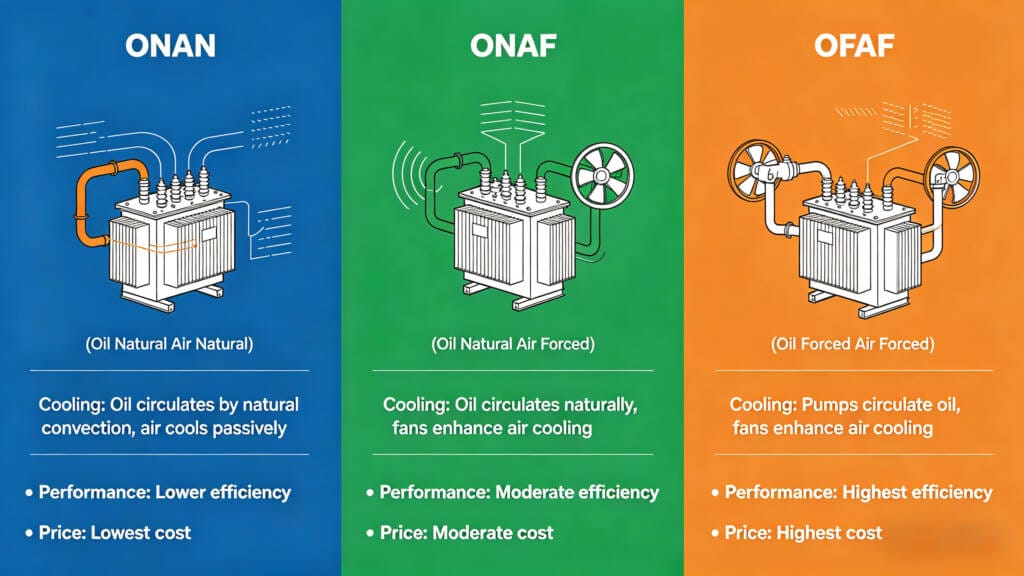
- ONAN (Oil Natural Air Natural) – basic and cost-effective
- ONAF (Oil Natural Air Forced) – moderate cost increase
- OFAF / OFWF – advanced cooling, higher cost
Dry-Type vs Oil-Immersed Transformers
- Dry-type transformers → higher upfront cost, lower maintenance
- Oil-immersed transformers → lower initial cost, better cooling efficiency
Cost implications
Upgrading from ONAN to ONAF can increase price by 15%–25%.
For industrial applications, choosing the right industrial power transformer with an appropriate cooling system ensures long-term operational stability and cost efficiency.
6. Transformer Design and Configuration
Transformer design complexity is a major factor affecting transformer price.
Key design elements
- Vector group configuration
- Winding arrangement
- Load tap changer (OLTC / NLTC)
- Short-circuit strength
OLTC impact
On-load tap changers allow voltage adjustment under load but increase cost by:
- 15%–20%
- Additional maintenance requirements
Why design matters
More complex designs require:
- Advanced engineering
- Precision manufacturing
- Additional testing
7. Efficiency and Energy Loss Considerations
Efficiency is a critical but often overlooked transformer price factor. Transformer efficiency is a key transformer cost factor, especially when evaluating long-term performance. High-efficiency transformers are designed to minimize both no-load and load losses, often using advanced core materials and optimized winding structures. According to international energy guidelines such as transformer energy efficiency standards, selecting low-loss transformers can significantly reduce lifecycle energy consumption.
Although high-efficiency models may have a higher initial cost, they offer substantial savings over time, making them a smart investment for industrial and utility applications.
Types of losses
- No-load losses (core losses)
- Load losses (copper losses)
Cost vs efficiency trade-off
Higher efficiency transformers:
- Use better materials
- Require more advanced design
- Cost more upfront
However, they reduce energy consumption over time.
Long-term impact
A low-loss transformer can save thousands of dollars annually in electricity costs.
8. Customization and Special Requirements
Customization is one of the biggest contributors to price variation.
Common customization options
- Voltage and frequency adjustments
- Special enclosures (IP-rated, outdoor, marine)
- Explosion-proof designs
- Corrosion-resistant coatings
- Compact or modular structures
Cost impact
Customized transformers can cost 20%–40% more than standard models.
Why customization increases cost
- Non-standard engineering
- Custom tooling
- Additional testing
If your project has specific requirements, you can request a custom transformer tailored to your exact specifications and operating conditions.
9. Standards, Certifications, and Testing
Compliance with international standards significantly affects transformer pricing. Compliance with international standards is another important factor affecting transformer price. Standards such as IEC 60076 transformer standard and widely recognized IEEE transformer standards define performance, safety, and testing requirements for transformers used worldwide.
Meeting these standards often involves stricter design specifications, additional testing procedures, and certification costs, all of which contribute to higher transformer pricing. However, certified transformers provide greater reliability, safety, and acceptance in international projects.
Common standards
- اللجنة الانتخابية المستقلة
- IEEE
- ANSI
Cost factors include
- Design compliance
- Type testing
- Third-party certification
Why certifications matter
Certified transformers:
- Ensure safety and reliability
- Are required for international projects
- Increase buyer confidence
10. Market Conditions and Raw Material Prices
External market conditions are key transformer price factors.
Material selection is one of the most critical transformer price factors, especially when comparing copper and aluminum windings. Copper offers higher conductivity and better efficiency, while aluminum provides a lower upfront cost but requires a larger design. For a deeper technical comparison, you can refer to detailed resources on copper vs aluminum transformer windings, which explain performance differences and cost implications.
In addition, the type of core material—such as conventional silicon steel or amorphous metal—also plays a major role in transformer material cost, directly impacting both efficiency and long-term operating expenses.
Influencing elements
- Copper prices
- Steel costs
- Global supply chain disruptions
- Shipping and logistics costs
- Currency exchange rates
Real-world impact
Transformer prices can fluctuate significantly within months due to raw material changes.
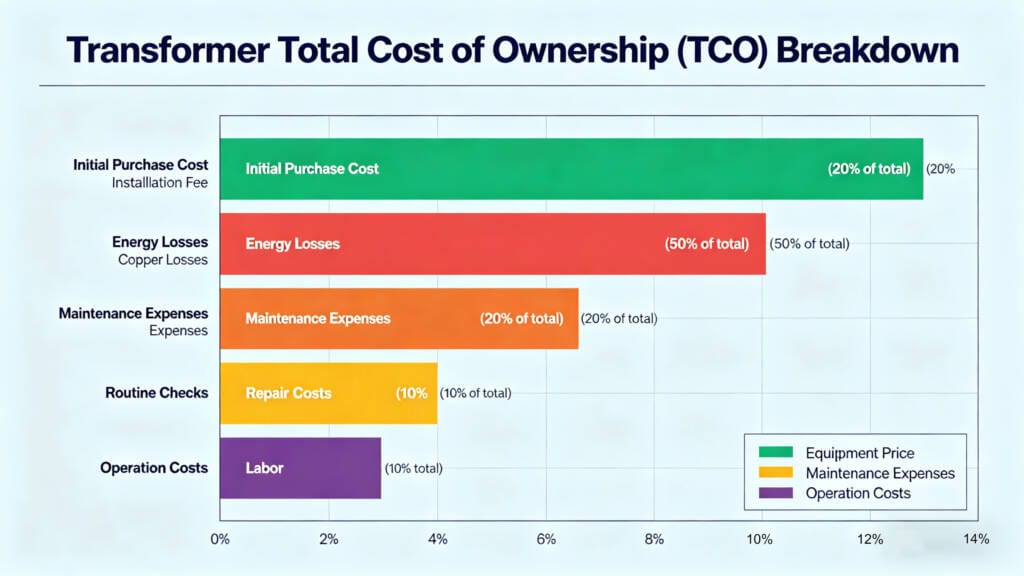
11. Total Cost of Ownership (TCO)
Focusing only on purchase price is a common mistake.
What is TCO?
Total Cost of Ownership includes:
- Initial purchase cost
- Installation cost
- Energy losses
- صيانة
- Lifecycle cost
Example
A cheaper transformer with higher losses may cost more over 10–20 years than a premium model.
Why TCO matters
- Reduces long-term expenses
- Improves operational efficiency
- Supports sustainability goals
12.How to Reduce Transformer Cost Without Sacrificing Quality
Understanding transformer price factors allows buyers to optimize cost effectively.
Practical strategies
- Choose the right capacity
Avoid oversizing transformers unnecessarily - Optimize material selection
Use aluminum where appropriate - Balance efficiency and cost
Avoid over-specification - Minimize unnecessary customization
Stick to standard designs when possible - Work with experienced manufacturers
Reduce design and production errors
Key insight
The lowest price is not always the best value. Smart optimization leads to better long-term performance.
13.Real Transformer Price Example (For Buyers)
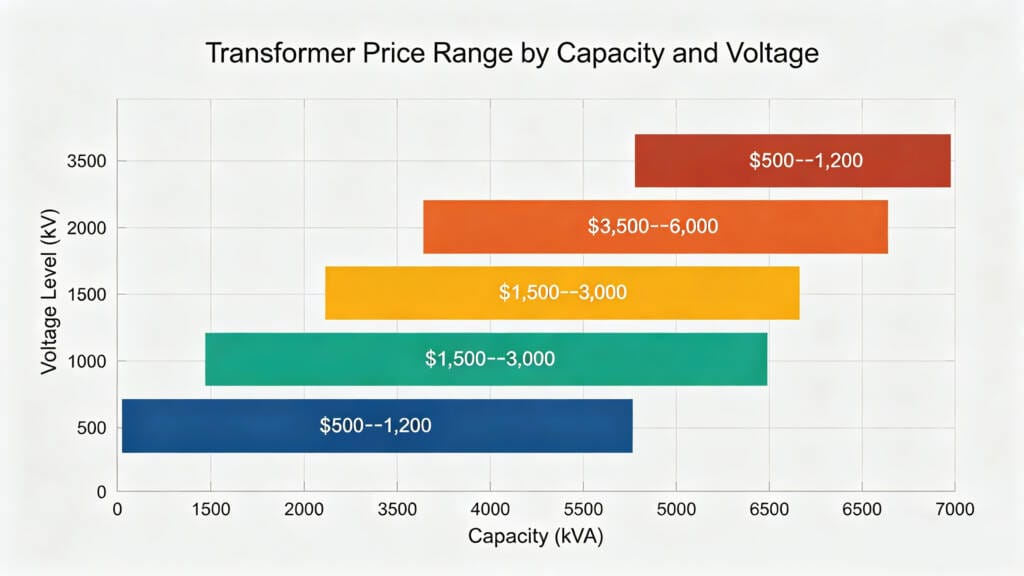
To give practical insight into transformer cost factors, here are typical ranges:
| سعة | الجهد االكهربى | يكتب | نطاق السعر |
|---|---|---|---|
| 500 kVA | 11 كيلو فولت | زيت | $5,000 – $10,000 |
| 1000 kVA | 11 كيلو فولت | زيت | $8,000 – $15,000 |
| 2500 kVA | 33kV | زيت | $20,000 – $50,000 |
| 10 MVA | 66kV | قوة | $80,000 – $200,000 |
Prices vary depending on specifications and market conditions.
14.Conclusion: Understanding Transformer Price Factors Before Buying
Transformer pricing is complex. It depends on a combination of engineering, materials, and market dynamics.
The most important transformer price factors include:
- Capacity and voltage
- Material selection
- Cooling method
- Design complexity
- Efficiency
- Customization
- Market conditions
By understanding these factors, buyers can make better decisions, reduce costs, and improve system performance.
15.FAQ
1. What are the main transformer price factors?
The main transformer price factors include:
- Capacity (kVA or MVA)
- Voltage level
- Core and winding materials (copper or aluminum)
- Cooling method
- Transformer design and configuration
- Efficiency and energy losses
- Customization requirements
- Certifications and standards
- Market conditions (raw material prices)
These factors affecting transformer price work together to determine the final cost. Among them, capacity, voltage, and materials have the biggest impact.
2. How does capacity affect transformer price?
Capacity is the most important transformer cost factor.
As transformer capacity increases:
- More materials are required
- Design complexity increases
- Cooling systems become more advanced
This leads to higher costs. However, the transformer price per kVA may decrease for larger units due to economies of scale.
3. Why are high voltage transformers more expensive?
High voltage transformers are more expensive because they require:
- Advanced insulation systems
- Larger safety clearances
- High-quality components
- More rigorous testing
These technical requirements significantly increase manufacturing costs, making voltage level a critical transformer price factor.
4. What is the difference between copper and aluminum transformers in terms of cost?
Copper and aluminum directly impact transformer material cost:
- Copper transformers are more expensive but more efficient and compact
- Aluminum transformers are cheaper but require larger size and may have higher losses
Choosing between them depends on budget, efficiency requirements, and application.
5. Which is more expensive: dry-type or oil-immersed transformers?
In most cases:
- Dry-type transformers have higher upfront costs
- Oil-immersed transformers are more cost-effective for larger capacities
However, dry-type transformers may reduce maintenance and fire risk, which can lower long-term costs.
6. How does transformer efficiency affect cost?
Higher efficiency increases initial cost because:
- Better core materials are used
- Advanced design reduces losses
However, energy-efficient transformers reduce electricity consumption, lowering long-term operating costs. This makes efficiency an important long-term transformer cost factor.
7. How much does a transformer typically cost?
Transformer prices vary widely depending on specifications:
- Small transformers (≤500 kVA): $3,000 – $10,000
- Medium transformers (1 MVA – 10 MVA): $10,000 – $200,000
- Large transformers (>50 MVA): $200,000 and above
Actual cost depends on multiple transformer price factors such as voltage, materials, and customization.
8. How do customization requirements affect transformer price?
Customization can significantly increase price because it involves:
- Non-standard engineering design
- Special materials or structures
- Additional testing
Customized transformers can cost 20%–40% more than standard models, making customization a major factor affecting transformer price.
9. Do raw material prices affect transformer cost?
Yes, raw materials are one of the biggest transformer cost factors.
Fluctuations in:
- Copper prices
- Silicon steel prices
directly impact transformer pricing. Market changes can cause noticeable price variations within short periods.
10. How can I reduce transformer cost without sacrificing quality?
You can optimize transformer cost by:
- Selecting the correct capacity
- Avoiding unnecessary customization
- Balancing efficiency and budget
- Choosing suitable materials
- Working with experienced manufacturers
Understanding key transformer price factors helps you make cost-effective decisions without compromising performance.
Looking for a reliable transformer supplier?