In the rapidly evolving landscape of electrical infrastructure, the 200kVA dry type transformer has emerged as the industry standard for safe, efficient, and indoor-compatible power distribution. Whether you are upgrading a commercial office complex, powering a sensitive data center, or expanding an industrial workshop, the primary question remains: What is a fair 200kVA dry type transformer price in today’s market?
Navigating the discrepancy between a $3,500 budget unit and an $8,500 high-performance model can be challenging for procurement managers and electrical engineers alike. The price tag is rarely just a number; it is a reflection of the unit’s winding material, thermal insulation class, and long-term energy efficiency. Choosing a “cheap” unit today often leads to exorbitant operational costs and premature failure tomorrow.
In this comprehensive guide, we leverage decades of manufacturing expertise to break down the specific components that drive the 200kVA dry transformer price. We will analyze the Total Cost of Ownership (TCO), compare various cooling technologies, and provide you with the technical transparency needed to secure a high-ROI investment for your facility. While the market fluctuates, understanding these core engineering value-drivers ensures you never overpay for substandard equipment.
Table of Contents
- Executive Summary: The 200kVA Market Landscape
- Current Price Benchmarks for 200kVA Dry Type Transformers
- The “Big Five” Factors Influencing 200kVA Transformer Costs
- Technical Deep Dive: Winding Materials and Core Engineering
- Cast Resin vs. VPI: Performance vs. Price Analysis
- Efficiency Standards and Long-term ROI
- Environmental Protection: Enclosures and IP Ratings
- The Hidden Costs of Procurement: Logistics and Compliance
- Real-World Case Study: 200kVA Unit in a Commercial Complex
- FAQ: Addressing Common Buyer Concerns
- Checklist: How to Request a Professional Quote
1. Executive Summary: The 200kVA Market Landscape
In modern electrical infrastructure, the 200kVA dry type transformer serves as a critical node for step-down distribution. Unlike oil-immersed units, dry type transformers use air as the cooling medium, making them the gold standard for indoor installations, hospitals, and high-rise buildings where fire safety is non-negotiable.
When searching for a 200kVA dry transformer price, buyers often encounter a wide delta in quotations—ranging from $3,000 to over $9,000. This guide elucidates the engineering nuances that justify these price differences, focusing on durability, efficiency, and safety.
While the 200kVA dry transformer price is a major factor in procurement, it is essential to understand how this capacity fits into our complete range of dry type transformers designed for modern power grids.
2. Current Price Benchmarks for 200kVA Dry Type Transformers
As of 2026, raw material fluctuations in copper and silicon steel have stabilized, yet premium efficiency requirements have pushed average prices upward.
| Transformer Configuration | Estimated Price Range (USD) | Primary Application |
| Aluminum Winding / Class F / IP00 | $3,200 – $4,100 | Budget-sensitive industrial builds |
| Copper Winding / Class F / IP20 | $4,800 – $6,200 | Standard commercial distribution |
| Copper Winding / Class H / IP23 | $6,500 – $8,000 | Heavy industrial/High-ambient temp |
| Amorphous Core / High Efficiency | $8,500 – $10,500 | Data centers & Green-certified buildings |
3. The “Big Five” Factors Influencing 200kVA Transformer Costs
3.1 Winding Material (Copper vs. Aluminum)
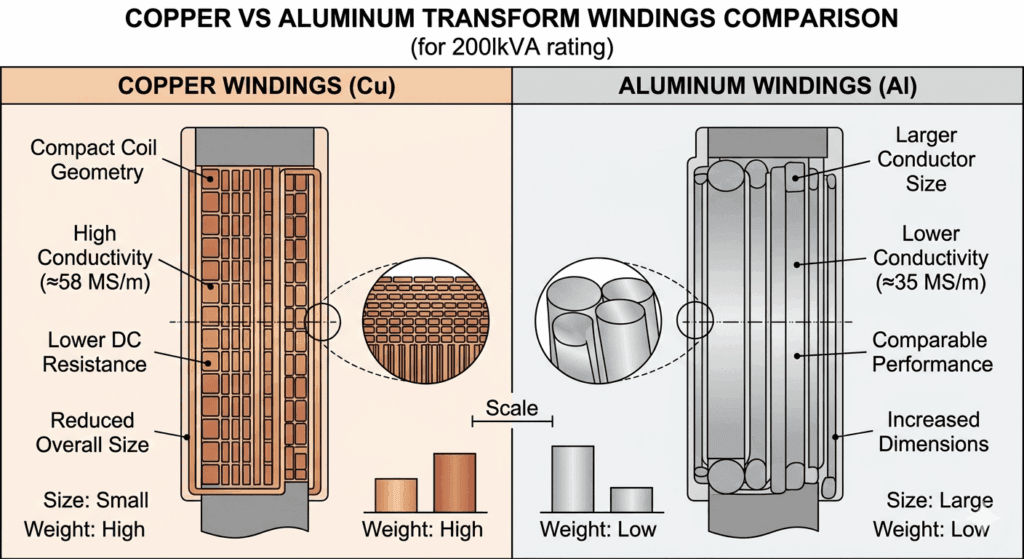
The “Cu vs. Al” choice is the primary price driver. Copper has a lower resistivity compared to Aluminum. While copper units are more expensive, they offer a smaller footprint and higher short-circuit withstand capability.
3.2 Insulation Class (Temperature Endurance)
Dry transformers are categorized by their ability to handle heat.
- Class F (155°C): The standard industrial choice.
- Class H (180°C): Uses high-grade Nomex or specialized resins. Expect a 15% price premium for Class H, which is essential for high-overload environments.
3.3 Core Steel Quality
The magnetic core is usually made of Cold-Rolled Grain-Oriented (CRGO) silicon steel. Lower-grade steel results in higher “No-Load Losses,” increasing the operational cost significantly over 20 years.
3.4 Brand and Origin
Tier 1 global brands (ABB, Siemens) carry a 30-50% “brand premium.” High-quality OEM manufacturers in China offer identical technical specs (IEC/IEEE compliance) at a significantly lower entry price due to supply chain integration.
3.5 Customization (K-Factor, Harmonics)
If your 200kVA unit needs to power non-linear loads (like LED lighting or UPS systems), a K-Factor rating (e.g., K-4 or K-13) is required. This involves thicker neutral conductors and specialized winding techniques, adding 10-25% to the base price.
4. Technical Deep Dive: Winding Materials and Core Engineering
The price of a 200kVA dry transformer is directly tied to the weight of the active materials.
- Copper Units: A standard 200kVA copper unit weighs approximately 850kg – 1,000kg.
- Aluminum Units: To match the conductivity of copper, aluminum windings must be larger, which in turn requires a larger steel core. Total weight may increase to 1,100kg+, despite aluminum being lighter than copper.
Pro Tip: Always ask for the “Total Weight” and “Loss Data” (No-load and Load losses) in your quote. If a unit is suspiciously cheap and light, the manufacturer likely compromised on the cross-sectional area of the conductors.
The choice between copper and aluminum is heavily influenced by the current LME copper price indices
. For a detailed technical breakdown, read our professional Copper vs Aluminum winding guide to see which fits your budget.
5. Cast Resin vs. VPI: Performance vs. Price Analysis
The manufacturing process defines the transformer’s resilience.
Cast Resin (CRT)
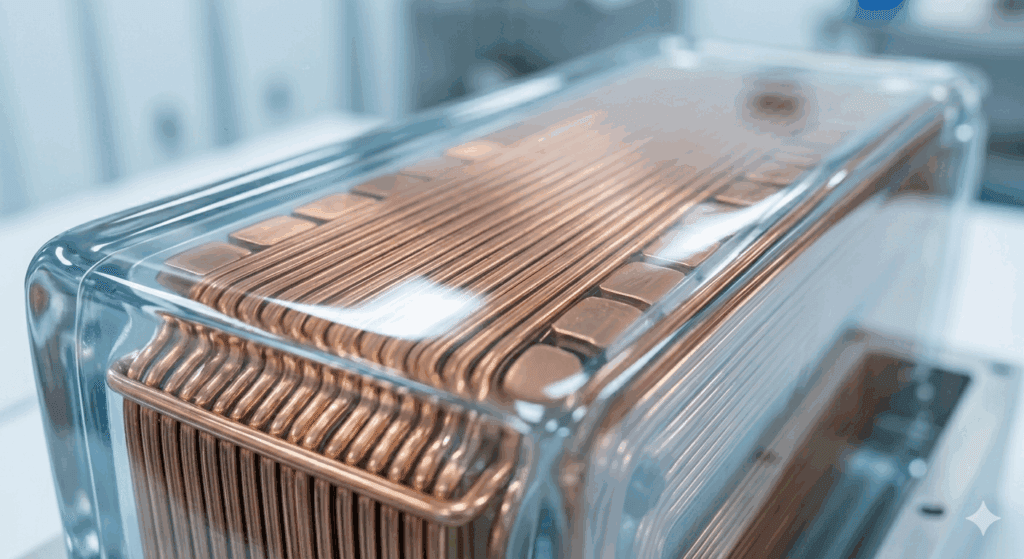
The windings are completely encapsulated in epoxy resin under a vacuum.
- Price: Higher.
- Best for: Harsh environments with high moisture, salt spray, or dust. It is virtually maintenance-free.
Vacuum Pressure Impregnated (VPI)
The windings are coated with a polyester resin varnish.
- Price: Lower.
- Best for: Clean, dry environments. It offers better cooling via air circulation through the “open” coils but is susceptible to moisture ingress over time.
6. Efficiency Standards and Long-term ROI
The Total Cost of Ownership (TCO) formula is:
TCO = Purchase Price + (No-load Loss X A) + (Load Loss XB)
Where A and B are capitalized costs of energy over the transformer’s life.
A high-efficiency 200kVA unit might cost $1,500 more upfront but save $400 annually in wasted energy. In less than 4 years, the premium unit pays for itself.
7. Environmental Protection: Enclosures and IP Ratings
The enclosure (cabinet) adds both cost and safety.
- IP00: No cabinet. Used when the unit is placed inside a larger switchgear.
- IP20/21: Protects against finger contact and vertical water drops. Standard for indoor rooms.
- IP23: Louvered design to prevent water spray at an angle. Essential for certain industrial zones. Adding an IP23 enclosure usually adds $600 – $900 to the 200kVA dry transformer price.
8. The Hidden Costs of Procurement: Logistics and Compliance
When importing or purchasing a 200kVA unit, factor in:
- Testing Fees: Routine tests are standard. “Type Tests” (Temperature rise, Lightning impulse) can cost thousands and are usually shared across a batch.
- Logistics: Due to the weight (approx. 1 ton), sea freight is standard. Factor in “Wooden Crate Packaging” to prevent core displacement during transit.
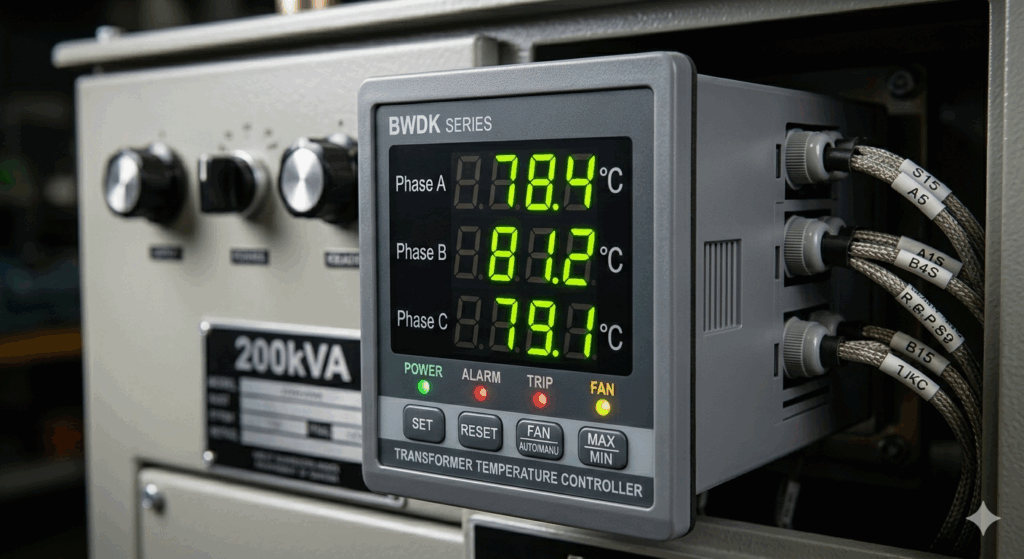
- Accessories: Temperature controllers (e.g., BWDK series) with RS485 communication for SCADA integration are often billed separately ($250-$450).
9. Real-World Case Study: 200kVA Unit in a Commercial Complex
Project: A 15-story office building in Manila, Philippines. Requirement: 200kVA, 13.8kV to 400V, Copper Winding, IP21. Decision Matrix:
- Option A (Local Stock): $7,500 (Immediate delivery).
- Option B (Imported OEM): $5,200 (6-week lead time). Result: The client chose Option B, saving $2,300. By investing $400 of those savings into a high-grade temperature monitoring system, they extended the expected lifespan of the unit by 5 years.
10. FAQ: Addressing Common Buyer Concerns
Q: Why is the 200kVA dry type transformer more expensive than the oil-type?
A: Dry type units require more expensive insulation materials (Nomex/Resin) and larger clearances for air cooling compared to the high dielectric strength of transformer oil. However, they save money on fire-vault construction and insurance premiums.
Q: Can I run a 200kVA transformer at 110% capacity?
A: Only if it is equipped with cooling fans (AF – Air Forced). With fans, a 200kVA unit can typically handle 266kVA (a 33% increase) for short periods, but this increases internal heat and aging.
Q: How often does a dry type transformer need maintenance?
A: Very rarely. Every 12 months, you should perform a visual inspection and vacuum the dust off the coils to ensure proper heat dissipation.
11. Checklist: How to Request a Professional Quote
To get the most accurate 200kVA dry transformer price, send the following specs to your supplier:
- [ ] Rated Power: 200kVA
- [ ] Voltage Ratio: (e.g., 11kV / 0.415kV)
- [ ] Phase: 3-Phase
- [ ] Vector Group: (Standard is Dyn11)
- [ ] Winding Material: Copper or Aluminum
- [ ] Insulation Class: F or H
- [ ] Enclosure Rating: (IP00, IP20, etc.)
- [ ] Standard: (IEC 60076 or IEEE C57.12.01)
Final Thought
The price of a 200kVA dry transformer is an investment in your facility’s uptime. By focusing on high-quality copper windings and superior insulation, you ensure a service life of 25+ years.
Ready to upgrade your power infrastructure?
Contact our engineering team for a detailed technical proposal and a factory-direct quote tailored to your region.