If you are deciding between an 11kV vs 33kV transformer, the choice depends on your project scale and transmission distance:
- Choose 11kV transformer for small to medium loads and short-distance distribution
- Choose 33kV transformer for large-scale projects and long-distance power transmission
👉 33kV systems offer higher efficiency and lower losses, while 11kV systems provide lower upfront cost and simpler installation
Table of Contents
- Introduction
- What Is an 11kV Transformer?
- What Is a 33kV Transformer?
- Key Differences Between 11kV and 33kV Transformers
- 11kV vs 33kV Transformer: Which One Should You Choose?
- Cost Comparison: 11kV vs 33kV Transformer
- Efficiency and Energy Loss Considerations
- Common Applications of 11kV and 33kV Transformers
- Expert Tips for Choosing the Right Transformer
- Frequently Asked Questions (FAQ)
- Conclusion: Making the Right Choice
1.Introduction
Choosing the correct transformer voltage level is one of the most critical decisions in any power distribution or industrial project. Selecting between an 11kV transformer and a 33kV transformer directly impacts system efficiency, project cost, long-term scalability, and operational reliability.
Many engineers, procurement managers, and project developers struggle with this decision because both voltage levels fall within the medium-voltage range and often overlap in application scenarios. However, the wrong choice can lead to excessive capital investment, higher energy losses, or future system limitations.
Medium voltage levels such as 11kV and 33kV are commonly used in modern power systems, as defined in standard voltage classifications in electrical engineering.
In this comprehensive guide, we will explore the difference between 11kV and 33kV transformers, compare their applications, costs, and performance, and help you determine which transformer is best suited for your specific project requirements.
2.What Is an 11kV Transformer?
An 11kV transformer is a medium-voltage electrical transformer commonly used for stepping down voltage from distribution networks to lower levels suitable for commercial, residential, or light industrial use.
Typically, 11kV transformers are part of local power distribution systems, where electricity is delivered from substations to end-users.
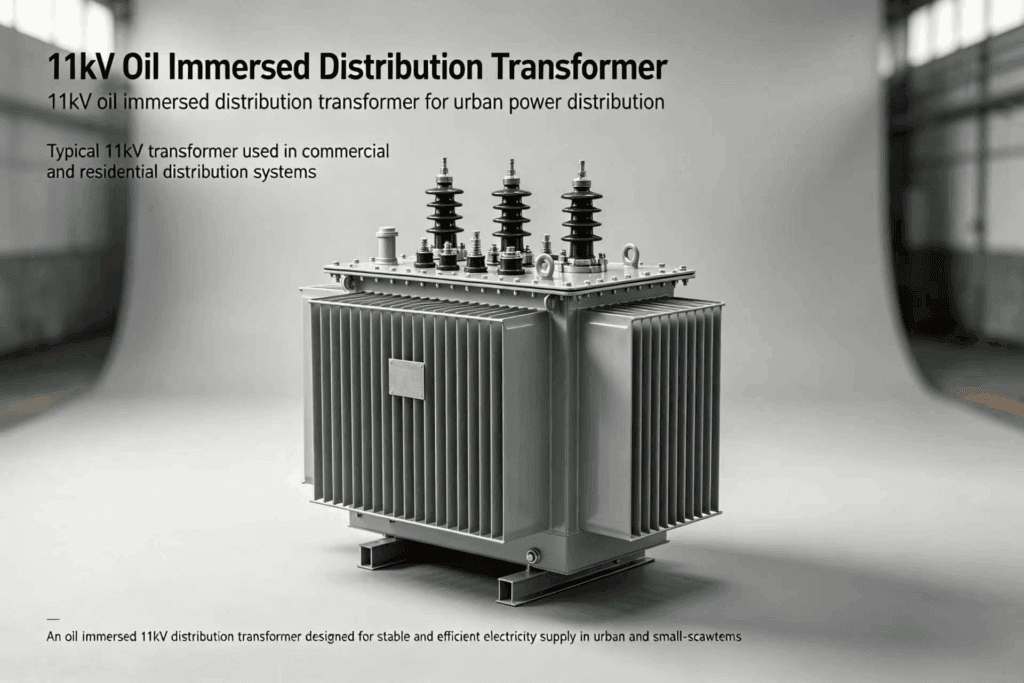
Key Characteristics of 11kV Transformers
- Voltage Level: 11kV primary distribution
- Typical Capacity Range: 500kVA to 2500kVA
- Frequency: 50Hz / 60Hz
- Cooling Type: Oil-immersed or dry-type
- Installation: Indoor or outdoor
Common Applications
11kV transformers are widely used in:
- Commercial buildings (shopping malls, office complexes)
- Residential developments
- Small and medium-sized industrial plants
- Urban distribution networks
- Renewable energy systems (solar/wind local distribution)
Advantages of 11kV Transformers
- Lower initial investment cost
- Simpler installation and maintenance
- Suitable for short-distance power distribution
- Widely available and standardized
Because of these advantages, 11kV transformers are often the default choice for projects with moderate load demand and limited geographic coverage.
3.What Is a 33kV Transformer?
A 33kV transformer operates at a higher medium-voltage level and is typically used in larger-scale power distribution systems or as part of transmission infrastructure.
These transformers are designed to handle higher loads and enable efficient electricity transfer over longer distances.
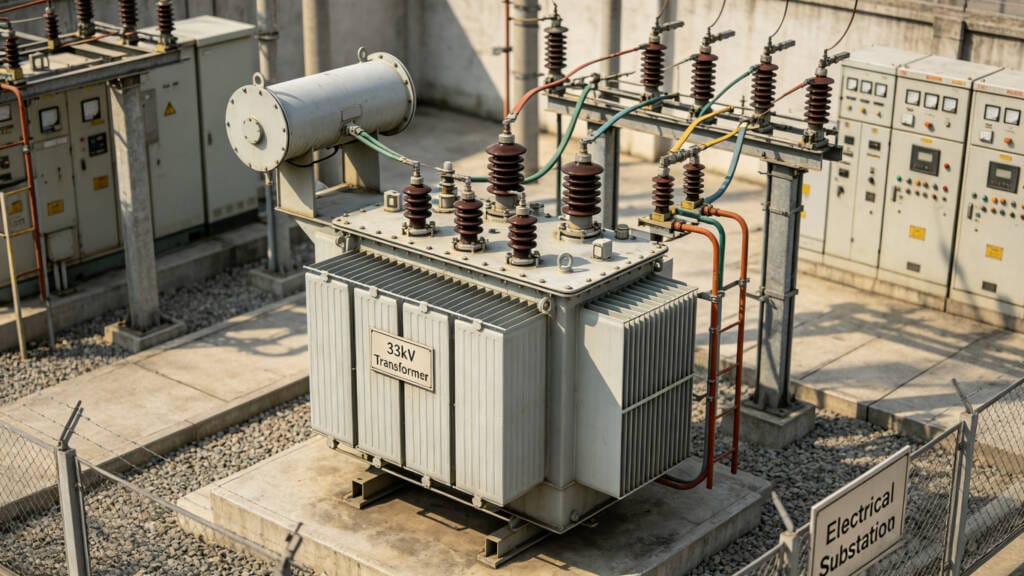
Key Characteristics of 33kV Transformers
- Voltage Level: 33kV primary distribution or sub-transmission
- Typical Capacity Range: 5MVA to 50MVA
- Application Level: Industrial and utility-scale
- Installation: Substations or large facilities
Common Applications
33kV transformers are commonly found in:
- Power substations
- Large industrial plants (steel, mining, manufacturing)
- Utility grid distribution systems
- Infrastructure projects (airports, railways)
- Large-scale renewable energy farms
Advantages of 33kV Transformers
- Higher transmission efficiency over long distances
- Lower current, reducing line losses
- Suitable for large power loads
- Scalable for future expansion
In projects where power demand is high or transmission distance is significant, 33kV transformers offer clear technical and economic advantages.
4.Key Differences Between 11kV and 33kV Transformers
Understanding the difference between 11kV and 33kV transformers is essential for making the right engineering and financial decision.
Below is a detailed comparison:
| Factor | 11kV Transformer | 33kV Transformer |
|---|---|---|
| Voltage Level | Medium (lower range) | Medium (higher range) |
| Typical Capacity | 500kVA–2.5MVA | 5MVA–50MVA |
| Application | Local distribution | Sub-transmission / large distribution |
| Installation Complexity | Simple | More complex |
| Cost | Lower | Higher |
| Efficiency | Suitable for short distances | Ideal for long distances |
| Line Losses | Higher (due to higher current) | Lower |
| Scalability | Limited | High |
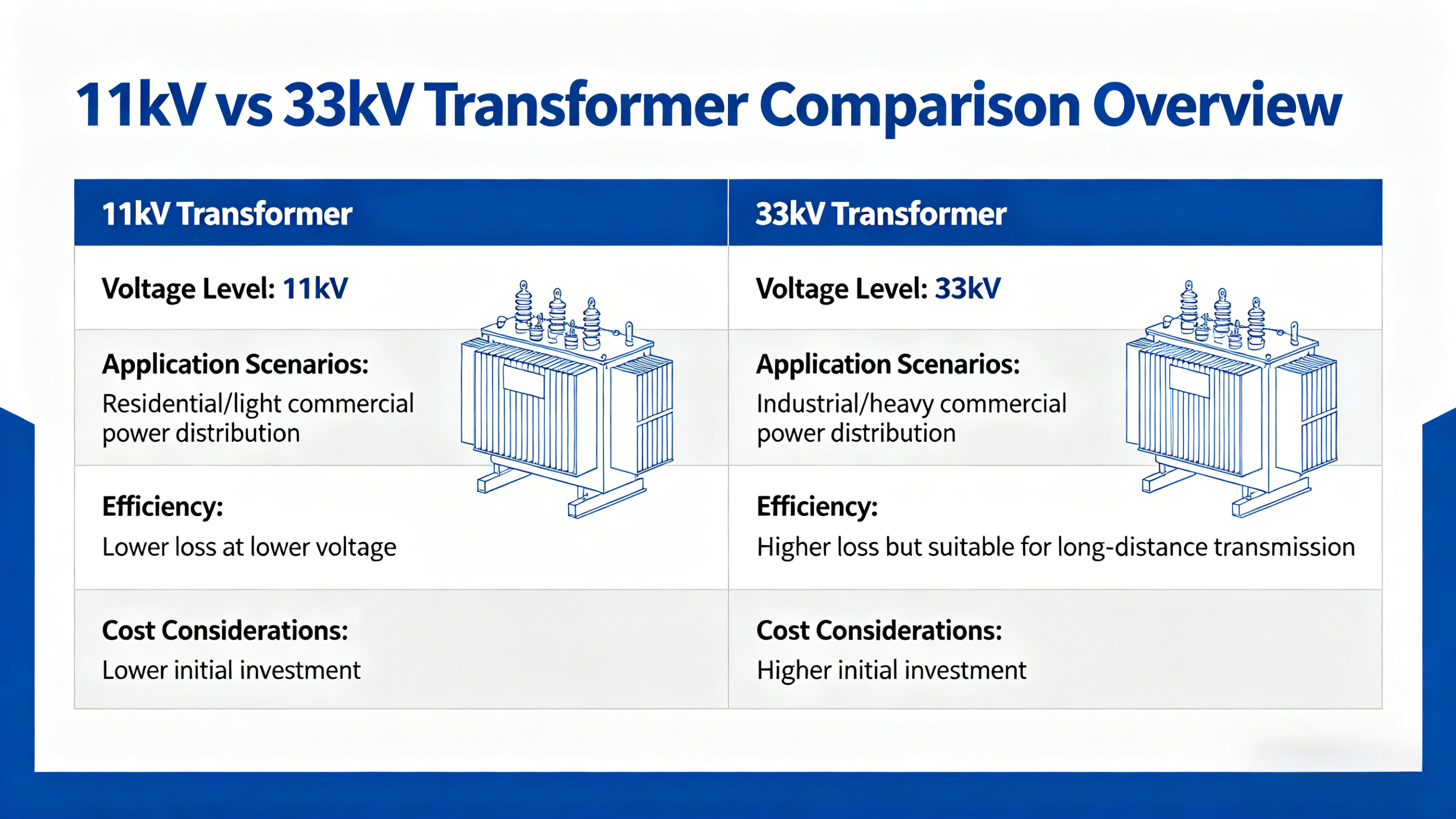
Key Insight
The main difference lies not just in voltage, but in system design philosophy:
- 11kV systems prioritize simplicity and cost
- 33kV systems prioritize efficiency and scalability
5.11kV vs 33kV Transformer: Which One Should You Choose?
This is the most important question for project owners and engineers:
Should you choose an 11kV or 33kV transformer?
The answer depends on several critical factors.
Choose an 11kV Transformer If:
- Your project has low to moderate power demand
- The distribution distance is relatively short
- You want to minimize initial investment cost
- The project is located in urban or compact areas
- Future expansion is limited
👉 Typical examples:
- Commercial complexes
- Residential zones
- Small factories
Choose a 33kV Transformer If:
- Your project requires high power capacity
- Power needs to be transmitted over long distances
- You want to reduce energy losses and improve efficiency
- The project involves industrial or utility-scale operations
- Future expansion is expected
👉 Typical examples:
- Industrial parks
- Mining operations
- Power plants
- Renewable energy farms
Decision Framework Table
| Project Condition | Recommended Choice |
|---|---|
| Small load (<2MVA) | 11kV Transformer |
| Medium load (2–10MVA) | Depends on distance |
| Large load (>10MVA) | 33kV Transformer |
| Long-distance transmission | 33kV Transformer |
| Budget-sensitive project | 11kV Transformer |
6.Cost Comparison: 11kV vs 33kV Transformer
Cost is often a deciding factor in transformer selection.
However, focusing only on initial price can be misleading. A complete evaluation should include lifecycle costs.
Cost Breakdown
| Cost Component | 11kV Transformer | 33kV Transformer |
|---|---|---|
| Equipment Cost | Lower | Higher |
| Installation Cost | Lower | Higher |
| Cable & Infrastructure | Higher (more current) | Lower (less current) |
| Energy Loss Cost | Higher | Lower |
| Maintenance | Moderate | Higher (but less frequent issues) |
Key Insight on Cost
- 11kV transformers are cheaper upfront
- 33kV transformers are often more cost-effective in the long run, especially for large projects
7.Efficiency and Energy Loss Considerations
One of the biggest technical differences is energy efficiency.
Higher voltage systems like 33kV reduce current for the same power level, which significantly reduces losses.
The reduction of transmission losses in higher voltage systems is based on fundamental electrical principles such as power loss in transmission lines (I²R losses).
Why 33kV Is More Efficient
- Lower current → Reduced I²R losses
- Better for long-distance transmission
- Improved voltage stability
Comparison Table
| Parameter | 11kV | 33kV |
|---|---|---|
| Current Level | Higher | Lower |
| Line Losses | Higher | Lower |
| Efficiency | Moderate | High |
| Best Use Case | Short distance | Long distance |
8.Common Applications of 11kV and 33kV Transformers
Understanding real-world applications helps reinforce decision-making.
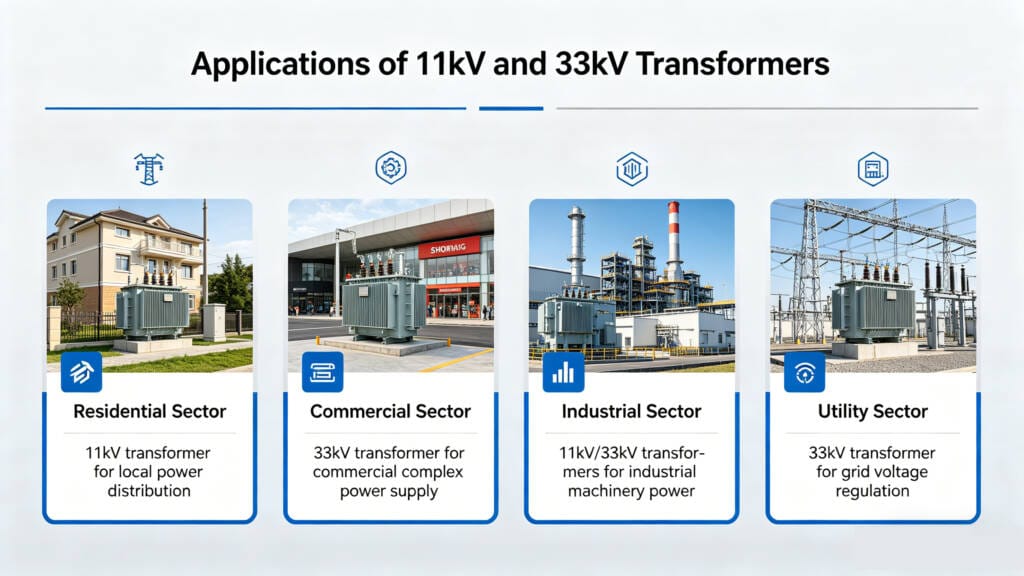
11kV Transformer Applications
- Urban distribution networks
- Commercial buildings
- Residential complexes
- Small industrial units
33kV Transformer Applications
- Substations
- Heavy industries
- Renewable energy plants
- Infrastructure projects
9.Expert Tips for Choosing the Right Transformer
To ensure optimal performance and long-term reliability, consider the following expert recommendations:
1. Evaluate Load Requirements
Accurately calculate current and future load demand. Oversizing or undersizing can lead to inefficiencies.
2. Consider Future Expansion
If your project is expected to grow, choosing a 33kV system may be more cost-effective in the long run.
3. Analyze Transmission Distance
- Short distance → 11kV
- Long distance → 33kV
4. Follow International Standards
Ensure compliance with:
- IEC 60076
- IEEE standards
This improves system safety and reliability.
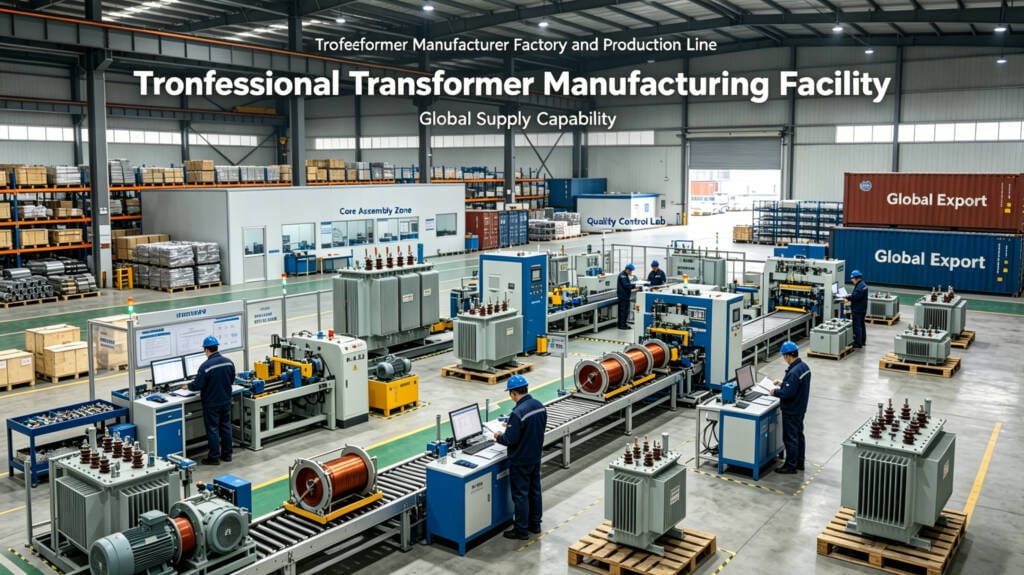
5. Choose a Reliable Manufacturer
A high-quality transformer supplier ensures:
- Better efficiency
- Longer lifespan
- Lower maintenance costs
To ensure safety and performance, transformers should comply with internationally recognized standards such as IEC 60076 transformer standard and IEEE transformer standards.
👉 Choose a Reliable Manufacturer
10.Frequently Asked Questions (FAQ)
What is the main difference between 11kV and 33kV transformers?
The primary difference lies in voltage level, capacity, and application. 33kV transformers are used for larger, long-distance power transmission, while 11kV transformers are used for local distribution.
Which is more efficient: 11kV or 33kV?
33kV transformers are generally more efficient due to lower current and reduced transmission losses.
Is a 33kV transformer more expensive than an 11kV transformer?
Yes, the initial cost is higher, but it may offer lower operating costs over time.
Can I upgrade from 11kV to 33kV later?
Yes, but it requires significant infrastructure changes. It is better to plan ahead during the initial design phase.
What industries use 33kV transformers?
Industries such as mining, manufacturing, utilities, and renewable energy commonly use 33kV transformers.
11.Conclusion: Making the Right Choice
Choosing between an 11kV and 33kV transformer is not just a technical decision—it is a strategic one that affects your project’s efficiency, scalability, and long-term cost.
- Choose 11kV for simplicity and lower upfront cost
- Choose 33kV for efficiency, scalability, and large-scale applications
Final Recommendation
Always evaluate:
- Load demand
- Transmission distance
- Budget
- Future expansion
before making your decision.
Looking for the right transformer solution for your project?
Our engineering team provides customized 11kV and 33kV transformer solutions tailored to your specific requirements, ensuring optimal performance and cost efficiency.
👉 Contact us today to get a free quote and expert consultation.