1.Introduction: The Critical Role of Industrial Transformer Applications
Industrial transformer applications are fundamental to the operation of modern power systems. In today’s highly electrified industrial landscape, transformers are not just auxiliary devices—they are essential infrastructure that ensures safe, efficient, and stable energy flow.
Industries such as manufacturing, oil and gas, mining, and data centers rely heavily on uninterrupted and high-quality electrical power. However, electricity generated at power plants is often transmitted at extremely high voltages, far exceeding the safe operating levels of industrial equipment. This is where transformers become indispensable.
Beyond voltage conversion, industrial transformer applications provide:
- System-wide voltage stability
- Protection against electrical faults
- Efficient energy distribution
- Adaptability for complex industrial loads
With the rise of Industry 4.0, automation, and renewable energy
TOC(Table of Contents)
- Introduction: The Critical Role of Industrial Transformer Applications
- What Are Industrial Transformer Applications?
- Core Functions of Transformers in Industrial Applications
- Types of Transformers Used in Industrial Applications
- Industrial Transformer Applications by Industry
- How to Choose the Right Transformer for Industrial Applications
- Customization of Industrial Transformers
- Advantages of Industrial Transformer Applications
- Future Trends in Industrial Transformer Applications
- Çözüm
- SSS
2.What Are Industrial Transformer Applications?
Industrial transformer applications refer to the use of transformers in industrial electrical systems to convert voltage levels, distribute electrical power, isolate circuits, and improve power quality across a wide range of industrial environments.
In modern industry, transformers are essential for ensuring that electricity generated at high voltage can be efficiently transmitted over long distances and then safely converted into usable voltage levels for machinery, equipment, and control systems.
In other words, industrial transformer applications enable efficient power transmission, reliable power distribution, and safe operation of industrial equipment.
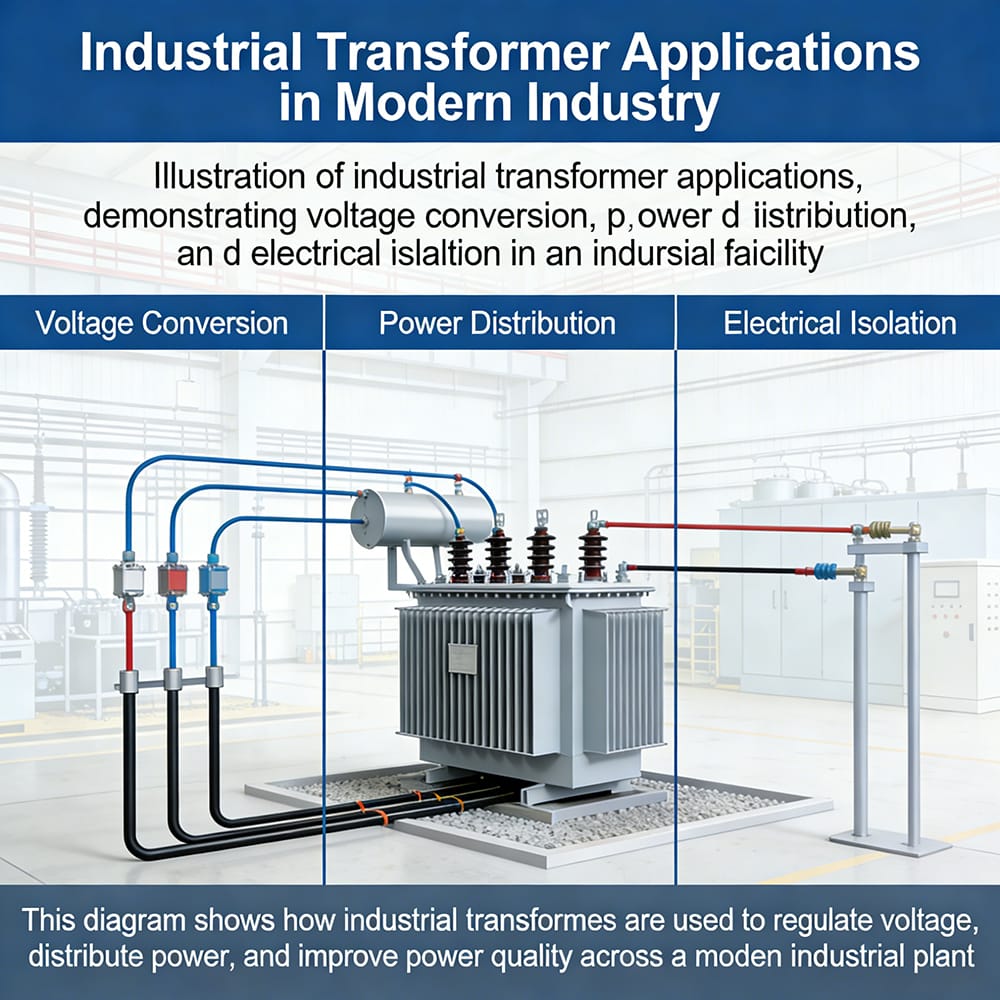
Key Roles of Transformers in Industrial Applications
From an operational perspective, transformers perform several critical roles:
- Voltage Conversion → Adjusting voltage levels (step-up and step-down transformers)
- Power Distribution → Delivering electricity across different sections of industrial facilities
- Electrical Isolation → Protecting equipment and personnel from electrical faults
- Power Quality Improvement → Reducing harmonics, voltage fluctuations, and disturbances
Because of these functions, transformer applications in industry are not limited to power transfer—they are integral to system stability, equipment protection, and energy optimization.
Working Principle (Simplified)
Industrial transformers operate based on the principle of elektromanyetik indüksiyon, which allows electrical energy to be transferred between circuits without direct electrical contact.
The process works as follows:
- The output voltage is determined by the turns ratio between primary and secondary coils
- Alternating current (AC) flows through the primary winding
- This current generates a time-varying magnetic field in the transformer core
- The magnetic field induces a voltage in the secondary winding
Why This Matters in Industrial Transformer Applications
This simple yet powerful principle enables transformers to:
- Increase voltage for efficient long-distance transmission (step-up transformers)
- Decrease voltage for safe equipment operation (step-down transformers)
- Maintain energy transfer with minimal losses
- Support stable and scalable industrial power systems
Get the Right Industrial Transformer for Your Facility Today
3.Core Functions of Transformers in Industrial Applications
Industrial transformer applications play a critical role in ensuring the safe, efficient, and stable operation of industrial power systems. In modern industry, transformers are not only used for voltage conversion, but also for power distribution, equipment protection, and energy optimization.
From manufacturing plants to heavy industries, the functions of transformers in industrial applications directly impact system reliability, operational efficiency, and overall production performance.
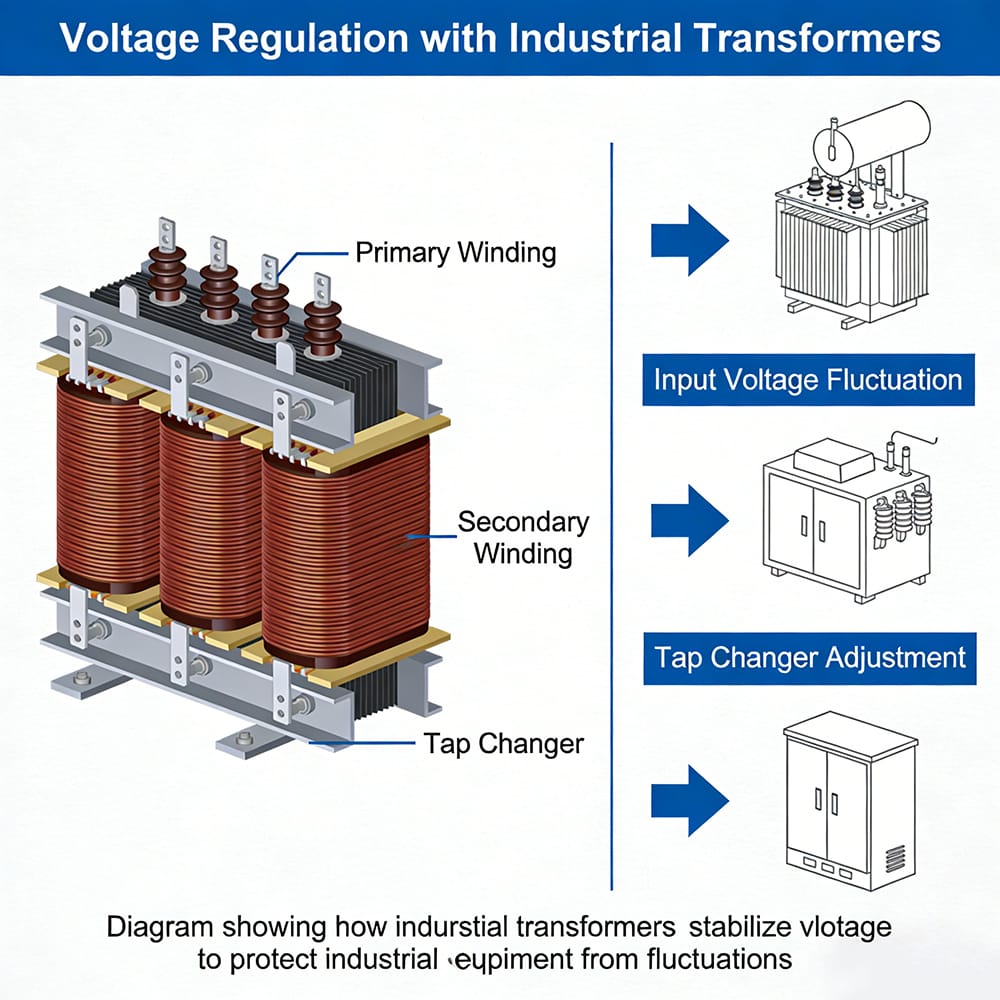
Below are the key functions of transformers in industry:
1. Voltage Regulation and Stability
Voltage regulation is the most fundamental function of industrial transformers and one of the primary reasons why transformers are widely used in industrial applications.
Industrial equipment such as CNC machines, motors, and automation systems requires stable and precise voltage levels. Even small voltage fluctuations can result in:
- Equipment malfunction
- Reduced operational efficiency
- Overheating or insulation failure
- Permanent damage to sensitive components
Industrial transformer applications ensure that voltage remains within a safe operating range by stepping up or stepping down voltage levels as required.
In addition, modern industrial power transformer applications often include voltage regulation features such as tap changers, which allow real-time adjustment of voltage to maintain system stability.
2. Power Transmission and Distribution
Another key function of transformer applications in industry is enabling efficient power transmission and distribution.
Electricity generated at power plants is transmitted at high voltage to minimize energy losses over long distances. However, industrial facilities cannot directly use high-voltage electricity. Transformers are used to convert this power into usable voltage levels.
In a typical industrial electrical system, transformers operate in multiple stages:
- Step-up transformers increase voltage for transmission
- Step-down transformers reduce voltage for industrial use
- Distribution transformers deliver power to specific equipment or zones
This multi-level system forms the backbone of industrial power distribution networks, ensuring:
- Efficient energy transfer
- Scalable infrastructure
- Reliable electricity supply across large facilities
As a result, industrial transformer applications in power distribution are essential for maintaining continuous and stable operations.
3. Electrical Isolation and Safety
Electrical isolation is a critical safety function in industrial transformer applications, particularly in environments with high-risk electrical exposure.
Isolation transformers are specifically designed to:
- Separate different sections of an electrical system
- Eliminate direct electrical connections between circuits
- Reduce the risk of electric shock and short circuits
These transformers are widely used in:
- Control panels
- Medical equipment
- Veri merkezleri
- Precision manufacturing systems
By providing electrical isolation, transformers help protect both personnel and sensitive equipment, making them indispensable in industrial electrical transformer applications.
4. Power Quality Improvement
Power quality is a major concern in industrial environments where advanced machinery and automation systems are used.
Poor power quality—such as voltage dips, harmonics, or electrical noise—can lead to:
- Equipment instability
- Increased maintenance costs
- Production downtime
- Reduced product quality
Transformers play a vital role in improving power quality in industrial applications by:
- Reducing harmonic distortion
- Stabilizing voltage fluctuations
- Minimizing electrical interference
- Supporting balanced load distribution
In modern industrial transformer applications, specially designed transformers (such as harmonic mitigating transformers) are used to ensure clean and stable power supply.
5. Energy Efficiency and Loss Reduction
Energy efficiency is a key consideration in today’s industrial transformer applications, especially with rising energy costs and stricter environmental regulations.
Transformers are designed to minimize two main types of losses:
- Core losses (no-load losses) → Occur due to magnetic hysteresis and eddy currents
- Copper losses (load losses) → Occur due to resistance in windings
Modern energy-efficient transformers use advanced materials and optimized designs to significantly reduce these losses.
Benefits include:
- Lower electricity consumption
- Reduced operating costs
- Improved system efficiency
- Lower carbon emissions
In large-scale industrial operations, optimizing transformer efficiency can result in substantial cost savings over the equipment lifecycle.ls.
Get a Custom Industrial Transformer Quote
4.Types of Transformers Used in Industrial Applications
In modern industrial transformer applications, different types of transformers are used to meet specific operational requirements such as voltage conversion, power distribution, equipment protection, and energy efficiency.
Each transformer type is designed for a particular role within industrial power systems, and selecting the right type is critical for ensuring reliable performance, safety, and cost-effectiveness.
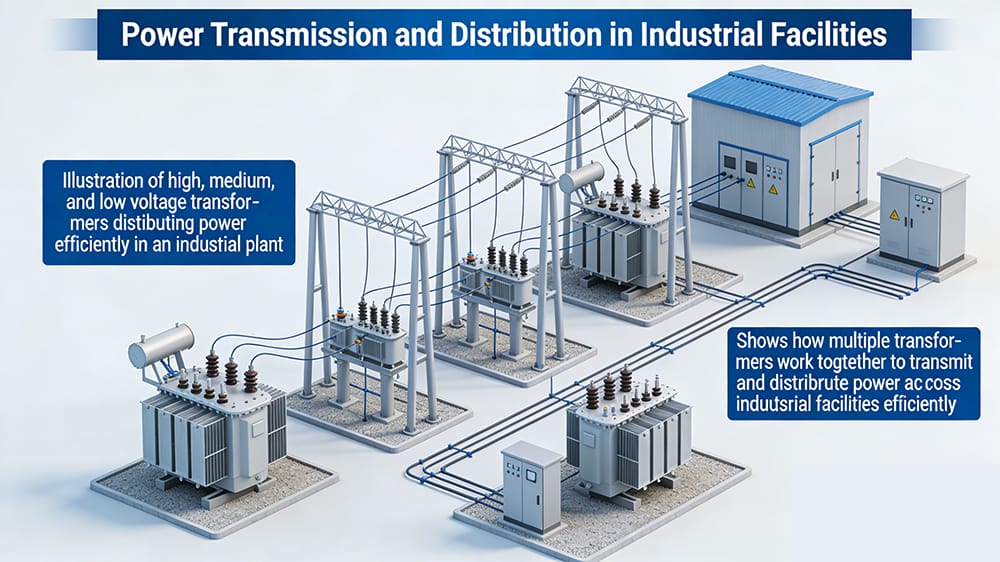
Below are the most commonly used transformer types in industrial applications:
1. Power Transformers
Power transformers are a key component in high-voltage industrial power transformer applications, primarily used in transmission networks and large-scale industrial substations.
These transformers are responsible for transferring electrical energy between generation and distribution systems at high voltage levels.
Key characteristics:
- Large capacity (typically above 10 MVA)
- Designed for high-voltage power transmission
- High efficiency at or near full load conditions
- Installed in substations or grid-connected facilities
Applications:
- Power plants
- Heavy industrial facilities
- Utility-scale energy systems
👉 Power transformers are essential in industrial power transmission applications, ensuring efficient long-distance electricity transfer with minimal losses.
2. Distribution Transformers
Distribution transformers are widely used in industrial transformer applications for power distribution, delivering electricity from substations to end-use equipment within facilities.
They operate at lower voltage levels compared to power transformers and are critical for final-stage voltage conversion.
Key features:
- Medium capacity (typically below 10 MVA)
- Continuous operation (24/7 industrial use)
- Installed close to load centers or production lines
Applications:
- Üretim tesisleri
- Ticari binalar
- Industrial zones
👉 Distribution transformers play a central role in transformer applications in industry, ensuring stable and efficient electricity supply across different sections of a facility.
3. Dry-Type Transformers
Dry-type transformers are commonly used in indoor industrial transformer applications, especially where safety and environmental concerns are a priority.
Unlike oil-filled transformers, they use air or solid insulation systems for cooling.
Advantages:
- Fire-resistant and explosion-proof
- Low maintenance requirements
- Environmentally friendly (no oil leakage risk)
- Suitable for enclosed spaces
Typical applications:
- Veri merkezleri
- Hospitals and commercial buildings
- High-rise industrial facilities
- Renewable energy systems
👉 Dry-type transformers are ideal for industrial electrical transformer applications requiring high safety standards.
4. Oil-Immersed Transformers
Oil-immersed transformers (also known as oil-filled transformers) are one of the most widely used types in heavy industrial transformer applications.
They use insulating oil for both cooling and electrical insulation, making them highly efficient under heavy load conditions.
Advantages:
- Excellent heat dissipation performance
- High overload capacity
- Long service life
- Suitable for high-voltage and high-capacity systems
Applications:
- Steel plants
- Mining operations
- Power distribution networks
- Outdoor substations
👉 Oil-immersed transformers dominate industrial power transformer applications where high reliability and durability are required.
5. Isolation Transformers
Isolation transformers are used in specialized industrial transformer applications where electrical separation and safety are critical.
They are designed to isolate one part of the electrical system from another, preventing direct current flow between circuits.
Key functions:
- Electrical isolation for safety
- Protection against voltage spikes and noise
- Reduction of ground loop issues
Used in:
- Sensitive electronic equipment
- Medical systems
- Control panels
- Laboratory environments
👉 These transformers are essential in electrical transformer applications focused on protection and signal stability.
6. Specialized Industrial Transformers
Certain industries require custom-designed transformers:
- Furnace transformers → steel manufacturing
- Rectifier transformers → DC conversion
- Traction transformers → rail systems
- Control transformers → automation
5.Industrial Transformer Applications by Industry
1. Manufacturing Industry
In the manufacturing sector, Industrial Transformer Applications are critical for powering automated production lines, CNC machinery, and robotics systems. Precision in manufacturing processes demands stable voltage to prevent defects, reduce downtime, and maintain product quality.
High-performance transformers help minimize energy losses and protect sensitive control systems from power surges. Additionally, modern manufacturing facilities increasingly integrate smart monitoring systems with transformers to optimize energy efficiency and predict maintenance needs.
2. Oil and Gas Industry
Transformers play a vital role in the oil and gas industry, supporting drilling rigs, pumping stations, and offshore platforms. These environments are often exposed to extreme temperatures, humidity, and potentially explosive atmospheres, making explosion-proof and rugged transformer designs essential.
Proper Industrial Transformer Applications in this sector ensure uninterrupted operations, safeguard personnel, and comply with international safety standards such as IEC 60076 for high-voltage transformers.
3. Mining Industry
Mining operations rely heavily on transformers to supply power to conveyor belts, ventilation systems, and underground equipment. Due to remote locations and harsh environmental conditions, reliability and durability are non-negotiable.
Transformers in mining must withstand dust, moisture, and temperature fluctuations while providing stable power for heavy machinery. Efficient Industrial Transformer Applications in mining help reduce operational risks, improve safety, and extend equipment lifespan, which is crucial for maintaining continuous production.
4. Steel and Metallurgical Industry
In steelmaking and metallurgical processes, transformers are indispensable for electric arc furnaces, smelting, and continuous casting lines. These applications require extremely high power capacity and robust thermal management to handle rapid load changes.
Advanced Industrial Transformer Applications in this industry not only support large-scale energy demands but also enhance operational efficiency by minimizing energy losses and improving temperature control within the production system.
5. Data Centers and IT Infrastructure
Data centers and IT infrastructure rely on transformers to ensure uninterrupted power supply, integrate seamlessly with UPS systems, and protect sensitive electronics from voltage fluctuations.
High-quality Industrial Transformer Applications in this field enable critical uptime, support high-density computing equipment, and comply with strict power quality standards. Transformers designed for IT environments also facilitate energy-efficient cooling and reduce overall operational costs.
6. Renewable Energy and Power Plants
Transformers are pivotal in renewable energy systems such as solar farms, wind turbines, and hydroelectric plants. They convert and stabilize generated power for grid integration, enabling efficient transmission and distribution.
Effective Industrial Transformer Applications in renewable energy not only improve system reliability but also enhance energy efficiency, support load balancing, and contribute to sustainable energy initiatives. Advanced transformers in this sector often feature smart monitoring and remote diagnostics to optimize performance and reduce maintenance costs.
Looking for a Transformer Solution?
6.How to Choose the Right Transformer for Industrial Applications
Selecting the right transformer for industrial operations is a critical decision that directly impacts operational efficiency, equipment longevity, and safety. A structured approach ensures optimal Industrial Transformer Applications.
1. Determine Voltage Levels
Ensure compatibility with input and output voltage requirements.
2. Calculate Load Capacity
Accurate load calculation is crucial. Evaluate:
- Peak load: Maximum power demand during short-term operations.
- Continuous load: Typical operational load under normal conditions.
- Future expansion: Potential increases in power demand due to additional machinery or facility growth.
Selecting a transformer with an appropriate load margin prevents overheating, reduces maintenance costs, and ensures uninterrupted operations in critical industrial processes.
3. Evaluate Environmental Conditions
Industrial transformers must withstand the conditions of their installation environment. Key factors include:
- Temperature extremes: High or fluctuating temperatures can affect insulation and reduce transformer lifespan.
- Humidity: Excess moisture may lead to corrosion and insulation degradation.
- Dust, chemicals, or corrosive elements: Certain industries like mining, chemical plants, or steel production require transformers with enhanced sealing and protective coatings.
Choosing a transformer designed for the environmental conditions ensures reliability and reduces the risk of premature failures.
4. Select Cooling Method
Cooling efficiency directly affects transformer performance and longevity. Common options include:
- ONAN (Oil Natural Air Natural): Uses natural circulation of oil and air; suitable for moderate loads and stable environments.
- ONAF (Oil Natural Air Forced): Oil circulates naturally, while fans increase air cooling; ideal for high-load or fluctuating conditions.
- Air-cooled systems (Dry-Type): Less maintenance and safer for indoor applications; suitable for sensitive industrial environments.
The choice of cooling method should align with your operational load, installation space, and maintenance capabilities.
5. Assess Efficiency Requirements
High-efficiency transformers reduce energy losses, lower operational costs, and contribute to sustainability goals. For industries with 24/7 operations, even small improvements in efficiency can result in significant cost savings over the transformer’s lifespan. Look for transformers with low no-load and load losses, especially for high-capacity industrial applications.
6. Check Compliance Standards
Ensure that the transformer complies with international or local standards such as IEC 60076, IEEE transformer standards, or relevant national codes. Compliance ensures safety, reliability, and interoperability with other industrial equipment. Certified transformers often offer better warranties and performance guarantees, making them a trusted choice for critical Industrial Transformer Applications.
| Step | Key Indicators | Checklist Questions | Notes / Tips |
|---|---|---|---|
| 1. Determine Voltage Levels | Primary & Secondary Voltage, Step-up/Step-down | Does the transformer match your system voltage requirements? | Include voltage margin for safety and future expansion. |
| 2. Calculate Load Capacity | Peak Load, Continuous Load, Future Growth | Can the transformer handle peak load without overheating? Is there room for expansion? | Oversizing slightly can prevent overloads, but avoid excessive oversizing to reduce cost. |
| 3. Evaluate Environmental Conditions | Temperature, Humidity, Dust/Chemicals | Will the transformer withstand local environmental factors? | Choose protective coatings, enclosures, or explosion-proof designs if needed. |
| 4. Select Cooling Method | ONAN, ONAF, Air-cooled | Which cooling method suits load and site conditions? | High-load or outdoor installations may require ONAF; indoor sensitive areas may prefer dry-type air-cooled. |
| 5. Assess Efficiency Requirements | No-load & Load Losses, Energy Efficiency | Does the transformer offer optimal efficiency for continuous operation? | Consider high-efficiency models for 24/7 operations to reduce operational costs. |
| 6. Check Compliance Standards | IEC 60076, IEEE, Local Standards | Is the transformer certified and compliant with relevant standards? | Compliance ensures safety, warranty eligibility, and long-term reliability. |
| 7. Expert Consultation | Manufacturer Recommendations, Site Assessment | Have you consulted with experts for load, environment, and maintenance factors? | Expert advice can help balance cost, performance, and reliability. |
7.Customization of Industrial Transformers
In many industries, standard transformers may not fully meet the unique requirements of complex operations. Industrial Transformer Applications often demand tailored solutions to ensure optimal performance, reliability, and safety. Customization allows businesses to address specific electrical, environmental, and operational challenges, enhancing both efficiency and longevity of the power system.
1. Voltage and Frequency Adjustment
Customized transformers can be designed to match unusual voltage levels or specific frequency requirements. This is essential for industries that operate specialized machinery or equipment imported from different regions with varying electrical standards. Correct voltage and frequency adaptation ensures smooth operation, prevents equipment damage, and maintains energy efficiency.
2. Special Insulation Systems
In harsh environments such as chemical plants, steel mills, or offshore platforms, transformers may require advanced insulation systems. Options include high-temperature insulation, moisture-resistant coatings, or epoxy resin encapsulation for dry-type transformers. These enhancements prevent breakdowns, extend service life, and ensure safe operation under extreme conditions.
3. Anti-Corrosion Coatings
Transformers installed in corrosive or humid environments benefit from anti-corrosion coatings. Industries like mining, oil & gas, and coastal manufacturing facilities often use customized coatings to protect metal surfaces, reduce maintenance, and prevent rust or deterioration over time.
4. Explosion-Proof Designs
For potentially explosive atmospheres, such as chemical refineries, oil rigs, or gas processing plants, explosion-proof transformers are crucial. These designs incorporate sealed housings, pressure relief mechanisms, and flame-retardant materials to comply with safety regulations while ensuring continuous power delivery.
5. Compact or Modular Structures
Space constraints in industrial plants, urban substations, or data centers may require compact or modular transformer designs. Modular transformers allow flexible installation, easier maintenance, and scalability. Customized structures ensure that transformers fit seamlessly within existing systems without compromising performance.
6. Enhanced Monitoring and Control Options
Modern customization can include integrated smart sensors, IoT-enabled monitoring, or remote diagnostics. These features allow operators to track transformer health, detect anomalies early, and optimize energy usage, which is particularly valuable in continuous-operation facilities.
Benefits of Customized Transformers in Industrial Applications:
- Improved system compatibility with unique industrial equipment.
- Enhanced operational efficiency and energy savings.
- Increased reliability in harsh or specialized environments.
- Extended service life and reduced maintenance costs.
By leveraging tailored solutions, manufacturers and facility managers can ensure that Industrial Transformer Applications fully meet operational demands while adhering to safety standards and environmental requirements.
8.Advantages of Industrial Transformer Applications
Implementing high-quality transformers in industrial settings offers a wide range of benefits that enhance both operational performance and cost efficiency. Industrial Transformer Applications play a critical role in ensuring stable, safe, and efficient power distribution across diverse industries.
1. Reliable Power Supply
Transformers provide consistent and stable voltage to industrial equipment, preventing sudden power fluctuations that could disrupt operations. In manufacturing plants, data centers, or steel mills, reliable power ensures that automated machinery, robotics, and sensitive electronics operate without interruption, minimizing downtime and production losses.
2. Reduced Equipment Failure
By stabilizing voltage and managing load demands, transformers protect equipment from electrical stress, overheating, and insulation breakdown. This is particularly important for high-precision machinery, pumps, or ventilation systems in harsh industrial environments. Proper Industrial Transformer Applications significantly reduce the risk of unexpected failures, thereby avoiding costly repairs and unplanned shutdowns.
3. Improved Operational Efficiency
Transformers optimize power distribution and reduce energy losses across industrial networks. High-efficiency transformers and smart monitoring systems allow plants to operate at optimal loads, balancing energy consumption with production requirements. For example, integrating a transformer with predictive maintenance systems can proactively alert operators to potential issues, improving overall operational efficiency.
4. Lower Energy Costs
Energy efficiency is a major advantage of well-designed transformers. Modern transformers minimize no-load and load losses, convert energy more effectively, and help industries meet sustainability targets. Over time, reduced energy losses translate directly into lower electricity bills, making Industrial Transformer Applications an investment that pays off in both financial and environmental terms.
5. Extended Equipment Lifespan
Stable power supply and protection against electrical surges extend the operational life of industrial machinery and critical infrastructure. Transformers reduce wear and tear on sensitive components, decrease maintenance frequency, and enhance the longevity of entire systems. For industries with continuous operations, this advantage leads to significant cost savings and improved return on investment.
6. Enhanced Safety and Compliance
Customizable transformers can meet stringent safety standards, such as IEC 60076 or IEEE C57 series, and include features like explosion-proof designs or high-quality insulation. This not only protects personnel and equipment but also ensures compliance with local regulations, making industrial operations safer and more reliable.
Summary:
Overall, Industrial Transformer Applications provide a strategic advantage by combining reliability, efficiency, cost savings, and safety. They are essential for maintaining uninterrupted industrial operations, protecting valuable assets, and optimizing energy management across diverse industrial sectors.
9.Future Trends in Industrial Transformer Applications
1. Smart Transformers
Real-time monitoring and predictive maintenance.
2. Digitalization and IoT Integration
Remote control and data-driven optimization.
3. Energy-Efficient Designs
Low-loss core materials and advanced cooling.
4. Renewable Energy Integration
Adaptation to variable energy sources like solar and wind.
5. Sustainable and Eco-Friendly Solutions
Biodegradable insulating oils and reduced emissions.
10.Conclusion
Industrial transformer applications are essential for ensuring efficient, reliable, and safe power systems across all industries.
As industrial demands continue to grow, the role of transformers is evolving—from simple voltage converters to intelligent energy management systems.
Choosing the right transformer and optimizing its application can significantly improve operational performance, reduce costs, and enhance system reliability.
11.FAQ
Q1: What are industrial transformer applications?
They refer to the use of transformers in industrial systems for voltage regulation, power distribution, and equipment protection.
Q2: Why are transformers essential in industrial systems?
They ensure stable voltage, protect equipment, and enable efficient energy distribution.
Q3: What is the difference between power and distribution transformers?
Power transformers are used in transmission systems, while distribution transformers supply power to end users.
Q4: Which transformer is best for heavy industrial use?
Oil-immersed transformers are typically preferred for high-load and outdoor applications.
Q5: Can transformers be customized for specific industries?
Yes, industrial transformers can be designed to meet specific voltage, environmental, and operational requirements.
Ready to Optimize Your Industrial Power System?
👉Request a Free Consultation – Let our engineers help you select and design the perfect transformer solution for your industrial operations.