When it comes to power distribution systems, the distribution transformer (also called power distribution transformer) stands as a critical component that directly impacts the stability, efficiency, and safety of your entire electrical network. Choosing the right distribution transformer is not a decision to take lightly—whether you’re an engineer designing a new industrial park, a contractor managing a commercial building project, or a facility manager upgrading an existing residential power system, the wrong selection can lead to costly downtime, excessive energy waste, safety hazards, and even premature equipment failure. This guide focuses exclusively on distribution transformer selection, walking you through every essential step to make an informed choice aligned with your application, budget, and long-term operational goals.
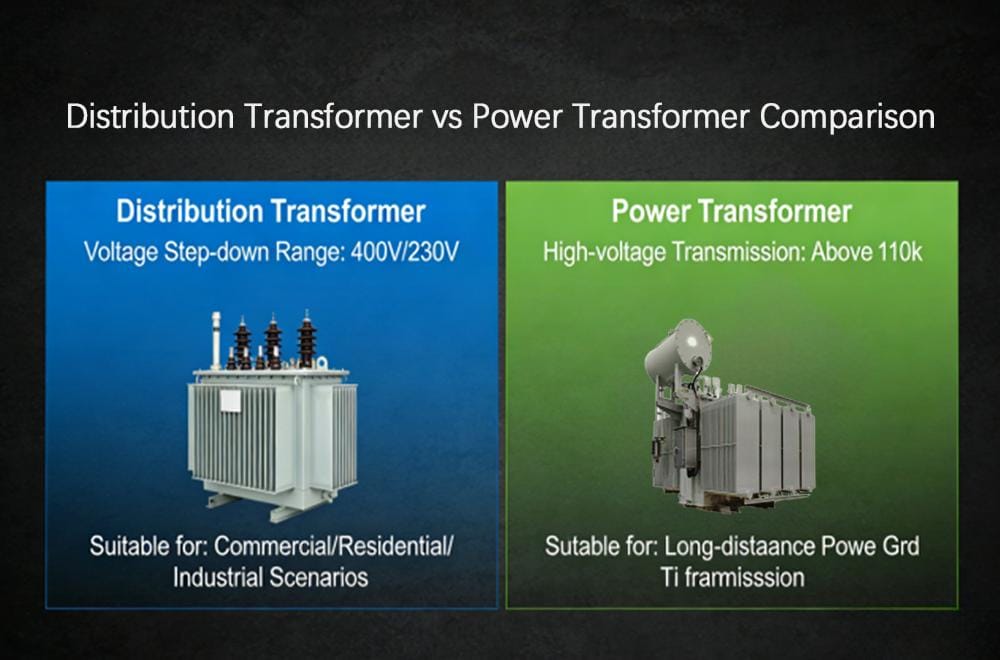
Unlike power transformers (handing high-voltage transmission above 110kV), dağıtım transformatörleri are designed to step down high voltage from the transmission grid to lower, usable voltages (typically 400V/230V for commercial/residential use, or higher for industrial applications). Their primary role is to deliver power reliably to end-users, so every decision in the selection process—from load calculation to environmental considerations—matters. By the end, you’ll have the knowledge to navigate the complexities of distribution transformer selection and avoid common pitfalls.
Table of Contents (TOC)
- Introduction to Distribution Transformer Selection
- Understand Your Application & Load Requirements
- Key Electrical Parameters for Distribution Transformer Selection
- Choose Between Oil-Immersed & Dry-Type Distribution Transformers
- Consider Cooling Methods & Efficiency Standards
- Installation Environment & Operating Conditions
- Safety Features & Compliance Certifications
- Manufacturer, Warranty & Total Cost of Ownership
- Final Checklist for Distribution Transformer Selection
- Çözüm
1. Introduction to Distribution Transformer Selection
The importance of correct distribution transformer selection cannot be overstated. A well-chosen distribution transformer ensures power flows smoothly from the grid to your equipment, minimizing energy loss and reducing the risk of power outages. Conversely, a poorly selected transformer will struggle with load demands, leading to overheating, reduced efficiency, and higher operational costs. For example, an undersized transformer will frequently overload, triggering protective devices and disrupting power; an oversized transformer wastes energy through higher no-load losses, driving up electricity bills unnecessarily.
This guide is for anyone involved in purchasing or specifying dağıtım transformatörleri: electrical engineers, project contractors, facility managers, and procurement professionals. Whether you’re working on a small residential complex, large industrial facility, or commercial building, the principles apply universally. We break the selection process into clear, actionable steps, starting with understanding your application and load requirements, moving through technical parameters and transformer types, and ending with a final checklist to avoid oversights.
Distribution transformer selection is not one-size-fits-all. Every application has unique needs, and factors like load type, installation environment, and budget influence your decision. By following this guide, you’ll evaluate your needs systematically and select a transformer that delivers reliable performance, meets safety standards, and optimizes total cost of ownership (TCO).
To make more informed decisions on distribution transformer selection, you can refer to authoritative resources such as the IEC 60076-11 standard for dry-type transformer specifications
Need help matching transformer specs to your project?
👉Contact our experts for a free consultation.
2. Understand Your Application & Load Requirements
The first and most critical step in distribution transformer selection is defining your application and calculating load requirements. Without a precise understanding of how the transformer will be used and the power it needs to deliver, you cannot make an informed choice. This step requires gathering data about your application, load type, and future expansion plans.
2.1 Determine Application Scenarios
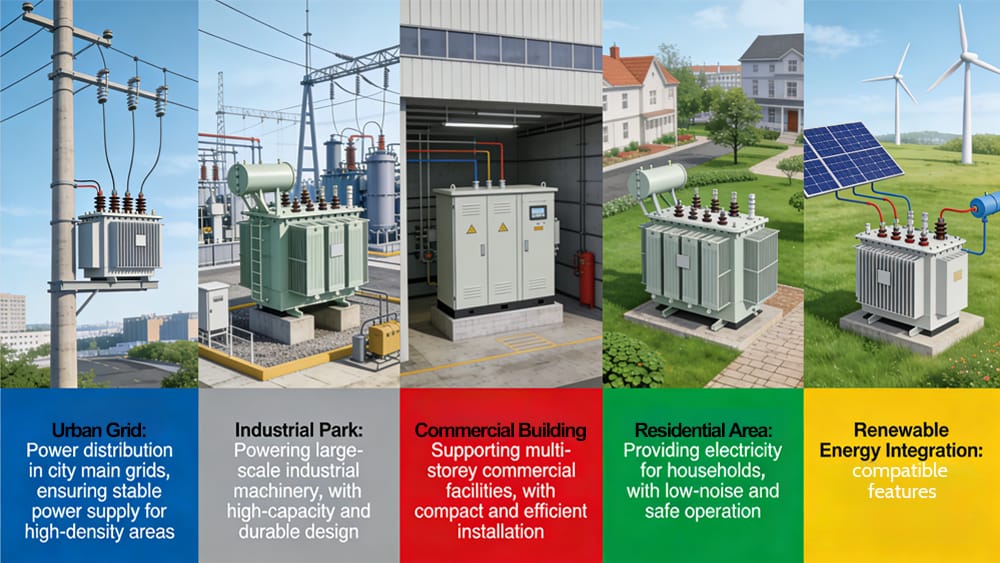
Start by identifying your specific application scenario—different uses demand different transformer specifications. Common scenarios include:
- Urban Grid Distribution: Municipal power projects require transformers that handle mixed residential, commercial, and light industrial loads—durable, efficient, and compliant with local grid standards.
- Industrial Parks: Industrial applications involve heavy machinery, inductive loads, and VFDs (variable frequency drives) that cause voltage fluctuations. Transformers here need to handle higher peak loads and have robust insulation to withstand harmonic distortions.
- Commercial Buildings: Offices, malls, and hotels need compact, quiet transformers (for indoor installation) to handle lighting, HVAC, elevators, and office equipment.
- Residential Areas: Residential transformers step down voltage to 230V (single-phase) or 400V (three-phase), requiring reliability, energy efficiency, and safety for installation near homes.
- Renewable Energy Integration: Transformers for solar/wind power must be compatible with renewable systems, handle variable power inputs, and meet grid-tie requirements.
Defining your scenario narrows down the transformer type (oil-immersed vs. dry-type) and technical specifications you need to consider.
2.2 Calculate Actual Load and Peak Load
Once you’ve identified your application, calculate the actual load the transformer will carry by summing the power requirements of all connected equipment. Follow these steps for accuracy:
- List all connected loads: Document every device/machine with rated power (kW/kVA), voltage requirements, and operating hours.
- Convert loads to kVA: Since transformers are rated in kVA (kilovolt-amps), use the formula: kVA = kW / Power Factor (PF). Most commercial/industrial applications have a PF of 0.8–0.9 (lagging). For example, a 100 kW load with a 0.8 PF requires 125 kVA.
- Calculate peak load: The maximum power demand at any time—critical for ensuring the transformer avoids overheating. Consider the maximum number of loads operating simultaneously (e.g., business hours for commercial buildings, machinery startup for industrial settings).
Be realistic: Underestimating peak load leads to an undersized transformer; overestimating results in an oversized transformer that wastes energy. Consult an electrical engineer if you’re unsure about calculations.
2.3 Reserve Capacity for Future Expansion
Always include reserve capacity (10–20% above calculated peak load) to accommodate future growth. For example, a 125 kVA peak load requires a 140–150 kVA transformer. This ensures the transformer handles increased load without overloading, but avoid excessive reserve capacity—this increases no-load losses and operating costs.
2.4 Differentiate Between Load Types
Load type impacts transformer capacity, efficiency, and reliability. Loads are categorized as:
- Resistive Loads: Heaters, ovens, incandescent lights (PF = 1.0), drawing only real power. Transformers for these loads can be sized precisely, with minimal voltage fluctuations.
- Inductive Loads: Motors, inductors (PF = 0.7–0.9 lagging), drawing real and reactive power. This increases required kVA, so you may need a larger transformer or better voltage regulation to handle startup voltage drops.
- Mixed Loads: Most applications (resistive + inductive/capacitive). Calculate total apparent power (kVA) using the overall PF; consider power factor correction devices to reduce kVA requirements.
3. Key Electrical Parameters for Distribution Transformer Selection
With your application and load requirements defined, focus on the key electrical parameters that define a distribution transformer—these determine performance in your specific use case.
3.1 Select Rated Capacity (kVA)
Rated capacity (kVA) is the maximum power the transformer can deliver continuously without exceeding temperature limits. Base this on peak load + 10–20% reserve capacity, and consider:
- Load Factor: Ratio of average load to peak load. A low load factor may allow a smaller transformer, but it must still handle peak loads (e.g., a 100 kVA transformer can handle 125 kVA peaks briefly).
- Ambient Temperature: High temperatures reduce transformer capacity (poor heat dissipation). Hot environments (e.g., tropical outdoors) may require a higher kVA rating.
Always refer to the manufacturer’s datasheet for capacity details under different operating conditions.
3.2 Confirm Input and Output Voltage Levels
Distribution transformers step down grid voltage (primary voltage: 11kV/22kV/33kV in most regions) to usable secondary voltage (400V three-phase for industrial/commercial, 230V single-phase for residential). Correct voltage levels are critical—wrong primary voltage damages the transformer and equipment; wrong secondary voltage causes under/overpowered devices and premature failure.
Some transformers have tap changers (±5% adjustment) to compensate for grid voltage drops. For stable voltage needs, choose transformers with on-load (OLTC) or off-load tap changers.
3.3 Frequency (50Hz / 60Hz)
Select a transformer matching your local grid frequency (50Hz in Europe/Asia/Africa, 60Hz in North/South America). Using a 50Hz transformer on a 60Hz grid (or vice versa) causes overheating, reduced efficiency, and shorter service life. Check the datasheet for frequency ratings—dual-frequency transformers are rare and have different capacity ratings.
3.4 Vector Group and Connection Type
Vector group defines the phase relationship between primary and secondary windings, critical for grid/equipment compatibility. Common groups fordağıtım transformatörleri:
- Dyn11: Most common—delta primary, star secondary (30° phase shift). Handles unbalanced loads and provides a neutral for single-phase use (ideal for commercial/industrial applications).
- Yyn0: Star primary/secondary (no phase shift). Suitable for residential unbalanced loads but less tolerant of short-circuit currents.
- Dd0: Delta primary/secondary (no phase shift). Ideal for industrial balanced loads (e.g., motor drives).
Delta connections handle unbalanced loads/short-circuits better; star connections provide a neutral for single-phase loads. Consult an engineer for the right vector group and connection type.
3.5 Short-Circuit Impedance Requirements
Short-circuit impedance (leakage reactance) measures the transformer’s ability to withstand short-circuit currents (expressed as a % of rated voltage). Higher impedance = better short-circuit protection but higher voltage drops under load. Match impedance to your application and local grid standards—insufficient impedance risks transformer damage during short-circuits, causing costly downtime.
4. Choose Between Oil-Immersed & Dry-Type Distribution Transformers
A key decision in distribution transformer selection is choosing between oil-immersed transformers Ve dry-type transformers. Both have pros and cons, with the right choice depending on application, environment, and safety needs.
4.1 Advantages and Suitable Scenarios
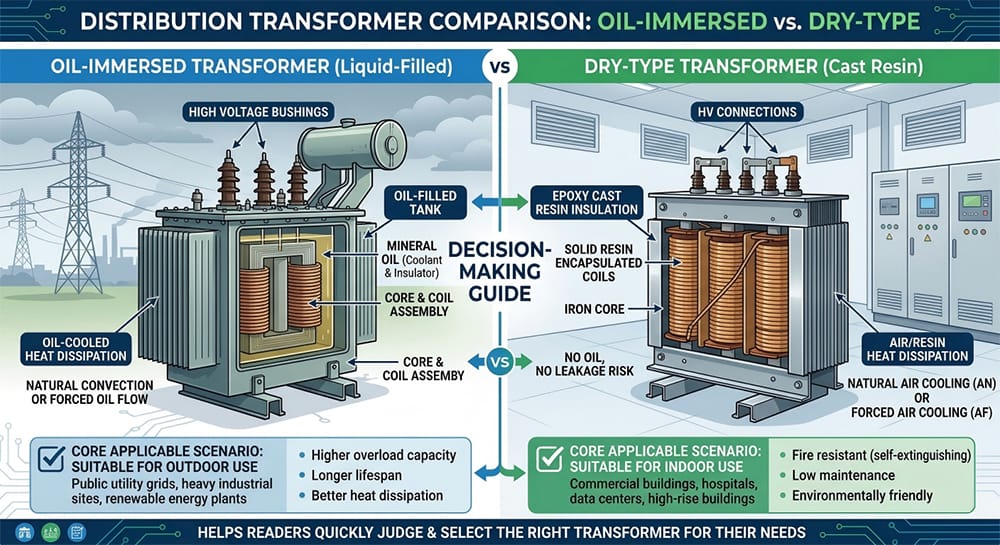
Oil-Immersed Transformers (mineral/synthetic oil as coolant/insulator):
- Advantages: Higher efficiency (full load), better heat dissipation, longer service life (30–40 years with maintenance), lower cost for large capacities (>500 kVA), robust insulation, and resistance to dust/humidity.
- Suitable Scenarios: Outdoor installations, industrial large loads (>500 kVA), hot environments, and cost/efficiency priorities (urban grid, industrial parks, remote areas).
Dry-Type Transformers (air/resin as coolant/insulator):
- Advantages: No oil leaks/fire risk, low maintenance, compact (indoor-friendly), quiet, and environmentally compliant. Easier to install and space-efficient.
- Suitable Scenarios: Indoor installations (commercial buildings, data centers, hospitals), strict fire safety regulations, small-medium loads (<500 kVA), and environments where oil leaks are catastrophic (near water/food facilities).
4.2 Safety, Environmental, and Maintenance Considerations
- Fire Safety: Oil-immersed transformers pose fire risks—install in fire-resistant enclosures or outdoor areas away from flammables. Dry-type transformers (F/H-class insulation) are non-flammable, safer for indoor/high-fire-risk areas.
- Environmental Protection: Oil-immersed transformers require proper oil disposal (hazardous if mishandled), increasing maintenance costs. Dry-type transformers are eco-friendly (no oil, no emissions).
- Bakım: Oil-immersed transformers need regular oil testing/replacement and cooling system checks. Dry-type transformers only require cleaning and winding/fan inspections—ideal for limited maintenance access.
Not sure if you’re choosing the right transformer type for your location or load?
👉Download our free distribution transformer selection checklist to avoid costly mistakes.
5. Consider Cooling Methods & Efficiency Standards
Cooling method directly impacts transformer efficiency, capacity, and service life. Choose based on application and environment.
5.1 Common Cooling Methods
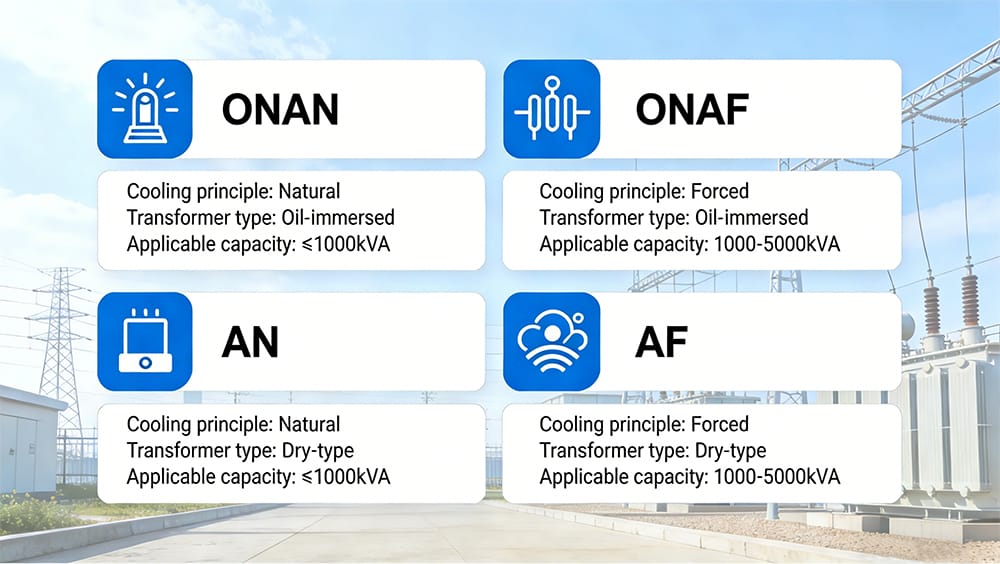
Transformers use natural or forced cooling, denoted by codes:
- ONAN (Oil Natural, Air Natural): Most common for oil-immersed transformers (≤500 kVA). Oil circulates via convection; heat dissipates through tank fins. Suitable for moderate outdoor temperatures.
- ONAF (Oil Natural, Air Forced): Fans improve heat dissipation foroil-immersed transformers (≤1000 kVA). Ideal for hot environments or large loads.
- AN (Air Natural): Natural convection for dry-type transformers (≤250 kVA). Suitable for well-ventilated indoor spaces.
- AF (Air Forced): Fans for dry-type transformers (≤1000 kVA). Ideal for poorly ventilated indoor areas or large loads.
5.2 Energy Efficiency Levels and Loss Standards
Yeterlik directly impacts operating costs—transformers lose energy via no-load losses (core losses, constant) and load losses (copper losses, proportional to load). International standards (IEC 60076-11, DOE) classify transformers into efficiency classes (IE1 to IE4), with IE4 being most efficient.
Choose the highest efficiency class within your budget. High-efficiency transformers (IE3/IE4) have higher upfront costs but lower long-term energy bills—e.g., an IE3 transformer reduces no-load losses by 30% vs. IE1, yielding significant savings over its service life.
5.3 How Efficiency Affects Long-Term Costs
Total Cost of Ownership (TCO) includes purchase, operating (energy losses), and maintenance costs. Low-cost, low-efficiency transformers have higher long-term costs; high-efficiency models (IE3/IE4) save money over time. Calculate annual savings: (No-Load Losses Difference + Load Losses Difference) × Operating Hours × Electricity Cost. For example, a 600W loss difference (0.6kW) at $0.15/kWh over 8760 hours = $788.40/year—$15,768 over 20 years.
6. Installation Environment & Operating Conditions
Installation environment and operating conditions significantly impact transformer performance and service life. Consider these factors during selection:
6.1 Indoor vs. Outdoor Installation
- Outdoor Installation: Oil-immersed transformers are common, requiring weatherproof enclosures, corrosion-resistant materials, and adequate drainage/ventilation. Ensure space for maintenance.
- Indoor Installation: Dry-type transformers are preferred, needing good ventilation and compliance with fire safety regulations. Compact designs fit limited spaces.
6.2 Altitude, Temperature, Humidity, and Corrosion
- Altitude: Above 1000 meters, reduced air density impairs heat dissipation—derate transformer capacity (use manufacturer derating charts).
- Temperature: Ambient temperatures above 40°C reduce capacity; low temperatures may cause condensation (damage windings).
- Humidity: High humidity causes condensation—seal outdoor transformers and maintain dry indoor environments.
- Corrosion: Coastal/industrial areas require transformers with corrosion-resistant materials (stainless steel, galvanized coatings) and protective finishes.
6.3 Noise Control and Space Requirements
Transformers produce noise from core vibration. Oil-immersed transformers are quieter (oil dampens vibration); larger units (>500 kVA) may need noise-reducing enclosures (keep <60 dB near residential areas).
Ensure sufficient space: Outdoor transformers need 1m clearance for ventilation/maintenance; indoor units require adequate ventilation to avoid overheating. Compact dry-type transformers save space for tight areas.
7. Safety Features & Compliance Certifications
Safety is paramount—transformers with inadequate safety features risk accidents, downtime, and injuries. Ensure compliance with international/local standards.
7.1 Essential Protection Devices
- Fuses and Circuit Breakers: Protect against overcurrent/short-circuits—fuses for small transformers, circuit breakers for larger units. Disconnect transformers during faults.
- Buchholz Relay: For oil-immersed transformers—detects internal faults (short-circuits, oil leaks) via gas buildup, triggering alarms/shutdowns.
- Temperature Sensors: Monitor transformer temperature, triggering alarms/shutdowns to prevent overheating (critical for winding/insulation protection).
- Lightning Arresters: Divert lightning/grid voltage surges to ground, protecting windings/insulation.
7.2 Insulation Class and Temperature Rise
Insulation class defines the maximum temperature insulation can withstand. Common classes for dağıtım transformatörleri:
- Class B: 80°C temperature rise (130°C total)
- Class F: 105°C temperature rise (155°C total)
- Class H: 125°C temperature rise (180°C total)
Choose higher classes (F/H) for hot environments or high load factors to prevent premature insulation degradation.
7.3 International and Local Standards
Transformers must comply with standards to ensure safety, performance, and grid compatibility. Common standards:
- IEC 60076: International standard for power/dağıtım transformatörleri (design, testing, performance).
- GB 1094: Chinese national standard (equivalent to IEC 60076).
- CE Marking: EU certification for safety/health/environmental compliance.
- ANSI/IEEE C57.12: US standard for dağıtım transformatörleri.
Non-compliant transformers may be banned from grid connection and pose safety risks.
7.4 Reliability and Lightning Protection
Select transformers with robust design and high-quality materials (reliable manufacturers). For outdoor units, add surge protection devices (SPDs) alongside lightning arresters to prevent surge damage.
8. Manufacturer, Warranty & Total Cost of Ownership
Choosing a reliable manufacturer, understanding warranty terms, and calculating TCO are critical for long-term value.
8.1 How to Choose a Reliable Manufacturer
- Reputation: Check customer reviews, testimonials, and case studies for real-world performance.
- Experience: Prioritize manufacturers with years of distribution transformer production expertise.
- Quality Control: Look for ISO 9001 certification (strict quality management systems).
- After-Sales Service: Choose manufacturers offering technical support, maintenance, and spare parts (minimizes downtime).
8.2 Warranty and After-Sales Service
A good warranty protects against material/workmanship defects. Look for: 1–5 year warranty periods (longer = greater manufacturer confidence), coverage for materials/workmanship/performance, and reliable after-sales support.
8.3 Initial Cost vs. Long-Term Costs
Initial purchase cost is only part of TCO. Low-cost transformers have higher energy losses and maintenance costs; high-quality, efficient models (IE3/IE4) have lower TCO over time (e.g., IE3 costs 10–20% more than IE1 but saves thousands in energy bills).
8.4 Service Life and Replacement Cycle
Oil-immersed transformers have a 30–40 year service life; dry-type transformers 20–30 years. Proper maintenance extends service life by 10–15 years. Plan for replacements to avoid unexpected downtime.
9. Final Checklist for Distribution Transformer Selection
Use this checklist to avoid critical oversights:
9.1 Step-by-Step Quick Selection Checklist
- Define your application scenario (urban grid, industrial, commercial, residential, renewable energy).
- Calculate actual load, peak load, and 10–20% reserve capacity.
- Determine rated capacity (kVA) based on load calculations.
- Confirm primary/secondary voltage levels and frequency.
- Select the correct vector group and connection type.
- Choose oil-immersed veya dry-type transformer based on environment/safety.
- Select cooling method (ONAN, ONAF, AN, AF) based on temperature/load.
- Choose the highest efficiency class (IE3/IE4) within budget.
- Ensure compliance with international/local standards (IEC, GB, CE, ANSI).
- Check safety features (fuses, Buchholz relay, temperature sensors).
- Select a reliable manufacturer with good after-sales service.
- Review warranty terms and calculate TCO.
- Ensure installation environment meets transformer requirements (space, ventilation, altitude, temperature, humidity).
9.2 Common Mistakes to Avoid
- Undersizing/Oversizing: Both cause inefficiency, overheating, or increased costs.
- Ignoring Application: Choosing the wrong transformer type (e.g., dry-type for outdoor industrial use) leads to performance/safety issues.
- Neglecting Efficiency: Low-efficiency transformers cost more long-term.
- Ignoring Safety Features: Inadequate protection risks accidents/downtime.
- Unreliable Manufacturer: Poor-quality transformers have shorter service lives and more maintenance needs.
9.3 When to Consult a Professional Engineer
Consult an engineer for accurate load calculations, technical parameter selection, standard compliance, and TCO analysis—especially for large/complex applications (industrial parks, renewable integration).
10. Conclusion
Distribution transformer selection requires careful consideration of application, load requirements, technical parameters, environment, safety, and budget. By following this guide, you’ll select a transformer that delivers reliable performance, meets safety standards, and optimizes TCO.
Core takeaways: Define your application and calculate loads accurately; select correct technical parameters; choose the right transformer type Ve cooling method; prioritize efficiency; ensure compliance; select a reliable manufacturer; and calculate TCO. The right distribution transformer ensures stable power, minimizes energy waste, and reduces downtime—investing in the long-term success of your electrical system. Consult an engineer or reputable manufacturer for further assistance.
Ready to find the perfect distribution transformer for your application?