1. Introduction: Why Initial Price Is Not the Real Cost
When planning a new power project, understanding the true substation cost is essential—not just the initial equipment price, but the full 10‑year cost of ownership. This guide compares oil‑immersed, dry‑type, and pad‑mounted substation solutions, showing how choices today affect substation cost over the long term, including CAPEX, energy losses, maintenance, and downtime risk.
Over a typical 10-year operating period, transformers and substations generate continuous expenses through energy losses, routine maintenance, inspections, downtime risks, and regulatory compliance. These ongoing costs often exceed the original equipment cost, especially in industrial, commercial, and utility-scale applications.
This is where many projects experience “hidden losses”:
- A transformer with a lower purchase price but higher energy losses
- A substation that requires frequent shutdowns for maintenance
- Equipment that meets basic standards but struggles with long-term reliability
From our experience working with EPC contractors, industrial plant owners, and overseas utility buyers, the most common regret we hear is:
“We should have evaluated the lifecycle cost, not just the quotation.”
In this article, we compare oil-immersed transformers, dry-type transformers, and pad-mounted substations through a 10-year cost-benefit lens. Rather than promoting a single “best” solution, our goal is to help you understand which option delivers the highest value for your specific application.
This analysis is especially relevant for:
- Industrial manufacturing facilities
- Commercial buildings and infrastructure projects
- Utility and distribution network upgrades
- Overseas EPC and renewable energy projects
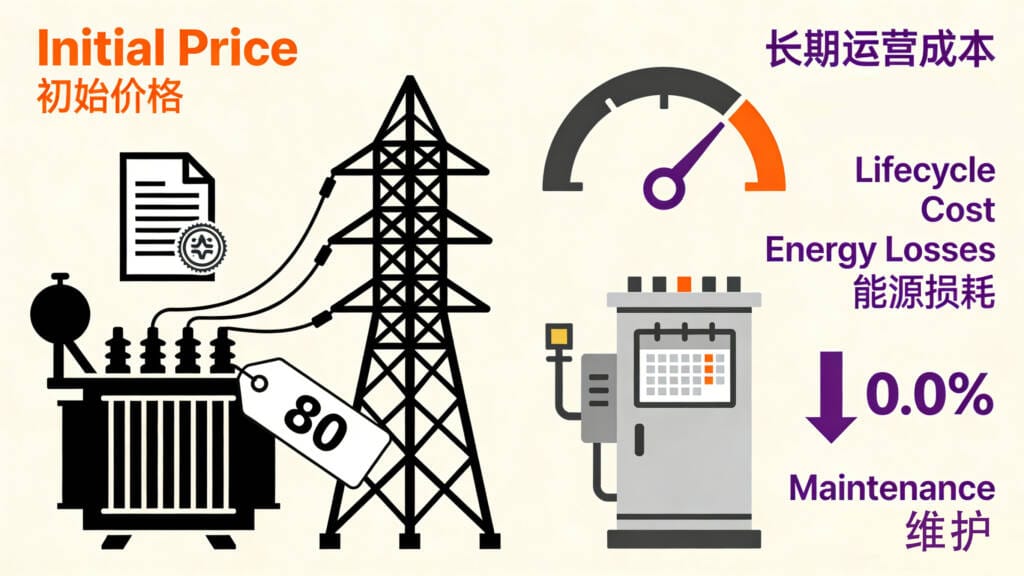
Table of Contents (TOC)
- Introduction: Why Initial Price Is Not the Real Cost
- Understanding Three Substation Cost Options in Power Distribution
- How We Evaluate 10‑Year Substation Cost and Value
- Initial Substation Capital Cost Comparison (Year 0)
- Operating Efficiency and Energy Loss in Substation Cost (Years 1‑10)
- Maintenance, Inspection, and Labor in Substation Life‑Cycle Cost
- Safety, Environmental, and Compliance‑Related Substation Costs
- Downtime Risk, Reliability, and Hidden Substation Costs
- 10‑Year Total Substation Cost of Ownership (TCO) Comparison
- Best‑Fit Substation Cost Solutions by Industry and Environment
- Practical Buying Advice to Reduce Long‑Term Substation Cost
- Final Conclusion and Substation Cost‑Based Decision Guidance
2. Understanding Three Substation Cost Options in Power Distribution
Before comparing costs, it is essential to clearly understand what each solution is designed to do and where it is typically used. Many cost misunderstandings stem from comparing products that are not functionally equivalent.
Power Distribution Solutions Comparison
| Feature / Aspect | Oil-Immersed Transformer | Dry-Type Transformer | Pad-Mounted Substation |
|---|---|---|---|
| Insulation & Cooling | Mineral oil or ester fluid; oil circulation for cooling | Air-cooled; solid insulation (cast resin or VPI) | Integrated transformer + switchgear; can be oil-immersed or dry-type, enclosed |
| Typical Installation | Outdoor, utility or industrial substations | Indoor (commercial buildings, data centers, hospitals) | Outdoor, compact pad-mounted unit |
| Fire & Safety Risk | Higher; flammable oil, requires fire protection | Low; no flammable liquid | Low to medium; designed for public safety and secure enclosure |
| Initial Equipment Cost | Generally lower per kVA | Medium to high | High (integration includes transformer + switchgear + enclosure) |
| Maintenance Requirement | Medium to high; oil testing, cooling inspection | Low to medium; regular cleaning and ventilation check | Low; factory-tested, enclosed, minimal on-site maintenance |
| Energy Efficiency | High efficiency; good heat dissipation | Medium; sensitive to high ambient temperature | Medium to high; depends on integrated transformer type |
| Space Requirement | Larger footprint; outdoor space needed | Compact indoors | Compact; minimal civil works required |
| Application Fit | Power plants, heavy industry, utilities | Commercial buildings, indoor industrial facilities | Urban distribution, residential compounds, renewable energy projects |
| Reliability | Proven, but maintenance-dependent | Reliable indoors; sensitive to dust/temperature | High; integrated and factory-tested |
| Lifecycle Consideration | Oil degradation, potential fire hazard | Insulation aging, ventilation critical | Long-term stability, minimal field variability |
2.1 Oil-Immersed Transformers and Substations
Oil-immersed transformers use mineral oil or ester fluid as both an insulating medium and a cooling agent. Heat generated by the windings is transferred to the oil, which circulates naturally or through forced cooling systems.
Oil-immersed transformers are widely used in:
- Power plants and substations
- Heavy industrial facilities
- Utility transmission and distribution networks
- Outdoor installations with sufficient space
Key characteristics:
- High efficiency and excellent heat dissipation
- Proven technology with decades of operational history
- Suitable for high-capacity and high-voltage applications
From a cost perspective, oil-immersed transformers often offer lower initial equipment cost per kVA, especially at medium and high ratings. However, they introduce additional considerations such as oil containment, fire protection, and environmental compliance.
In many projects, oil-immersed transformers are installed as part of a traditional outdoor substation, which includes foundations, oil pits, fencing, and fire safety systems.
2.2 Dry-Type Transformers
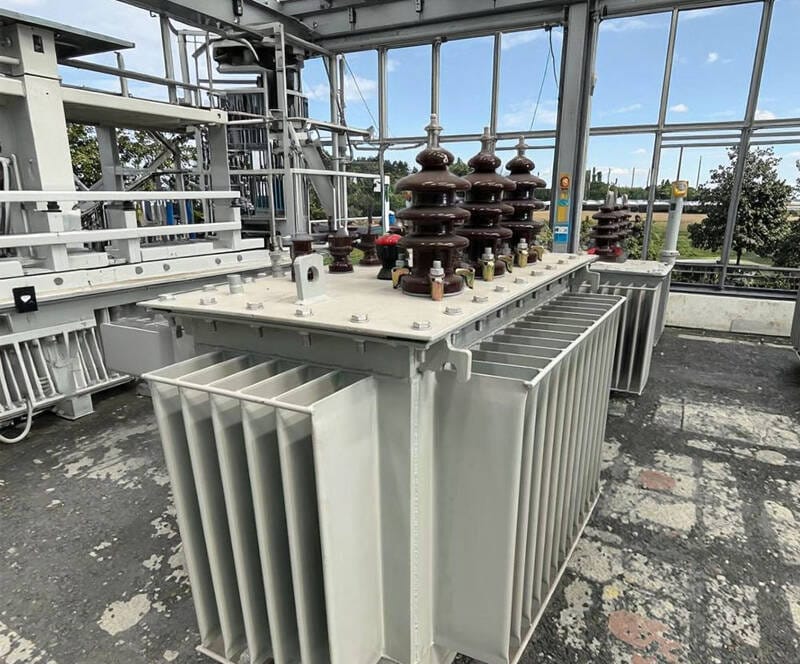
Dry-type transformers use air as the primary cooling medium and solid insulation systems such as cast resin or vacuum pressure impregnation (VPI). They do not contain flammable oil, which makes them particularly attractive for indoor and densely populated environments.
Typical applications include:
- Commercial buildings
- Hospitals and data centers
- Airports and transportation hubs
- Indoor industrial power rooms
Key characteristics:
- No oil leakage or fire risk from liquid insulation
- Lower environmental and regulatory burden
- Compact footprint for indoor installation
From an operational standpoint, dry-type transformers are often perceived as “low-maintenance” equipment. While this is generally true, they can be sensitive to dust, humidity, and ambient temperature, which directly affects long-term performance and cooling efficiency.
Initial purchase cost for dry-type transformers is usually higher than oil-immersed units of the same capacity, particularly for cast resin designs.
2.3 Pad-Mounted Substations
Pad-mounted substations are fully integrated power distribution units that typically include:
- A pad-mounted transformer
- Medium-voltage switchgear (RMU or load break switches)
- Low-voltage distribution panel
All components are enclosed in a weatherproof steel housing and installed on a concrete pad at ground level.
They are commonly used in:
- Urban distribution networks
- Residential and commercial developments
- Industrial parks
- Renewable energy projects
Key characteristics:
- Compact, integrated, and space-saving design
- Enhanced safety with dead-front construction
- Reduced on-site installation complexity
While pad-mounted substations often have a higher upfront cost, they can significantly reduce installation time, civil works, and coordination between multiple suppliers.
In many cases, buyers underestimate the cost savings from integration, focusing only on the equipment price rather than the total installed cost.
👉Request a Free 10‑Year Substation Cost Comparison for Your Project
3. How We Evaluate 10‑Year Substation Cost and Value
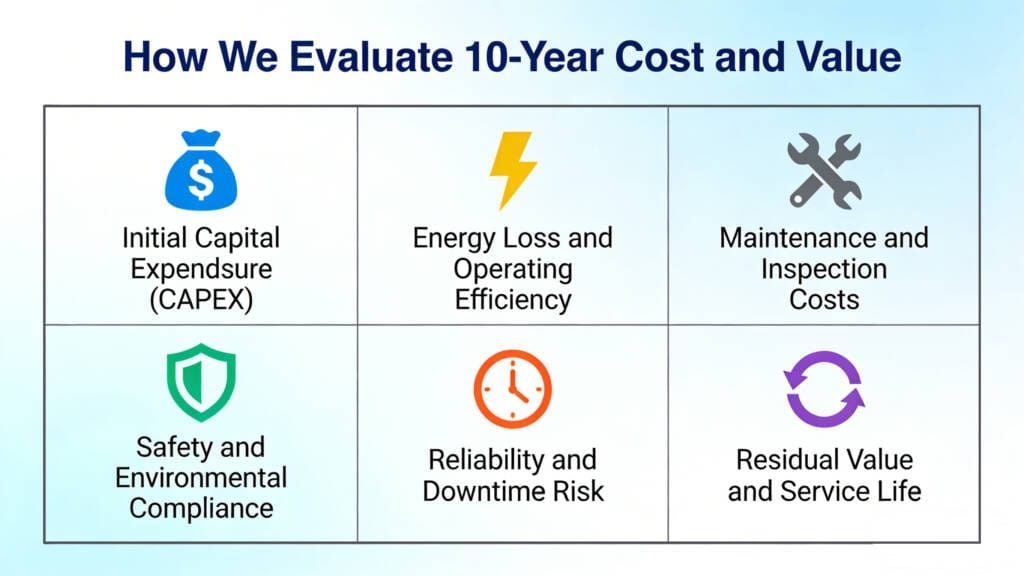
To ensure a fair comparison, this analysis evaluates each solution across the same cost dimensions over a 10-year operating period, which is a standard planning horizon for industrial and utility assets.
Cost Evaluation Framework
We divide costs into six major categories:
- Initial Capital Expenditure (CAPEX)
- Equipment purchase price
- Transportation and import costs
- Installation and commissioning
- Energy Loss and Operating Efficiency
- No-load losses
- Load losses
- Impact on electricity bills
- Maintenance and Inspection Costs
- Routine servicing
- Testing and diagnostics
- Labor and spare parts
- Safety and Environmental Compliance
- Fire protection systems
- Environmental safeguards
- Regulatory inspections
- Reliability and Downtime Risk
- Failure probability
- Repair time
- Production or service interruption
- Residual Value and Service Life
- Expected lifespan beyond 10 years
- Refurbishment or replacement potential
By applying this framework, we avoid the common mistake of comparing equipment based solely on nameplate specifications or initial quotations.
4. Initial Substation Capital Cost Comparison (Year 0)
In Middle East projects, initial capital cost is often the most visible number during tender evaluation. However, what appears as a “lower price” at quotation stage can change significantly once installation conditions, climate adaptation, and regulatory requirements are fully considered.
4.1 Equipment Purchase Cost in Middle East Projects
For comparable capacity ratings (e.g., 1000 kVA to 2500 kVA at 11 kV or 33 kV), the general pricing trend in Middle East markets is:
- Oil-immersed transformers
Typically offer the lowest equipment price per kVA, especially for outdoor installations. Local utilities and EPCs are very familiar with oil-filled designs, which keeps acceptance barriers low. - Dry-type transformers
Usually 20–40% higher in initial unit price compared to oil-immersed transformers of the same rating. Cast resin designs further increase cost but are often specified for indoor commercial or infrastructure projects. - Pad-mounted substations
Appear more expensive at first glance because they combine multiple components into a single package. However, this comparison is misleading if evaluated only as “equipment cost.”
In Middle East tenders, we frequently observe that pad-mounted substations are compared against separately quoted transformers, RMUs, LV panels, foundations, and cabling, without accounting for the integration value.
4.2 Installation and Civil Works Cost
Installation costs in the Middle East are heavily influenced by labor availability, site conditions, and climate protection requirements.
Oil-Immersed Substations
Oil-immersed transformers typically require:
- Concrete foundations
- Oil containment pits or bund walls
- Fire protection clearances
- Fencing and restricted access
In hot desert environments, additional shading structures or cooling considerations may be required to prevent oil temperature from exceeding design limits.
While the transformer itself may be economical, civil works and fire safety systems can significantly increase total installed cost.
Dry-Type Transformers
Dry-type transformers are commonly installed indoors, which can reduce outdoor civil works. However, this shifts cost toward:
- Dedicated transformer rooms
- Ventilation or air-conditioning systems
- Dust protection measures
In Middle East climates, maintaining proper airflow and ambient temperature is critical. Poor ventilation can lead to derating, which effectively increases cost per usable kVA.
Pad-Mounted Substations
Pad-mounted substations are designed for outdoor installation, making them highly suitable for Middle East conditions.
Key installation advantages include:
- Minimal foundation requirements
- No oil pits (for dry-type pad-mounted designs)
- Reduced on-site wiring and commissioning time
For large-scale developments such as industrial parks or residential compounds, these advantages often translate into lower total installed cost, despite a higher equipment price.
👉Get a Custom Substation Cost Analysis to Choose the Right Solution
5. Operating Efficiency and Energy Loss in Substation Cost (Years 1‑10)
In Middle East countries, electricity tariffs for industrial users vary widely. Some regions benefit from subsidized rates, while others—especially private industrial zones—face rising energy costs.
Regardless of tariff structure, energy losses accumulate continuously over 10 years, making efficiency a critical cost factor.
5.1 Transformer Losses in High Ambient Temperature
High ambient temperatures directly affect transformer performance:
- Increased winding resistance
- Higher operating temperature
- Reduced cooling efficiency
Oil-immersed transformers generally perform well under high loads due to superior heat dissipation. However, prolonged exposure to extreme heat accelerates oil aging, which can indirectly increase long-term maintenance cost.
Dry-type transformers are more sensitive to ambient temperature. In Middle East conditions, it is common to see:
- Derating requirements of 5–15%
- Higher ventilation or cooling energy consumption
Pad-mounted substations, when properly designed with ventilation and sun-shielding, can maintain stable performance while minimizing auxiliary energy use.
5.2 Long-Term Energy Cost Impact
Even small differences in transformer losses can result in significant cost over 10 years.
For example, in a continuously loaded industrial facility:
- A slightly higher no-load loss may seem negligible
- Over 10 years, this loss translates into thousands of kilowatt-hours
- Which directly affects operating expenditure
In Middle East projects, where many facilities operate 24/7, loss optimization often delivers better ROI than initial cost savings.
6. Maintenance, Inspection, and Labor in Substation Life‑Cycle Cost
Maintenance practices in the Middle East vary depending on whether the asset is owned by:
- A utility company
- A private industrial operator
- An EPC under long-term service contract
6.1 Oil-Immersed Transformers
Oil-immersed transformers require periodic:
- Oil testing (dielectric strength, moisture content)
- Visual inspection for leaks
- Cooling system checks
In desert environments, dust accumulation on radiators and cooling fins is common, increasing cleaning frequency.
While these tasks are well understood, they introduce ongoing labor and downtime costs, especially in remote industrial locations.
6.2 Dry-Type Transformers
Dry-type transformers are often described as “low maintenance,” which is true in clean indoor environments.
However, in Middle East conditions:
- Dust and sand ingress can accumulate on windings
- High humidity near coastal areas can affect insulation
- Regular cleaning and inspection become essential
If neglected, these factors reduce cooling efficiency and increase failure risk.
6.3 Pad-Mounted Substations
Pad-mounted substations benefit from:
- Factory-tested integration
- Enclosed, weather-resistant design
- Simplified inspection routines
For utility-style networks and large developments, this often translates into lower maintenance labor per unit, which becomes a major advantage when managing dozens or hundreds of substations.
7. Safety, Environmental, and Compliance‑Related Substation Costs
Safety and compliance are especially critical in the Middle East due to:
- Dense urban developments
- High public safety expectations
- Strict utility and municipal regulations
7.1 Fire and Environmental Risk
Oil-immersed equipment introduces:
- Fire risk from flammable insulation
- Environmental liability in case of oil leakage
This often requires additional investment in fire barriers, drainage systems, and insurance coverage.
Dry-type transformers significantly reduce fire risk, making them preferred for indoor commercial projects.
Pad-mounted substations, particularly dry-type or ester-filled designs, offer a balanced solution—enhanced safety with outdoor flexibility.
7.2 Regulatory and Utility Approval
Many Middle East utilities maintain approved vendor lists and specific technical standards.
Pad-mounted substations are often favored because:
- They align with standardized utility designs
- Reduce variation in field installation
- Simplify inspection and approval processes
This indirect cost saving—faster approval and commissioning—is frequently overlooked but highly valuable in schedule-driven projects.
👉Talk to Our Engineers About Finding the Lowest Total Substation Cost for Your Site
8. Downtime Risk, Reliability, and Hidden Substation Costs
In Middle East industrial and infrastructure projects, reliability is not a technical preference—it is a financial necessity.
Many facilities operate under one or more of the following conditions:
- Continuous or near-continuous operation (24/7)
- High cost of production interruption
- Remote locations with limited maintenance access
- Contractual penalties for power outages
Under these conditions, even short periods of downtime can result in significant financial losses.
8.1 Oil-Immersed Transformers: Proven but Maintenance-Dependent
Oil-immersed transformers have a long operational history and are generally considered reliable when properly maintained. However, reliability in Middle East environments is highly dependent on maintenance discipline.
Common reliability-related challenges include:
- Oil degradation accelerated by high ambient temperatures
- Cooling efficiency reduction due to dust accumulation
- Increased failure risk if oil testing intervals are extended
In utility-managed substations, these risks are usually well controlled.
In privately operated industrial facilities, however, maintenance gaps are a frequent cause of unexpected failures.
Downtime impact in such cases includes:
- Long repair or replacement lead times
- Environmental cleanup requirements
- Utility re-approval before re-energization
8.2 Dry-Type Transformers: Stable Indoors, Sensitive to Environment
Dry-type transformers perform very reliably when installed in clean, well-ventilated indoor environments.
In Middle East projects, reliability issues often arise when:
- Indoor ventilation is insufficient
- Dust control measures are underestimated
- Transformers operate close to thermal limits due to derating
When properly specified and installed, dry-type transformers can deliver excellent long-term stability. When environmental control is poor, however, failures tend to occur suddenly rather than gradually, leaving limited warning time.
8.3 Pad-Mounted Substations: Reliability Through Integration
Pad-mounted substations are designed to reduce field variability, which is one of the primary causes of reliability problems in power distribution systems.
Key reliability advantages include:
- Factory-assembled and factory-tested systems
- Consistent protection coordination
- Reduced on-site wiring errors
For Middle East EPC projects with tight schedules and multiple subcontractors, this integrated approach often results in lower commissioning risk and fewer early-life failures.
9. 10‑Year Total Substation Cost of Ownership (TCO) Comparison
When all cost components are combined, the picture becomes much clearer.
9.1 Summary of Cost Drivers Over 10 Years
| Cost Category | Oil-Immersed | Dry-Type | Pad-Mounted Substation |
|---|---|---|---|
| Initial Equipment Cost | Low | Medium–High | High |
| Installation & Civil Works | High | Medium | Low |
| Energy Loss Cost | Low–Medium | Medium | Low |
| Maintenance Cost | Medium–High | Low–Medium | Low |
| Safety & Compliance Cost | High | Low | Low |
| Downtime Risk Cost | Medium | Medium | Low |
9.2 Interpreting the Results
- Oil-immersed solutions often show the lowest initial price but accumulate higher costs through maintenance, safety systems, and downtime risk.
- Dry-type transformers balance safety and maintenance advantages but may incur higher operating costs if environmental control is inadequate.
- Pad-mounted substations typically have the highest upfront investment but deliver the lowest and most predictable 10-year TCO in many Middle East outdoor and utility-style applications.
The key takeaway is simple:
The most economical solution over 10 years is rarely the one with the lowest quotation.
10. Best‑Fit Substation Cost Solutions by Industry and Environment
Rather than recommending a single solution, experienced buyers match technology to application.
10.1 Oil & Gas and Heavy Industry
Best fit:
- Oil-immersed substations
- Pad-mounted substations (utility-grade)
Why:
- High load demand
- Outdoor installation
- Strong maintenance capability
10.2 Commercial Buildings and Infrastructure
Best fit:
- Dry-type transformers
- Indoor substations
Why:
- Fire safety priority
- Indoor installation
- Lower environmental risk
10.3 Urban Distribution and Residential Developments
Best fit:
- Pad-mounted substations
Why:
- Compact footprint
- Public safety
- Fast deployment and approval
10.4 Renewable Energy Projects (Solar & Storage)
Best fit:
- Pad-mounted substations
- Oil-immersed transformers with compact outdoor enclosures
Why:
- Remote locations
- Standardized layouts
- Scalability
11. Practical Buying Advice to Reduce Long‑Term Substation Cost
Based on real Middle East projects, here are the most important lessons buyers learn—often too late.
11.1 Do Not Compare Equipment in Isolation
Always evaluate:
- Installation requirements
- Environmental adaptation
- Utility approval timelines
A lower-priced transformer can easily become the most expensive solution after installation.
11.2 Ask Suppliers Lifecycle Questions, Not Just Technical Ones
Key questions to ask:
- What maintenance is required in desert conditions?
- How does the design handle high ambient temperatures?
- What failures are most common after 5–7 years?
Suppliers with real regional experience will answer confidently and specifically.
11.3 Prioritize Standardization for Large Projects
For projects involving multiple substations:
- Standardized pad-mounted designs
- Unified protection schemes
- Consistent spare parts
These choices dramatically reduce long-term operational complexity and cost.
12. Final Conclusion and Substation Cost‑Based Decision Guidance
Choosing between oil-immersed transformers, dry-type transformers, and pad-mounted substations is not a matter of technology preference—it is a matter of lifecycle value.
In Middle East environments, where heat, dust, safety, and project timelines all play critical roles, decisions based solely on initial price almost always lead to higher long-term costs.
A well-informed decision considers:
- Total cost of ownership over 10 years
- Environmental and safety risks
- Reliability and downtime impact
- Approval and commissioning efficiency
For many modern Middle East projects, pad-mounted substations and properly specified dry-type solutions increasingly outperform traditional approaches when evaluated holistically.
- Evaluate the best-fit solution for your application
- Optimize for high ambient temperature environments
- Reduce long-term operational and maintenance risk
👉 Request a customized cost-benefit analysis for your project
FAQ
1. How much does a substation cost?
A substation can range from tens of thousands to several million USD, depending on voltage level, capacity, and design. Always include civil works, installation, and 10‑year operating cost in your budget.
2. What factors have the biggest impact on substation cost?
Key factors are voltage level, transformer rating, insulation type (oil or dry), switchgear configuration, and local standards. Site conditions, labor, and logistics can also change the final price a lot.
3. How much does a high-capacity utility substation cost?
High‑capacity utility substations with multi‑MVA transformers and HV switchgear have much higher CAPEX than commercial units. For these projects you should compare 10‑year TCO instead of only equipment price.
4. How much does a substation transformer cost?
Substation transformer cost depends mainly on rating, voltage, and insulation type. Oil‑immersed units are usually cheaper per kVA, while dry‑type units cost more upfront but can save on installation and maintenance.
5. What is a package substation and how much does it cost?
A package substation is a compact, factory‑assembled unit with MV switchgear, transformer, and LV distribution. Its price includes the enclosure and integrated equipment, often reducing on‑site work and overall project cost.
6. How much does a power distribution system cost for industrial facilities?
For industrial plants, you need to add substation cost plus downstream panels, busducts, and cables. The more critical your process is, the more you may invest in redundancy and reliability.
7. Is underground distribution switchgear more expensive?
Yes, underground distribution switchgear usually has a higher initial price due to heavier enclosures and installation work. It can be justified in dense urban areas or harsh environments where reliability and appearance matter.
8. How do efficiency and energy losses affect substation cost?
Losses in transformers and switchgear add up over 10 years and can exceed the price difference between products. Choosing higher‑efficiency equipment often lowers the total substation cost over its life.
9. What maintenance costs should I expect for a substation?
Expect routine inspection, testing, and occasional part replacement. Oil‑immersed substations need oil‑related checks, while dry‑type and pad‑mounted solutions can reduce some maintenance tasks.
10. How can I reduce long-term substation cost?
Avoid choosing only the lowest upfront price. Work with reliable suppliers, select the right insulation and configuration, and evaluate 10‑year TCO to balance CAPEX, efficiency, and maintenance.