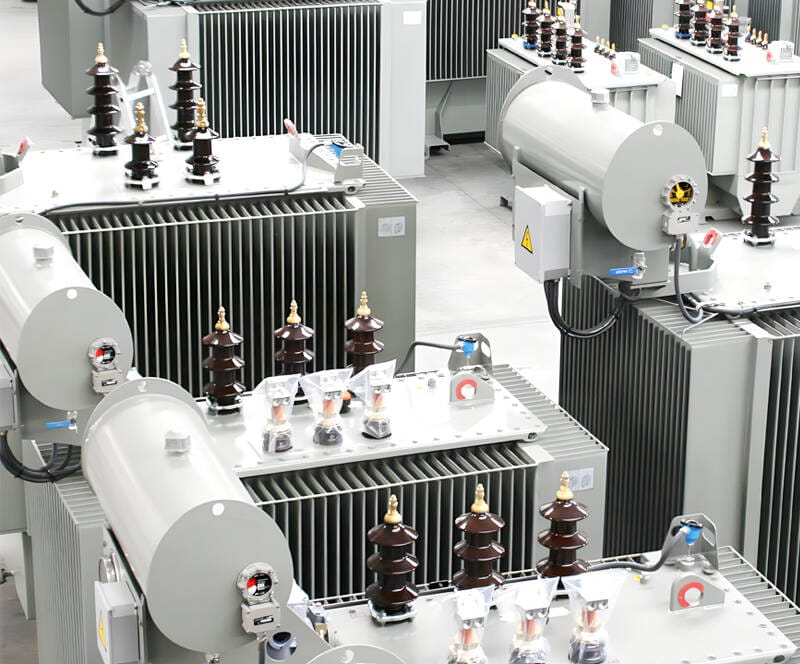
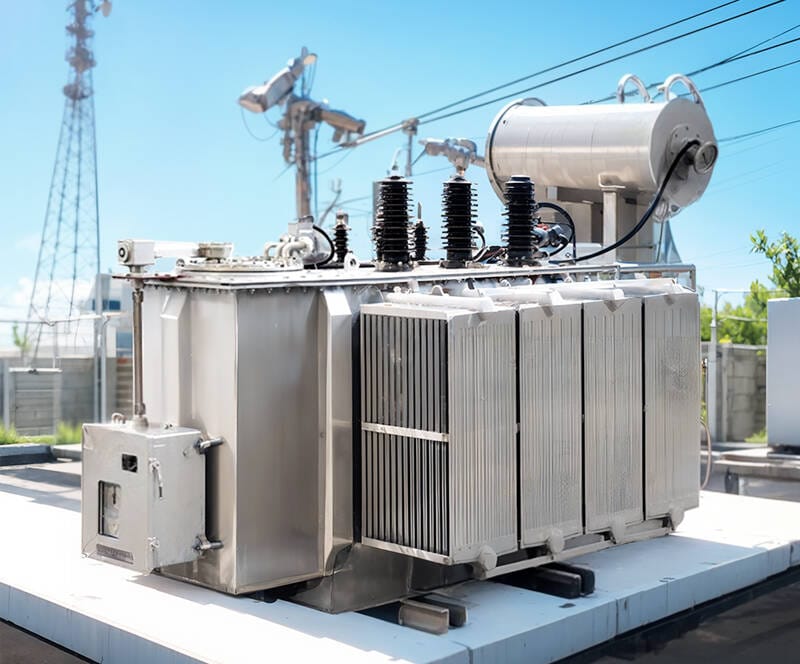
In today’s high-energy-cost environment, many businesses are looking for effective ways to reduce transformer TCO and lower their long-term operating expenses. Transformer Total Cost of Ownership (TCO) goes far beyond the initial purchase price — it includes capitalized energy losses, maintenance, downtime risks, and eventual disposal costs over a 25–30 year lifespan. For most organizations, energy losses alone can account for 70% or more of the total lifetime cost, often 3 to 5 times the upfront capital investment.
By understanding how to reduce transformer TCO through smarter design choices, accurate loss calculations, and optimized maintenance strategies, companies can achieve substantial savings while improving energy efficiency and reliability. This practical guide shows you exactly how to evaluate and minimize transformer lifetime costs using proven IEC methodologies and real-world best practices.
Table of Contents
- Introduction
- What is Transformer Total Cost of Ownership (TCO)?
- Key Components of Transformer TCO
- Understanding No-Load and Load Losses
- How to Calculate Transformer TCO Using IEC Methodology
- Factors That Significantly Impact Transformer TCO
- Practical Strategies to Reduce Transformer TCO
- Dry-Type vs. Oil-Immersed Transformers: TCO Comparison
- Real-World TCO Calculation Example
- Case Studies: Proven Savings from TCO-Optimized Transformers
- Common Mistakes to Avoid When Managing Transformer TCO
- Conclusion
1.Introduction
In today’s high-energy-cost environment, with rising electricity prices, stricter efficiency regulations, and growing sustainability demands, simply purchasing the cheapest transformer can be a costly mistake. The Transformer Total Cost of Ownership (TCO) — also known as Total Owning Cost or Life Cycle Cost — reveals the true economic picture over a transformer’s 20- to 30-year lifespan.
Many organizations focus only on the initial purchase price, yet energy losses alone can account for 70% or more of the total lifetime cost, often 3 to 5 times the upfront capital expenditure. No-load losses occur continuously (24/7), while load losses scale with usage. Add maintenance, installation, downtime risks, and eventual decommissioning, and the long-term financial impact becomes substantial.
Reducing transformer TCO delivers multiple benefits: lower operating expenses, improved energy efficiency, reduced carbon emissions, higher reliability, and compliance with standards such as IEC and DOE efficiency requirements. This comprehensive guide explains what transformer TCO entails, how to calculate it accurately, the key factors influencing it, and proven strategies to minimize it — whether for industrial plants, data centers, utilities, or renewable energy projects.
By adopting a TCO mindset during procurement and operation, businesses can achieve payback periods of 2–5 years on premium efficient designs and realize significant savings over decades. This article provides actionable insights, formulas, tables, and examples to help you evaluate and optimize your transformer investments effectively.
2.What is Transformer Total Cost of Ownership (TCO)?
Transformer Total Cost of Ownership (TCO) represents the complete economic cost of acquiring, operating, maintaining, and eventually retiring a transformer over its entire service life. Unlike simple purchase price comparisons, TCO incorporates the capitalized value of future energy losses, operational expenses, and other lifecycle factors.
The IEC methodology (detailed in IEC TS 60076-20) provides a standardized approach to TCO evaluation. It converts ongoing loss costs into a present-value equivalent at the time of purchase using capitalization factors. This allows fair apples-to-apples comparisons between different transformer designs and bids.
Why does TCO matter? Transformers are long-life assets. A distribution or power transformer installed today will likely operate for 25–40 years. During this period, even small reductions in losses translate into substantial cumulative savings, especially in regions with high electricity rates or continuous high-load operation.
TCO thinking shifts the focus from “lowest first cost” to “lowest lifetime cost.” It encourages investment in higher-efficiency designs that may carry a 10–30% higher initial price but deliver far greater long-term value through reduced energy bills and maintenance.
In practice, TCO helps utilities, facility managers, and EPC contractors make informed decisions that align with energy efficiency regulations, corporate sustainability goals, and budget optimization.
3.Key Components of Transformer TCO
Transformer TCO generally breaks down into these major elements:
- Purchase Price (Capital Cost) — The upfront bid or quoted price from the manufacturer.
- Capitalized Cost of No-Load Losses — Continuous core (iron) losses that occur even at zero load.
- Capitalized Cost of Load Losses — Winding (copper or aluminum) losses that vary with the square of the load current.
- Installation and Commissioning Costs — Foundation, cabling, cooling systems, and labor.
- Maintenance and Operating Costs — Routine inspections, oil testing/replacement (for oil-immersed units), cleaning, and monitoring.
- Downtime and Reliability Costs — Potential production losses from unexpected failures.
- Decommissioning and Disposal Costs — End-of-life removal, recycling, or environmentally compliant disposal (especially important for oil-filled units due to fluid handling regulations).
Energy losses typically dominate the TCO equation. In many cases, the present value of losses over the transformer’s life exceeds the purchase price by a wide margin.
Table 1: Typical Breakdown of Transformer TCO Components (Approximate Percentages for a Standard Distribution Transformer)
| Component | Approximate Share of TCO | Notes |
|---|---|---|
| Purchase Price | 15–30% | Varies by design efficiency |
| Capitalized No-Load Losses | 30–50% | Constant 24/7 cost |
| Capitalized Load Losses | 20–40% | Depends on average loading |
| Maintenance & Installation | 5–15% | Higher for oil-immersed |
| Other (Downtime, Disposal) | 5–10% | Risk-based |
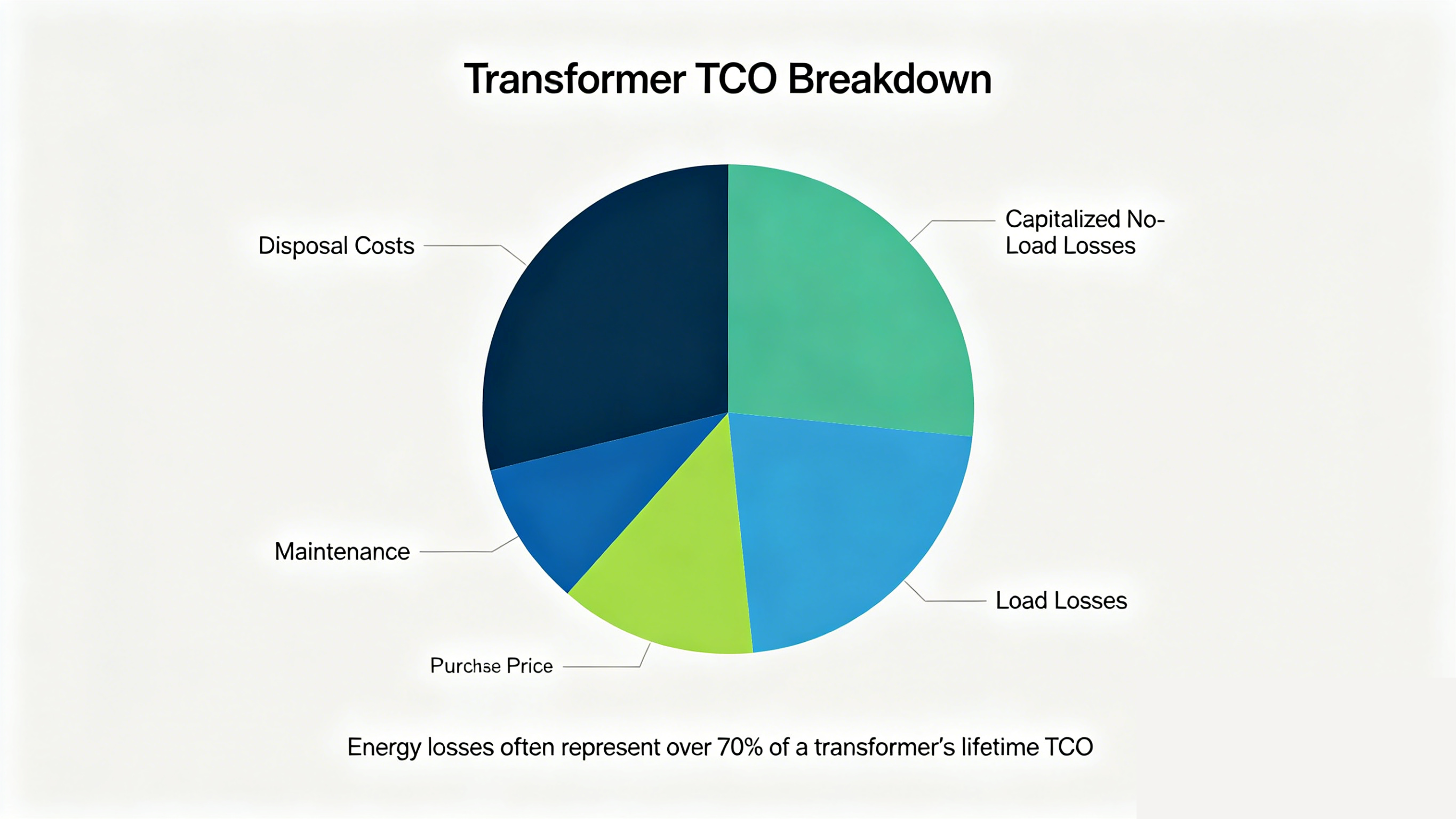
Note: Actual percentages depend on electricity price, load profile, discount rate, and transformer type. Losses often represent 70%+ of total TCO.
Understanding these components is the first step toward targeted reduction strategies.
Reduce your transformer TCO by up to 30%.
👉Get a free personalized TCO assessment from our team today.
4.Understanding No-Load and Load Losses
Transformer losses are categorized into two primary types:
- No-Load Losses (P₀ or Iron/Core Losses): These occur whenever the transformer is energized, regardless of load. They primarily consist of hysteresis losses (due to magnetic reversal in the core) and eddy current losses (induced currents in the core material). No-load losses are relatively constant and represent a significant “always-on” energy drain.
- Load Losses (Pₖ or Copper/Winding Losses): These occur due to the resistance of the windings and stray eddy currents when current flows through the transformer. Load losses increase approximately with the square of the load current (I²R losses). At full load, they can be several times higher than no-load losses.
The relationship between these losses determines the transformer’s peak efficiency point, which usually occurs below rated capacity — typically where no-load losses equal load losses.
Table 2: Comparison of No-Load vs. Load Losses
| Aspect | No-Load Losses (P₀) | Load Losses (Pₖ) |
|---|---|---|
| Dependency | Independent of load | Varies with load² |
| Main Causes | Core hysteresis + eddy currents | Winding resistance + stray losses |
| Occurs When | Transformer energized (24/7) | When carrying load |
| Reduction Strategies | Better core steel (e.g., amorphous), optimized geometry | Larger conductor cross-section, copper vs aluminum, improved cooling |
| Impact on TCO | High if transformer runs lightly loaded or continuously | High in high-load or cyclic applications |
相关图片及说明整理-1-1-1024x1024.png)
Reducing either type of loss requires design trade-offs. For example, using higher-quality grain-oriented electrical steel or amorphous cores lowers no-load losses but may increase material costs. Larger windings reduce load losses but raise the overall size and price.
Modern efficiency standards (IEC Ecodesign Tier 2, DOE 2024 updates) push manufacturers toward lower-loss designs, often mandating 10–30% reductions compared to older models. These improvements directly translate to lower TCO.
5.How to Calculate Transformer TCO Using IEC Methodology
The IEC-recommended TCO formula is straightforward yet powerful:
TCO = Purchase Price + (A × No-Load Losses) + (B × Load Losses)
The recommended approach follows the IEC TS 60076-20 technical specification, which provides a standardized methodology for evaluating transformer energy efficiency and total cost of ownership.
Where:
- A = Capitalization factor for no-load losses ($/kW or €/kW)
- B = Capitalization factor for load losses ($/kW or €/kW)
- Losses are typically expressed in kW (or watts, with consistent units)
The capitalization factors A and B convert future annual loss costs into a present lump-sum value, accounting for:
- Electricity price (often at mid-life forecast)
- Discount rate (cost of capital)
- Transformer economic life (n years, commonly 20–30)
- Annual operating hours (usually 8760)
- Average load factor (k, between 0 and 1)
Simplified formulas for A and B (based on IEC TS 60076-20):
A = Present value of cost per kW of no-load loss over lifetime B = A × (Load factor)² (adjusted for load profile)
More precise calculations incorporate the annuity factor for discounting:
Present Value Factor = [(1 + i)^n – 1] / [i × (1 + i)^n] (where i = discount rate, n = years)
Example Capitalization Factors (common industry ranges):
- A: $3,000 – $10,000 per kW (no-load)
- B: $1,000 – $5,000 per kW (load), often lower than A because load losses are not continuous
Table 3: Sample TCO Calculation Inputs for a 1000 kVA Transformer
| Parameter | Value | Notes |
|---|---|---|
| Purchase Price | $15,000 | Bid price |
| No-Load Losses (P₀) | 1.2 kW | Measured |
| Load Losses (Pₖ) | 8.5 kW | At rated current |
| A Factor | $7,500 / kW | No-load capitalization |
| B Factor | $2,500 / kW | Load capitalization |
| Expected Life | 25 years | – |
| Electricity Price | $0.12 / kWh | Average forecast |
相关图片及说明整理-2-2.png)
For detailed examples and an Excel tool, refer to the United for Efficiency (U4E) TCO guide, which offers practical guidance on applying the IEC capitalization factors A and B.
Plugging into the formula:
TCO = 15,000 + (7,500 × 1.2) + (2,500 × 8.5) = 15,000 + 9,000 + 21,250 = $45,250
This example shows how losses add significant capitalized cost beyond the purchase price.
Many utilities and consultants provide Excel tools based on IEC equations to automate these calculations, allowing sensitivity analysis on electricity prices, load factors, or discount rates.
6.Factors That Significantly Impact Transformer TCO
Several variables heavily influence the final TCO:
- Load Profile: Average and peak loading. Lightly loaded transformers emphasize no-load losses; heavily loaded ones emphasize load losses. A mismatched design (e.g., oversized unit) inflates TCO.
- Electricity Price and Forecast: Higher rates or expected increases amplify the value of loss reduction. In regions with $0.10–$0.20/kWh, loss capitalization factors rise sharply.
- Transformer Type and Technology: Dry-type vs. oil-immersed, core material (CRGO steel vs. amorphous), winding material (copper vs. aluminum), and cooling method all affect losses and maintenance.
- Efficiency Standards Compliance: Meeting or exceeding IEC Tier 2, DOE 2024, or local MEPS requirements ensures lower baseline losses.
- Operating Environment: Ambient temperature, altitude, humidity, and pollution levels affect efficiency and lifespan. High temperatures increase losses and accelerate aging.
- Discount Rate and Economic Life: Lower discount rates favor long-term savings; longer assumed life increases the present value of loss reductions.
- Maintenance Practices: Poor maintenance shortens life and increases effective TCO through higher failure risk.
Careful evaluation of your specific load profile and site conditions is essential when specifying transformers.
7.Practical Strategies to Reduce Transformer TCO
Here are proven, actionable strategies:
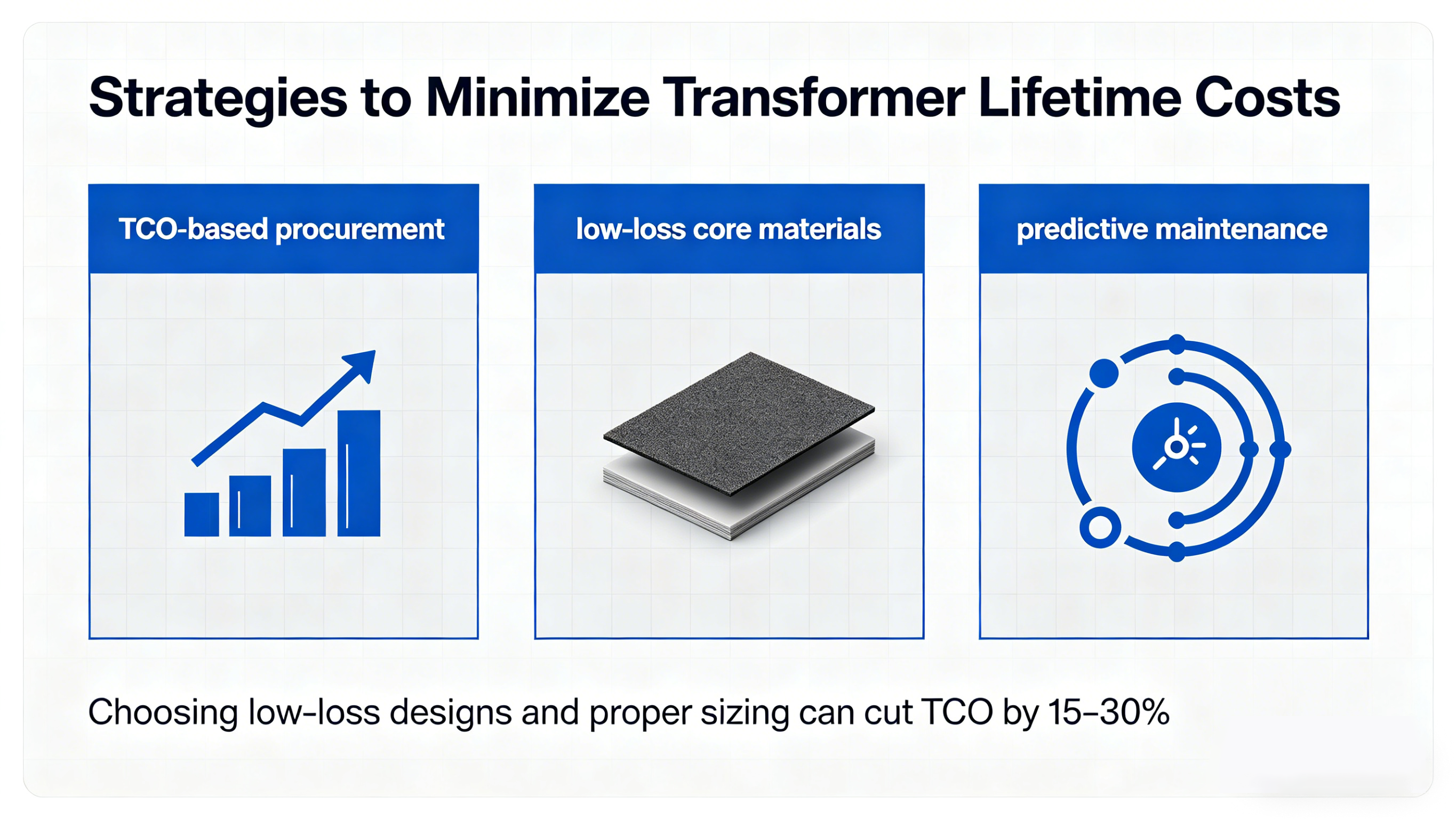
Strategy 1: Adopt TCO-Based Procurement Instead of Lowest-Price Bidding Specify A and B factors in your tender documents. Require manufacturers to optimize designs around your capitalization values rather than minimizing purchase price alone. This often results in 10–20% higher upfront cost but 15–30% lower lifetime TCO.
Strategy 2: Select Low-Loss Designs and Materials
- Use amorphous core or high-grade silicon steel to cut no-load losses by 30–70%.
- Opt for copper windings (lower resistivity than aluminum) for better load loss performance in high-utilization applications.
- Choose designs optimized for your actual load factor.
Strategy 3: Right-Size the Transformer Avoid significant oversizing. An oversized transformer runs at low load factor, wasting money on excess no-load losses and higher capital cost.
Strategy 4: Choose the Appropriate Transformer Type Evaluate dry-type for indoor, fire-sensitive, or low-maintenance environments versus oil-immersed for outdoor or high-capacity needs. (Detailed comparison in the next section.)
Strategy 5: Implement Proactive Maintenance and Monitoring
- Use online dissolved gas analysis (DGA), partial discharge monitoring, and thermal imaging.
- Schedule regular oil testing for immersed units.
- Predictive maintenance can extend life and prevent costly downtime.
Strategy 6: Leverage Efficiency Standards and Incentives Select units exceeding minimum efficiency levels. In some jurisdictions, energy savings may qualify for rebates or carbon credits, further lowering effective TCO.
Strategy 7: Consider Extended TCO Including CO₂ Costs Incorporate the social or regulatory cost of carbon emissions from losses. This “extended TCO” favors even lower-loss designs and supports ESG goals.
Combining multiple strategies often yields compounding benefits.
8.Dry-Type vs. Oil-Immersed Transformers: TCO Comparison
The choice between dry-type and oil-immersed transformers significantly affects TCO.
Oil-Immersed Transformers:
- Advantages: Excellent heat dissipation → potentially lower losses at high loads; lower initial cost for larger ratings; proven long-term reliability.
- Disadvantages: Higher maintenance (oil testing, filtration, replacement, leak prevention); fire and environmental risks; indoor installation restrictions; higher disposal costs.
Dry-Type Transformers:
- Advantages: Minimal maintenance (no oil); safer for indoor/data center/marine use; lower fire risk; easier permitting; potentially lower long-term operating costs in low-maintenance scenarios.
- Disadvantages: May have slightly higher losses in some designs; higher initial purchase price (10–35% more); limited overload capacity compared to oil units in certain applications.
Table 4: TCO Comparison – Dry-Type vs. Oil-Immersed (Typical 1000–2500 kVA Example, 25-Year Horizon)
| Factor | Dry-Type | Oil-Immersed | TCO Winner (Typical Scenario) |
|---|---|---|---|
| Initial Purchase Price | Higher | Lower | Oil |
| Energy Losses | Comparable or slightly higher | Often lower due to better cooling | Oil (high load) / Dry (low load) |
| Maintenance Costs | Low (cleaning, inspections) | High (oil handling, testing) | Dry |
| Fire/Environmental Risk | Low | Higher | Dry |
| Installation Flexibility | Excellent for indoors | Better for outdoors | Depends on site |
| Overall TCO (Low Load <30%) | Lower | Higher | Dry |
| Overall TCO (High Load >50%) | Higher | Lower | Oil |
For indoor or fire-sensitive applications such as data centers and commercial buildings, dry-type transformers often deliver better TCO due to minimal maintenance and lower risk.
👉Explore our range of energy-efficient dry-type transformers here.
In high-load outdoor or utility applications, oil-immersed transformers frequently provide superior cooling and lower overall TCO.
👉View our oil-immersed transformer solutions optimized for heavy industrial use.
In data centers or commercial buildings with strict fire codes, dry-type often wins on TCO due to maintenance and risk savings. In heavy industrial or utility outdoor applications with high continuous loading, oil-immersed units frequently deliver better lifetime economics.
Always run a site-specific TCO calculation rather than relying on generalizations.
9.Real-World TCO Calculation Example
Consider a 1600 kVA distribution transformer for an industrial facility with average load factor of 60%, electricity price $0.12/kWh, 25-year life, and 5% discount rate.
Option 1: Standard Design
- Purchase Price: $14,500
- No-Load Losses: 2.8 kW
- Load Losses: 15.2 kW
- Calculated A: ~$3.74/W (adjusted), B: ~$1.58/W (example from industry cases)
Option 2: High-Efficiency Design
- Purchase Price: $15,000
- No-Load Losses: 2.67 kW
- Load Losses: 14.22 kW
Using the TCO formula, the efficient design often shows ~$1,500 lower total owning cost with a payback under 5 years, despite the slightly higher purchase price.
Sensitivity analysis reveals that if electricity prices rise 3% annually, savings increase dramatically. Tools like U4E Excel spreadsheets or manufacturer calculators make such comparisons easy.
10.Case Studies: Proven Savings from TCO-Optimized Transformers
Case 1: Utility Distribution Upgrade A utility compared standard and low-loss 1600 kVA transformers. The efficient unit saved approximately €1,500 in TCO over the standard model, with payback in about 5 years through reduced losses.
Case 2: Industrial Plant Retrofit An manufacturing facility replaced aging oil-immersed units with modern dry-type designs optimized for their variable load profile. Results included 15–25% lower annual energy costs, drastically reduced maintenance, and improved safety — leading to full TCO recovery within 4 years.
Case 3: Renewable Energy Integration A solar PV plant used dynamically rated transformers with TCO analysis incorporating variable loading. The optimized design reduced both losses and carbon footprint significantly while maintaining grid compliance.
These examples demonstrate that TCO-focused decisions deliver measurable financial and operational returns across sectors.
11.Common Mistakes to Avoid When Managing Transformer TCO
- Focusing Solely on Purchase Price — This is the most frequent and expensive error.
- Ignoring Actual Load Profile — Using nameplate ratings instead of real operating data leads to suboptimal designs.
- Underestimating Maintenance — Especially for oil-immersed units; skimping here raises long-term risk and cost.
- Using Outdated Capitalization Factors — A and B must reflect current electricity forecasts and your cost of capital.
- Neglecting End-of-Life Costs — Disposal of oil and environmental compliance can be substantial.
- Failing to Monitor Performance — Without ongoing measurement, you cannot verify expected savings or detect issues early.
Avoid these pitfalls by implementing a formal TCO evaluation process in your procurement and asset management policies.
12.Conclusion
Reducing Transformer Total Cost of Ownership requires shifting from short-term price focus to a holistic lifecycle view. By understanding losses, applying the IEC TCO methodology, selecting appropriate designs, and maintaining assets proactively, organizations can achieve substantial savings — often tens or hundreds of thousands of dollars per transformer over its lifetime — while improving efficiency and sustainability. All recommendations in this guide align with the IEC 60076 series of international standards for power transformers.
Key takeaways:
- Losses typically dominate TCO; even modest reductions yield big returns.
- Use capitalization factors A and B tailored to your operation.
- Compare options rigorously with site-specific data.
- Balance initial cost against long-term energy, maintenance, and risk savings.
- Consider both dry-type and oil-immersed technologies based on application.
Ready to optimize your transformer TCO?
Start by calculating the current TCO of your existing fleet or specifying TCO criteria in your next procurement.
👉Contact our team for a free preliminary TCO assessment, customized loss calculations, or expert recommendations on energy-efficient transformer solutions tailored to your load profile and environment. Download our TCO calculation template or request a quote today to begin realizing lower lifetime costs.
Investing in TCO optimization is one of the highest-ROI decisions you can make for your electrical infrastructure.