
1.Introduction: Why a Transformer Specification Checklist Matters in International Procurement
International power transformer procurement is fundamentally different from domestic purchasing. Buyers are not only selecting electrical equipment; they are making a long-term investment that directly impacts grid stability, project safety, energy efficiency, and total cost of ownership. In cross-border projects, even minor specification gaps—such as unclear voltage tolerances, missing standard references, or underestimated environmental conditions—can trigger design revisions, delivery delays, failed inspections, or operational risks after commissioning.
From an international buyer’s perspective, a transformer specification is not simply a technical formality. It is a critical communication document that aligns multiple stakeholders, including project owners, EPC contractors, consulting engineers, utilities, inspection agencies, and manufacturers. A well-prepared transformer specification checklist reduces ambiguity, shortens quotation cycles, and ensures that the delivered transformer complies with local grid codes and long-term operating requirements.
Many procurement challenges arise because buyers rely on generic specifications or copy parameters from previous projects without considering regional differences. Voltage levels, frequency, ambient temperature, altitude, and applicable standards can vary significantly from one country to another. Without a structured checklist, these differences are often discovered too late in the procurement process, resulting in increased costs and project risk.
This guide targets international buyers, EPC contractors, renewable energy developers, and industrial project owners seeking a professional and systematic approach to transformer specification. Drawing on practical project experience and internationally recognized standards, this checklist helps buyers avoid common mistakes, communicate more effectively with suppliers, and build a solid technical foundation for successful transformer procurement.
👉Download Your Free Transformer Specification Checklist Now
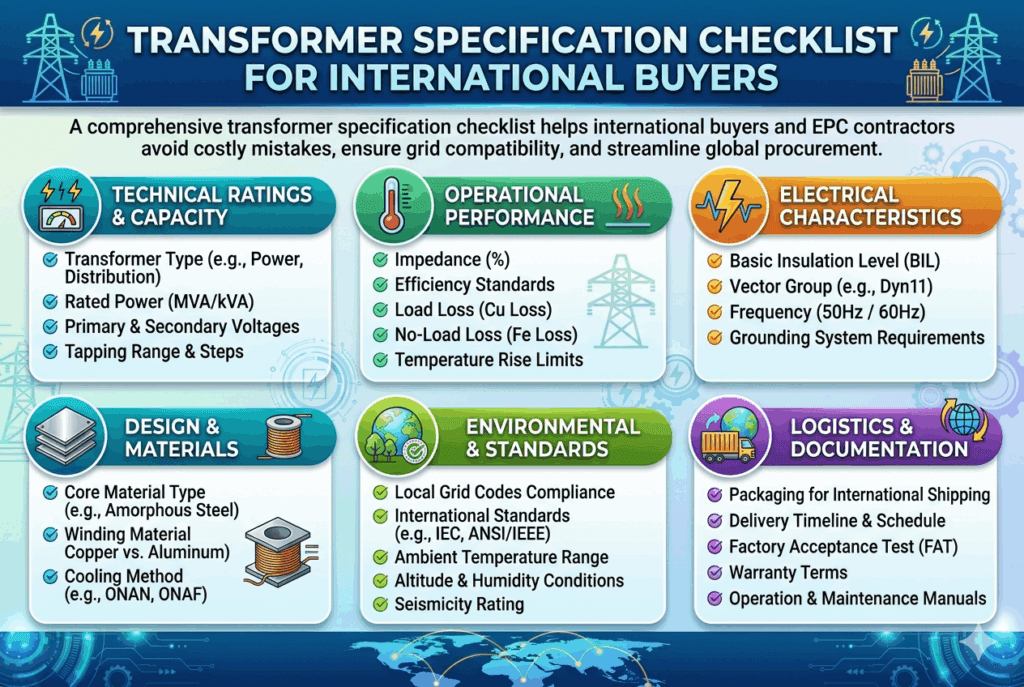
Table of Contents
- Introduction: Why a Transformer Specification Checklist Matters in International Procurement
- Basic Transformer Information in a Transformer Specification Checklist
- Voltage and Electrical Parameters in a Transformer Specification Checklist
- Insulation, Cooling, and Temperature Rise in a Transformer Specification Checklist
- Standards and Compliance Requirements in a Transformer Specification Checklist
- Mechanical and Structural Specifications in a Transformer Specification Checklist
- Accessories and Optional Configurations in a Transformer Specification Checklist
- Installation, Operation, and Maintenance in a Transformer Specification Checklist
- Logistics, Packing, and Delivery in a Transformer Specification Checklist
- Common Mistakes to Avoid When Using a Transformer Specification Checklist
- Transformer Specification Checklist Summary for International Buyers
- Conclusion: Using a Transformer Specification Checklist for Successful International Procurement
2. Basic Transformer Information in a Transformer Specification Checklist
Every transformer specification starts with basic identification details. These parameters define the transformer’s functional role in the power system and set the overall design direction for the manufacturer. Clear identification at this stage prevents misunderstandings later in the quotation and engineering process.
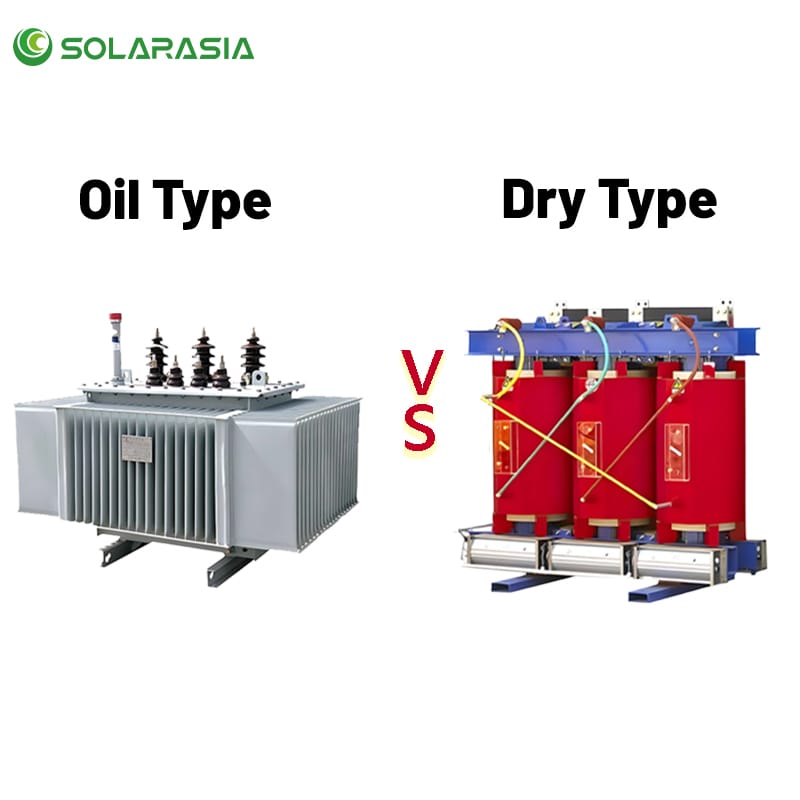
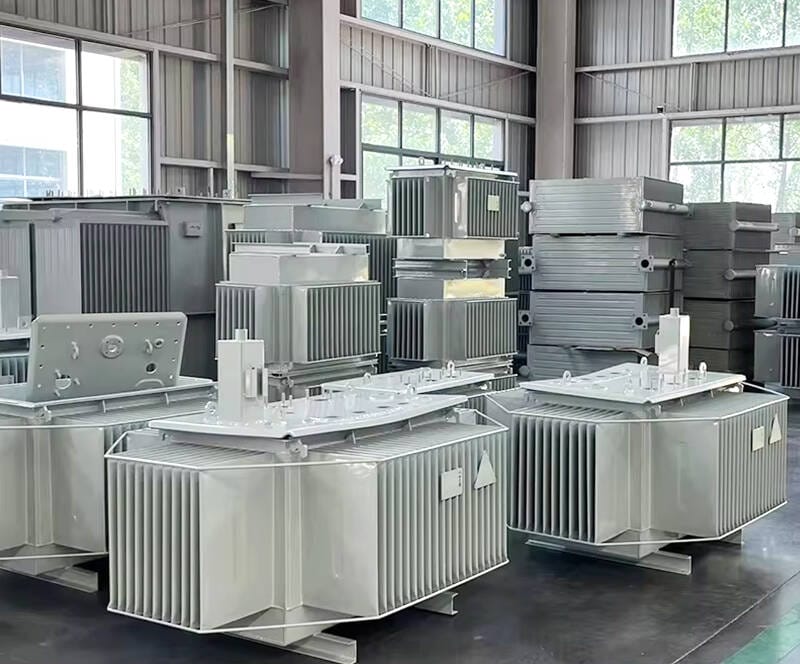
The transformer type is the first and most fundamental decision. International buyers typically choose between oil immersed transformers and dry type transformers based on installation environment, safety regulations, and maintenance philosophy. Oil immersed transformers play a critical role in outdoor substations, utility networks, renewable energy plants, and heavy industrial applications because they deliver high efficiency, excellent heat dissipation, and long service life. In contrast, engineers and project developers choose dry type transformers for indoor installations, commercial buildings, hospitals, data centers, and infrastructure projects where fire safety and low environmental impact are essential.
Rated capacity, expressed in kilovolt-amperes (kVA) or megavolt-amperes (MVA), defines how much load the transformer can supply continuously under rated conditions. International buyers should evaluate not only current demand but also potential future expansion. Undersized transformers may lead to overheating and reduced lifespan, while oversized units increase capital cost and no-load losses.
The number of phases must match the grid configuration and load characteristics. Single phase transformers are typically used for rural distribution or specific applications, while three phase transformers dominate industrial, commercial, and utility-scale projects due to their efficiency and balanced power delivery.
Application scenario is another critical identification element. Transformers installed in substations, solar power plants, wind farms, mining operations, or manufacturing facilities face different electrical stresses, load profiles, and environmental conditions. Clearly stating the application allows manufacturers to optimize insulation systems, cooling design, and mechanical strength to suit real operating conditions.
3. Voltage and Electrical Parameters in a Transformer Specification Checklist
Voltage and electrical parameters form the technical core of any transformer specification. For international buyers, this section carries the highest risk if defined incorrectly, as it directly determines compatibility with the local power grid, protection systems, and downstream equipment. Clear and accurate electrical specifications significantly reduce redesign cycles and approval delays.
Rated voltage must be specified separately for the high-voltage (HV) and low-voltage (LV) sides. Buyers should not only state nominal voltage levels but also clarify system voltage variation and grounding method. In many countries, the actual operating voltage can fluctuate within a defined tolerance band, and transformers must be designed to operate reliably within this range.
Frequency is a non-negotiable parameter in international procurement. Most regions operate at either 50Hz or 60Hz, and transformers are optimized for a specific frequency. Operating a transformer at the wrong frequency can increase core losses, raise temperature, and shorten service life. Buyers must clearly indicate frequency to ensure correct electromagnetic design.
Vector group selection defines the phase displacement and connection method between windings. Common vector groups such as Dyn11, Yyn0, or Yd11 are not interchangeable. Utilities often mandate specific vector groups to control neutral grounding, harmonics, and parallel operation. International buyers should always confirm vector group requirements with local grid authorities or consulting engineers.
Impedance voltage, expressed as a percentage, influences short-circuit current levels and voltage regulation. A lower impedance results in higher fault current, affecting circuit breaker selection and protection coordination. A higher impedance reduces fault current but may cause larger voltage drops under load. Proper impedance selection balances system protection and operational stability.
Electrical Specification Reference Table
| Parameter | Typical Options | Practical Considerations |
|---|---|---|
| HV Rated Voltage | 6kV–66kV | Must align with grid code |
| LV Rated Voltage | 0.4kV–13.8kV | Match load and equipment |
| Frequency | 50Hz / 60Hz | Region-specific |
| Vector Group | Dyn11, Yyn0 | Utility approval required |
| Impedance (%) | 4–10% | Affects fault current |
By clearly defining these electrical parameters, international buyers can ensure that quotations are technically comparable and that supplied transformers integrate smoothly into the target power system.
4. Insulation, Cooling, and Temperature Rise in a Transformer Specification Checklist
Insulation and cooling systems determine transformer reliability, thermal stability, and service life. In international projects, environmental conditions such as high ambient temperature, altitude, humidity, and pollution often exceed standard assumptions, making this section especially important.
Insulation class defines the thermal endurance of winding insulation materials. Common classes include Class A, Class F, and Class H, each corresponding to a maximum allowable operating temperature. Selecting an appropriate insulation class helps manage thermal aging and ensures consistent performance under continuous or fluctuating load conditions.
Cooling method selection depends on transformer type, capacity, and installation environment. Oil immersed transformers typically use ONAN (Oil Natural Air Natural) cooling for standard applications and ONAF (Oil Natural Air Forced) cooling when higher capacity or improved heat dissipation is required. Dry type transformers commonly use AN (Air Natural) or AF (Air Forced) cooling. The chosen cooling method affects transformer size, efficiency, noise level, and operational flexibility.
Temperature rise limits specify how much the transformer’s internal temperature may increase above ambient conditions during operation. International standards define acceptable temperature rise values to protect insulation systems and ensure long-term reliability. Buyers operating in hot climates or high-altitude regions should request design corrections to account for reduced cooling efficiency.
Cooling and Thermal Design Overview
| Item | Common Options | Buyer Considerations |
| Insulation Class | A / F / H | Affects lifespan |
| Cooling Method | ONAN / ONAF / AN / AF | Impacts efficiency |
| Temperature Rise | 55K / 65K | Standard dependent |
| Altitude Correction | Yes / No | Required above 1000m |
Properly defining insulation and cooling requirements helps international buyers avoid premature aging, overheating issues, and unplanned derating during operation.
Need a quick reference for all key parameters?
5. Standards and Compliance Requirements in a Transformer Specification Checklist
Standards and compliance requirements are critical for transformer acceptance, grid connection, and long-term operation. For international buyers, this section often determines whether a transformer can be legally installed and commissioned in the target country.
The most commonly referenced international transformer standards are IEC 60076 and IEEE/ANSI standards. IEC standards are widely adopted across Europe, Asia, Africa, and the Middle East, while IEEE/ANSI standards are primarily used in North America and certain international projects. Although both frameworks define performance, testing, and safety requirements, they differ in design margins, temperature rise limits, and testing procedures.
In addition to international standards, many countries and utilities impose local grid codes or project-specific technical specifications. These may include requirements for short-circuit withstand capability, noise limits, efficiency classes, or environmental compliance. International buyers should always request confirmation of local authority or utility approval requirements before finalizing specifications.
Certification and testing requirements should also be clearly defined. Routine tests verify manufacturing quality for each transformer, while type tests validate design performance. For critical projects, utilities may require witnessed testing or third-party inspection. Including these requirements upfront avoids disputes during factory acceptance testing.
Standards and Compliance Checklist
| Category | Typical Requirement |
| International Standard | IEC 60076 / IEEE |
| Local Grid Code | Utility specification |
| Quality Certification | ISO 9001 |
| Testing | Routine / Type Test |
| Inspection | Third-party witness |
Clearly defined standards and compliance requirements strengthen technical credibility and demonstrate professional procurement practices, aligning with globally recognized engineering and quality principles.
6. Mechanical and Structural Specifications in a Transformer Specification Checklist
Mechanical and structural specifications ensure that the transformer can withstand transportation, installation, and long-term operation without physical degradation or safety risks. For international buyers, mechanical design is especially important because transformers often travel long distances and operate in harsh or unfamiliar environments.
Installation location is the first mechanical consideration. Buyers must specify whether the transformer will be installed indoors or outdoors. Outdoor installations require weather-resistant enclosures, enhanced corrosion protection, and sealing against dust, moisture, and insects. Indoor transformers may prioritize compact design, lower noise levels, and fire safety compliance.
The degree of protection, commonly defined by IP rating, indicates resistance to solid particles and water ingress. Selecting the appropriate IP rating is essential for transformers installed in dusty industrial zones, coastal areas, or regions with heavy rainfall. An inadequate protection level can lead to accelerated aging and insulation failure.
Tank material and surface treatment directly affect durability. Mild steel tanks with high-quality painting systems are commonly used, while stainless steel or galvanized tanks may be preferred in highly corrosive environments. Buyers should also specify coating thickness, color requirements, and anti-corrosion standards when relevant.
Noise level is another critical mechanical parameter, particularly in urban, commercial, or residential projects. Transformers generate audible noise due to magnetostriction and cooling systems. Many utilities and municipalities impose strict noise limits, and compliance should be verified at the design stage.
Dimensions and weight must be compatible with transportation routes, lifting equipment, and installation foundations. International buyers should confirm site constraints early to avoid costly modifications during delivery or installation.
Mechanical Specification Reference Table
| Item | Typical Options | Impact on Project |
| Installation | Indoor / Outdoor | Affects enclosure design |
| Protection Degree | IP20–IP55 | Environmental resistance |
| Tank Material | Mild / Stainless Steel | Corrosion protection |
| Noise Level | ≤ specified dB | Regulatory compliance |
| Dimensions & Weight | Project-specific | Transport & installation |
A clear mechanical specification helps manufacturers design transformers that are not only electrically sound but also physically robust and compliant with site conditions.
7. Accessories and Optional Configurations in a Transformer Specification Checklist
Accessories and optional configurations play a significant role in transformer safety, monitoring, and long-term operability. For international buyers, unclear accessory requirements are a common source of quotation discrepancies and post-delivery disputes.
Standard accessories typically include oil level indicators, winding and oil temperature indicators, pressure relief devices, and earthing terminals. These components support basic operation and safety monitoring. Buyers should confirm whether these items are included as standard or listed separately in quotations.
Protection accessories enhance operational safety and fault detection. Buchholz relays are commonly specified for oil immersed transformers to detect internal faults, while surge arresters protect against overvoltage events caused by lightning or switching operations. In critical installations, sudden pressure relays and gas accumulation detectors may be required.
Advanced monitoring options are increasingly popular in modern power systems. Online temperature monitoring, load monitoring, and remote communication interfaces allow operators to track transformer condition in real time. These smart features support predictive maintenance and reduce the risk of unexpected failures, particularly in remote or unmanned substations.
International buyers should clearly distinguish between mandatory accessories and optional features. This clarity ensures transparent pricing and allows fair technical and commercial comparison between suppliers.
Typical Transformer Accessories Overview
| Category | Common Accessories | Purpose |
| Standard | Oil level, Temp indicator | Basic monitoring |
| Protection | Buchholz relay, PRD | Fault detection |
| Electrical | Surge arrester | Overvoltage protection |
| Monitoring | Online sensors | Predictive maintenance |
Well-defined accessory specifications improve operational reliability and demonstrate a proactive approach to asset management.
8. Installation, Operation, and Maintenance in a Transformer Specification Checklist
Transformers serve as long-term assets that deliver reliable performance for decades when teams install and maintain them properly. International buyers should evaluate installation, operation, and maintenance requirements during the specification stage, not after delivery. Early planning reduces commissioning risks and long-term operating costs.
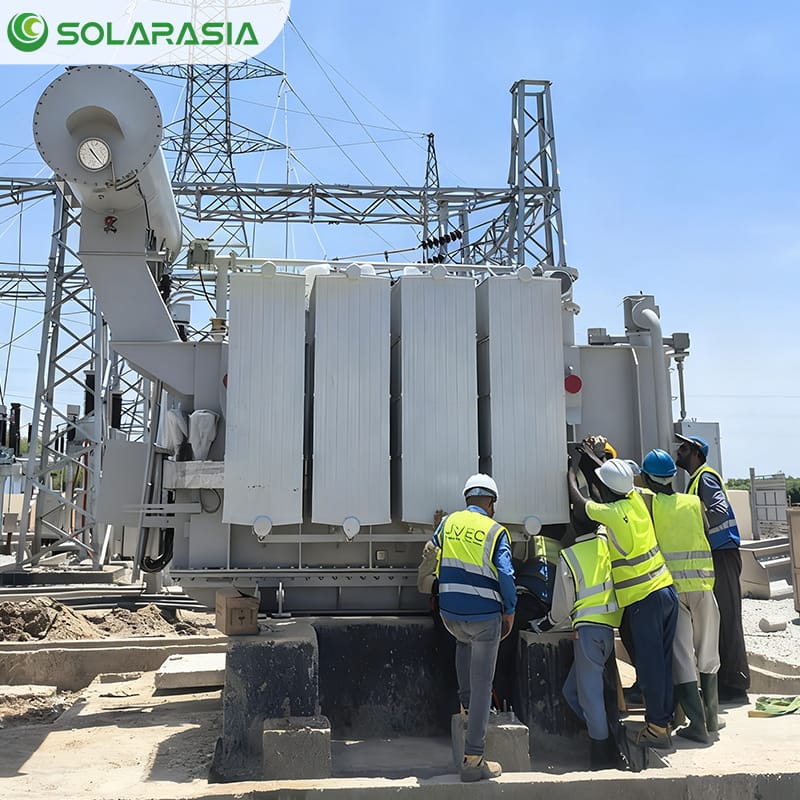
Installation requirements begin with site conditions. Buyers should specify foundation type, space constraints, ventilation requirements, and access for lifting and positioning. In remote or confined sites, limitations on crane capacity or transportation routes can influence transformer size and design. Clear installation data allows manufacturers to propose suitable configurations and accessories.
Operational requirements define how the transformer will be used throughout its service life. Load profile, duty cycle, and expected overload conditions should be stated whenever possible. Transformers operating under fluctuating loads, such as those in renewable energy projects or industrial plants, may require enhanced thermal margins or monitoring solutions.
Maintenance philosophy varies by project owner and region. Some buyers prefer minimal maintenance designs, while others implement scheduled inspection and oil testing programs. Specifying maintenance expectations helps suppliers recommend appropriate accessories, oil types, and monitoring systems. Availability of spare parts and technical documentation is particularly important for international projects with limited local support.
Installation and Maintenance Planning Checklist
| Aspect | Key Considerations |
| Installation Site | Foundation, clearance, access |
| Ventilation | Natural or forced airflow |
| Load Profile | Continuous / variable load |
| Maintenance | Periodic inspection, oil tests |
| Documentation | Manuals, drawings, test reports |
Considering installation and maintenance at the specification stage demonstrates professional asset management practices and supports long-term transformer reliability.
9. Logistics, Packing, and Delivery in a Transformer Specification Checklist
Logistics and delivery are critical elements of international transformer procurement. Improper packing or unclear delivery terms can result in transit damage, delays, and additional costs. Including logistics requirements in the specification helps align expectations between buyers and suppliers.
Packing methods should protect the transformer against mechanical shock, moisture, and corrosion during transportation. Common options include wooden crates, steel frames, or nude packing with protective coverings. The choice depends on transformer size, transport distance, and handling conditions. Buyers should also specify whether oil filling will be completed at the factory or on site.
Delivery terms define responsibility for transportation, insurance, and customs clearance. International buyers typically use Incoterms such as EXW, FOB, or CIF. Clear agreement on delivery terms avoids disputes and ensures accurate cost comparison between suppliers.
Lead time expectations should reflect project schedules and approval processes. Buyers should confirm manufacturing time, testing duration, and shipping transit time. For large projects, phased delivery or site coordination may be required.
Logistics and Delivery Overview
| Item | Common Options |
| Packing | Crated / Nude / Steel frame |
| Oil Filling | Factory / Site |
| Delivery Term | EXW / FOB / CIF |
| Lead Time | Weeks to months |
| Inspection | Pre-shipment / On-site |
Proactive logistics planning reduces project risk and ensures that transformers arrive on site in optimal condition and on schedule.
10. Common Mistakes to Avoid When Using a Transformer Specification Checklist
Many transformer procurement challenges stem from incomplete or unclear specifications. Understanding common mistakes helps international buyers improve specification quality and avoid costly corrections.
One frequent issue is voltage mismatch with the local grid. Buyers may specify nominal voltage without confirming allowable voltage variation or grounding method, leading to redesign or operational limitations. Another common mistake is ignoring altitude or ambient temperature corrections, which can result in unexpected derating or overheating.
Selecting an inappropriate cooling method is another risk. Buyers sometimes choose standard cooling configurations without considering load profile or environmental conditions, reducing transformer efficiency and lifespan. Missing or unclear accessory requirements often cause quotation discrepancies and post-order disputes.
Finally, overlooking applicable standards or local utility requirements can delay approval and commissioning. Specifications copied from previous projects may not comply with current grid codes or regional regulations.
Avoiding these mistakes requires a structured checklist approach and close coordination with experienced transformer manufacturers and consultants.
11. Transformer Specification Checklist Summary for International Buyers
A summarized transformer specification checklist allows international buyers to verify completeness before issuing inquiries, tenders, or purchase orders. This overview supports internal review and improves communication with suppliers.
| Category | Key Specification Items |
| Basic Information | Type, capacity, phases, application |
| Electrical Parameters | Voltage, frequency, vector group, impedance |
| Thermal Design | Insulation class, cooling, temperature rise |
| Standards | IEC / IEEE, local grid codes |
| Mechanical Design | Enclosure, IP rating, noise level |
| Accessories | Protection, monitoring, options |
| Logistics | Packing, delivery terms, lead time |
Using this checklist as a reference helps ensure that no critical parameters are overlooked during international procurement.
12.Conclusion: Using a Transformer Specification Checklist for Successful International Procurement
A comprehensive transformer specification checklist is the foundation of successful international procurement. Clear specifications reduce technical risk, accelerate supplier communication, and support reliable long-term operation. For international buyers, investing time in detailed specifications delivers measurable benefits in cost control, delivery performance, and asset reliability.
Working with experienced transformer manufacturers who understand international standards, diverse operating environments, and project execution challenges further strengthens procurement outcomes. Such partners can support buyers with technical consultation, specification review, and customized solutions tailored to local grid requirements.
FAQ
1. What is a transformer specification checklist?
A transformer specification checklist is a structured list of technical, electrical, mechanical, and compliance parameters used to define transformer requirements clearly before procurement. It helps international buyers communicate expectations accurately and reduce technical and commercial risks.
2. Why is a transformer specification checklist important for international buyers?
International projects involve different grid codes, environmental conditions, and standards. A detailed checklist ensures the transformer complies with local regulations, operates reliably, and avoids costly redesigns, delays, or commissioning issues.
3. Which standards should be included in a transformer specification?
Most international buyers reference IEC 60076 or IEEE/ANSI standards, along with local utility or grid code requirements. The applicable standard depends on the project location and utility regulations and should always be confirmed early.
4. What electrical parameters are most critical in transformer specifications?
Key electrical parameters include rated voltage, frequency, vector group, impedance, and grounding method. Incorrect definition of these items can lead to incompatibility with the power system and protection equipment.
5. How do environmental conditions affect transformer specifications?
Ambient temperature, altitude, humidity, and pollution levels influence insulation design, cooling method, and temperature rise limits. International buyers should specify site conditions so manufacturers can apply appropriate design corrections.
6. Should accessories and monitoring systems be included in the initial specification?
Yes. Clearly defining mandatory accessories and optional monitoring systems ensures transparent quotations and avoids disputes after ordering. It also supports safer operation and long-term asset management.
7. Can a transformer specification checklist reduce procurement costs?
A well-prepared checklist reduces rework, shortens quotation cycles, and minimizes change orders. While it does not lower equipment cost directly, it significantly reduces hidden costs caused by delays, redesigns, and operational issues.
Let our engineers help you build the right specification.


1 Comment